
Llandaff
On a July afternoon in 1952, two de Havilland Vampire jets from RAF Merryfield collided at 29,000 feet over Cardiff. One pilot bailed out and landed at Cardiff Airport. The other landed in the River Rumney. One of the planes - VF265 - went straight down through a three-storey building next to the Llandaff Hotel, all the way to the basement, killing a 53-year-old woman inside. The other crashed in Pontcanna Fields. It was not the worst thing that happened to Llandaff in the twentieth century. Eleven years earlier the Luftwaffe had bombed the cathedral - making it the second-most-damaged cathedral in the UK after Coventry. Llandaff has spent fifteen centuries being damaged and rebuilt, attacked by Owain Glyndŵr, sacked by Oliver Cromwell, hit by Hitler, struck by lightning, and somehow always restored. It is, technically, not even a city.
The City That Isn't
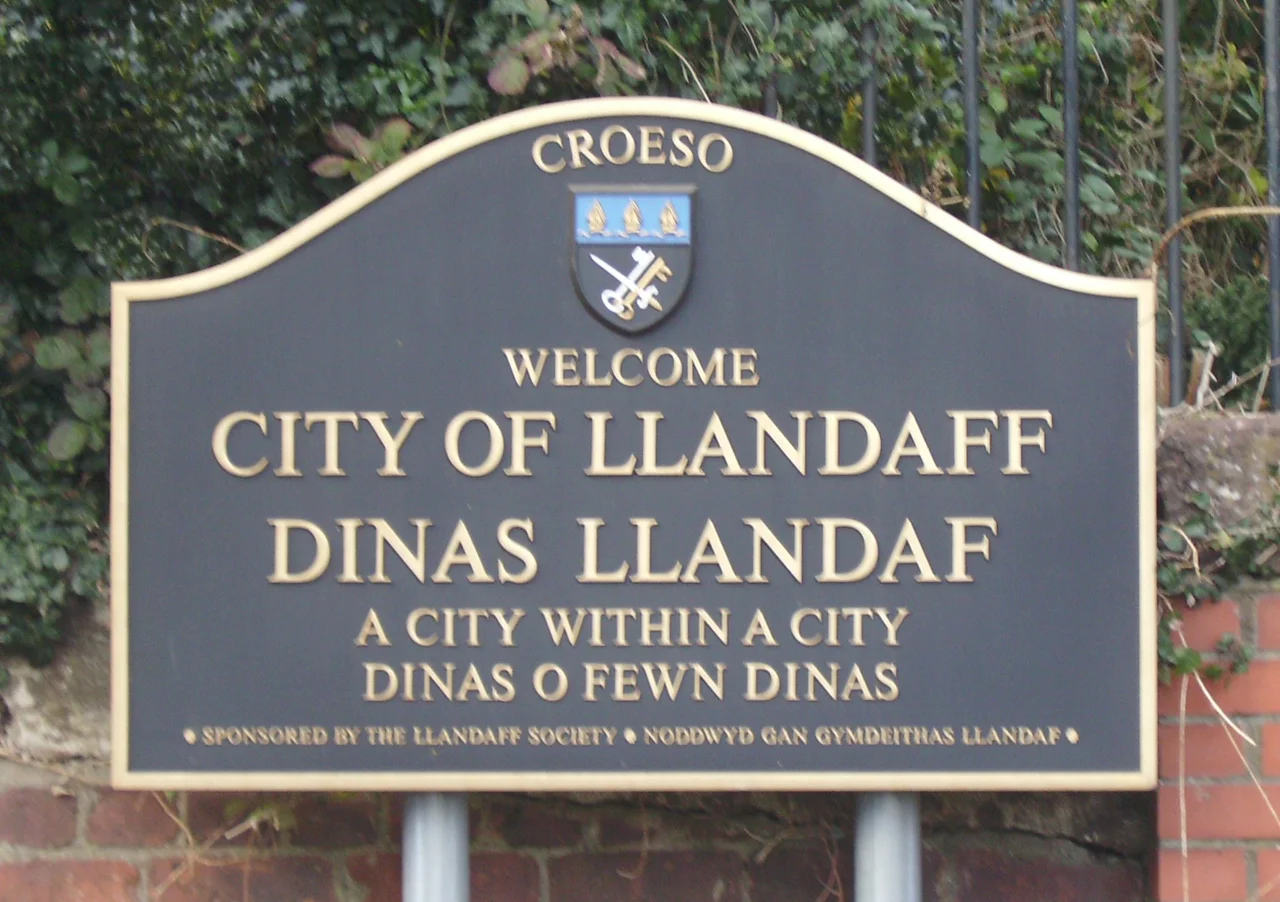
Llandaff was informally called a city for centuries because it had a cathedral and a bishop, but it never received the formal charter of incorporation that would have made the title official. It was a village with a cathedral, then a parish, then a civil parish, then in 1922 absorbed into the county borough of Cardiff. The name comes from llan - church - and Taf, the river that runs through it. Christian worship started here in the sixth century AD, probably because this was the first firm ground north of the Taff's confluence with the Bristol Channel, and because the site had already been a river crossing on a north-south trade route. Romano-British ritual burials have been found beneath the present cathedral, which means people were burying their dead here even before the Christians arrived.
The Cathedral and Its Wreckers
The current cathedral incorporates twelfth-century Romanesque work, including the impressive Urban Arch named after Bishop Urban who oversaw its construction. Beyond that, the building is a layered record of repeated destruction and patient repair. Owain Glyndŵr's forces attacked it during the early-fifteenth-century Welsh war of independence. The Bishop's Palace next door - sometimes called Llandaff Castle, built around the same time as Caerphilly Castle in the late thirteenth century - was reduced to ruins in the same assault, and only the gatehouse and a public garden survive. Oliver Cromwell's Parliamentarian forces did further damage during the seventeenth-century civil wars. Then on 2 January 1941 the Luftwaffe dropped a parachute mine near the cathedral - a German air-burst weapon designed to flatten a wide area - and Llandaff Cathedral was wrecked, second only to Coventry in the league of British cathedral damage. The architect George Pace led the postwar restoration.
Christ in Majesty
The most striking thing in the restored cathedral is suspended above the nave: a vast aluminium figure of Christ in Majesty by Jacob Epstein, executed between 1954 and 1955. Epstein - American-born, controversial throughout his career, knighted near the end of it - cast the figure in aluminium specifically because the metal was light enough to hang from the structure. It is one of the strangest and most powerful works of mid-century religious art in Britain. Then in 2007 lightning struck the cathedral spire. The electrical surge ran through the building and destroyed the organ - a Welsh Cathedral organ blown out by a single bolt. The replacement, inaugurated in 2010, was the largest new pipe organ built in the UK in over forty years. Llandaff's relationship with disaster has produced an unusual amount of brilliant rebuilding.
Roald Dahl's Mouse
Roald Dahl was born in Llandaff in 1916 and attended the Cathedral School. The blue plaque outside 11 High Street commemorates not a literary triumph but a piece of childhood mischief: young Roald and his friends, infuriated by a mean-spirited sweet-shop owner named Mrs Pratchett, put a dead mouse in her jar of gobstoppers. The shop is gone, the building survives, the plaque remains. Dahl is one in a remarkable line of figures from this small district. Terry Nation (1930-1997), born here, wrote seventy episodes of Doctor Who and created the Daleks - the most successful villains in British television history. He also created Blake's 7 and Survivors. Charlotte Church was born here and attended Howell's School. James Dean Bradfield of the Manic Street Preachers came from here. So did Sir Ivor Atkins, Worcester Cathedral organist. So did Francis Lewis (1713-1802), who later signed the American Declaration of Independence. Llandaff produces an improbable density of remarkable people for a place of nine thousand.
BBC Wales and Doctor Who
Broadcasting House on Llantrisant Road served as the headquarters of BBC Cymru Wales from 1966 until 2020, when the broadcaster moved to a new building at Central Square in central Cardiff. From 2005 to 2012, the revived Doctor Who was produced from the Llandaff studios before moving to Roath Lock in Cardiff Bay - and four episodes had location scenes filmed in Llandaff itself: Human Nature and The Family of Blood (2007), The Eleventh Hour and Vincent and the Doctor (2010). The Llandaff Cathedral Festival, founded in 1958, was for almost three decades one of the most important venues for new Welsh music - commissioning works from Alun Hoddinott, Arwel Hughes, William Mathias, Grace Williams and other composers, attracting international soloists to a building that had been bombed out of recognition fifteen years earlier and rebuilt for sound. The festival ran until 1986, was briefly revived 2008-2013, and returned as a four-day event in 2022.
Sir David's Tomb
Inside the cathedral, in a chapel along the south aisle, lies the tomb of Sir David Mathew - Dafydd ap Mathew (1400-1484) - Standard Bearer of England to Edward IV. He fought at the Battle of Towton on Palm Sunday 1461, the bloodiest single day in English history, and is credited with saving Edward IV's life on the field. For this Edward granted him the right to use the name Towton on the Mathew family arms. His effigy lies in stone, a knight in armour from a war his family had won. Outside, the cathedral's twin towers rise above the Taff valley as they have for centuries. The Urban Arch from the twelfth century. The Epstein Christ from the twentieth. The new organ from 2010. The Roald Dahl plaque around the corner where a small boy once dropped a mouse into a sweet jar. Llandaff is a small village inside a city, an unofficial city inside a borough, with a cathedral that keeps being broken and a population that keeps fixing it.
From the Air
Located at 51.49°N, 3.21°W, in the north of Cardiff on the west bank of the River Taff. The cathedral is the most prominent feature, with its twin towers and the surrounding green of Llandaff Fields and Pontcanna Fields visible from above. Cardiff (EGFF) is approximately 6 miles southwest. Best viewed at 1,500-2,500 feet AGL with the River Taff curving through Cardiff to the south, the M4 visible to the north, and the modern Cardiff city centre and bay to the southeast.
Nearby Stories
- Aberfan Disaster 1.3 km away
- Glastonbury 6.5 km away
- Quantock Hills 7.4 km away
- Tyntesfield 7.5 km away
- Tintern 9.2 km away
- The Mumbles Lifeboat Station 19 km away
- Carreg Cennen Castle 20 km away
- Appledore Lifeboat Station 26 km away