
Loch Maree
Eilean Sùbhainn is the largest island in Loch Maree. On Eilean Sùbhainn, there is a small loch. In that loch, there is an island. It is the only place in Great Britain where you can find an island inside a lake inside an island inside a lake. Loch Maree, the 13-mile freshwater loch in Wester Ross that holds this Russian-doll arrangement, contains 66 islands in total. The ratio of island surface to water surface is greater than any other large loch in Scotland. And it is named for an 8th-century Irish saint who built a hermitage on one of those islands and was so thoroughly remembered that he changed the name of the water itself.
The Saint Who Renamed the Loch
Before the late seventh century, this body of water was called Loch Ewe. The village at its eastern end is still called Kinlochewe - Head of Loch Ewe - a fossil of that older name. Sometime between 671 and 722, an Irish monk named Maol Rubha left the great Celtic Church centre at Bangor Abbey in Ireland, founded the monastery at Applecross on the west coast, and at some point came inland to build a chapel and hermitage on a wooded island in this loch. He died in 722. Over the following centuries his cult absorbed and was absorbed by older Highland traditions, including what scholars believe was a pagan bull-sacrifice ritual on the shore at Creag nan Tarbh. By the medieval period the loch had been renamed in his honour, and Loch Ewe shrank to mean only the sea-loch at the western end.
Three Basins, Sixty-Six Islands
The loch is divided geologically into three deep basins. The Grudie Basin in the south-east, 367 feet at its deepest, lies between Isle Maree and the head of the loch. The Slattadale Basin north-west of it holds most of the islands. The Ardlair Basin, the most irregularly shaped of the three, lies at the far northern end. The islands include some of the best-preserved Caledonian pinewood in Scotland - native Scots pine, genetically distinct from other Scottish pinewoods and more closely related to southern European populations, a clue to how the species survived the last ice age. Twelve species of dragonfly have been recorded, including the rare northern emerald, azure hawker and white-faced darter. The islands are also a breeding site for redwings.
Iron and Charcoal
Loch Maree looks remote and timeless now, but for one extraordinary period in the seventeenth century it was an industrial site. The Letterewe ironworks on the north-east shore smelted bog iron using charcoal from the local oak woods. Records suggest as much as eight hectares of oak was being turned into charcoal a day - a rate that, sustained, would have stripped the loch's shoreline forests within a generation. The Letterewe operation eventually closed, but the trace it left on the landscape is still visible: bare, oak-poor slopes today were once dense woodland. Some of the workers who died at the furnaces are said to have been buried on Isle Maree, in the small chapel cemetery that already held earlier pilgrims.
Queen Victoria's Loch
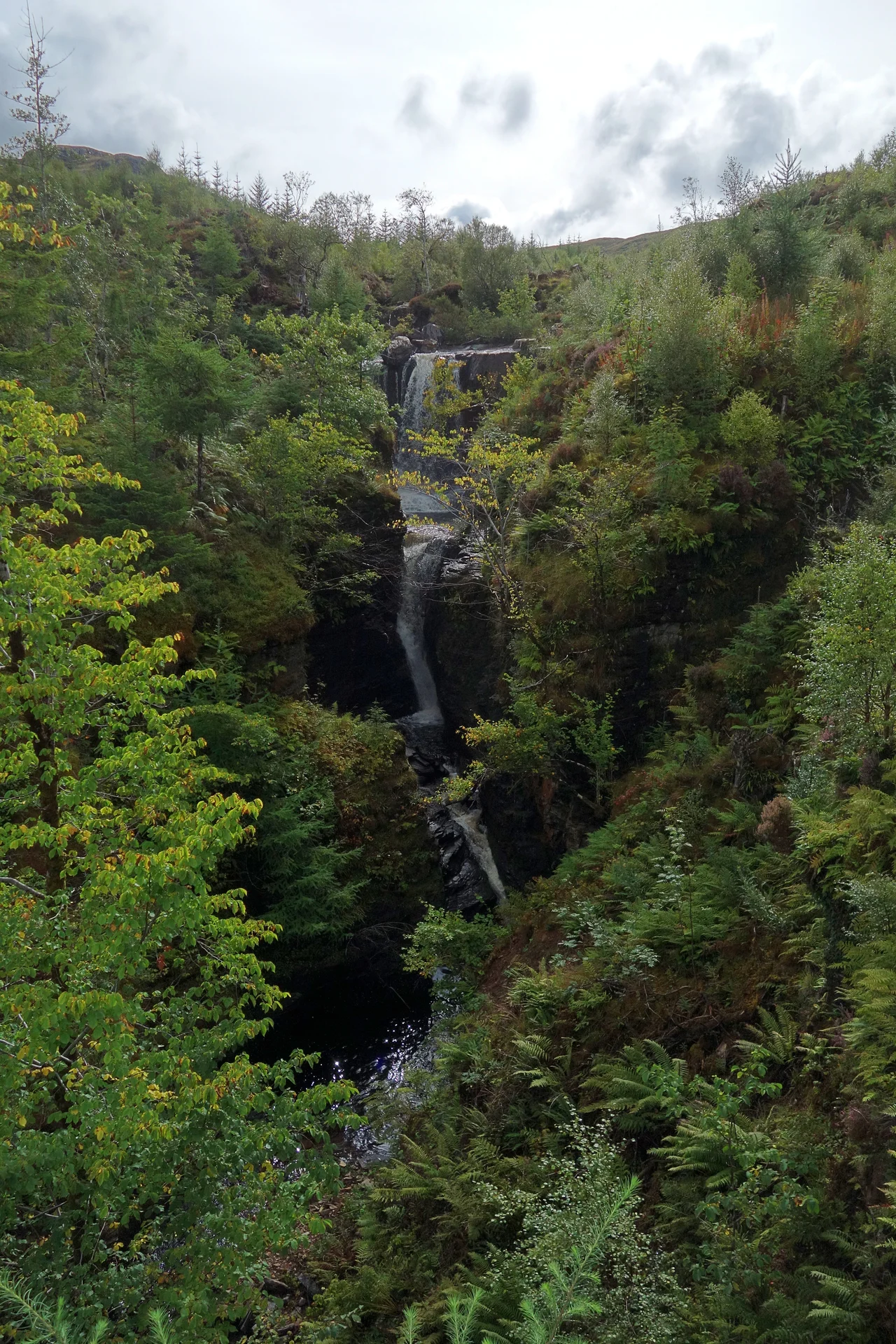
In September 1877, Queen Victoria came to stay at the Loch Maree Hotel at Talladale. She walked, she fished, she visited Isle Maree and hammered a coin into the wish tree there, and she wrote about the experience in her diary. When her diaries were published, Loch Maree became one of the fashionable Highland destinations of late-Victorian travel. A nearby waterfall was renamed Victoria Falls in her honour. The fishery boomed: the loch's sea trout were said to be the finest in Britain, and a British record sea trout of 19.5 pounds was caught here in 1952. Then, in the 1980s and 1990s, the sea trout fishery collapsed. The reasons are still argued - salmon farming in nearby sea lochs, climate change, river acidification - but the great runs of fish that defined Loch Maree's sporting identity have not fully returned. The loch is now a Ramsar site and part of a National Nature Reserve.
The View From Above
From the air, Loch Maree is one of the most photographed sights in the Highlands. The water threads thirteen miles north-west to south-east. On the south side, Beinn Eighe rises - white-capped quartzite even in summer, a peak so distinctive it gave its name to Britain's first National Nature Reserve. On the north side, the great spear of Slioch dominates the view. The islands scatter through the middle section like a flotilla anchored in place. In good light the loch turns deep blue; on overcast days it goes silver, then black. Black-throated divers nest here in some of the largest concentrations in Britain. There are no settlements between Slattadale on the south shore and Letterewe on the north - the country is empty in a way that very little of Western Europe still is.
From the Air
Loch Maree lies in Wester Ross, centred near 57.69 N, 5.46 W. Inverness Airport (ICAO EGPE) is about 95 km east; Stornoway (EGPO) about 100 km west across the Minch. Recommended viewing altitude 3,000-5,000 ft AGL - high enough to read the full length of the loch and its three basins, low enough to pick out the islands. Slioch and Beinn Eighe are the dominant peaks; the A832 follows the south shore. Watch for sudden weather changes off the Atlantic; the loch lies in a major west-east weather corridor.
Nearby Stories
- Summer Isles 2.5 km away
- Raasay 9.6 km away
- Lochalsh 15 km away
- Staffin 19 km away
- Affric-Beauly hydro-electric power scheme 19 km away
- Alladale Wilderness Reserve 22 km away
- Bayble Island 24 km away
- Loch Shin 25 km away