
Gamelan From Heaven
The name means "gamelan from heaven," and for a few decades it almost lived up to it. Lokananta, Indonesia's first record label, pressed the vinyl that carried gamelan orchestras, wayang puppet performances, and the country's earliest pop stars into living rooms across the archipelago. Founded in Surakarta in 1956, it was the sound factory of a young nation still figuring out what its music should be. By 2001, it was bankrupt. Today, the studio where Gesang recorded "Bengawan Solo" -- one of the most famous songs in Southeast Asian history -- earns most of its income renting floor space for futsal games.
A Nation Presses Record
Indonesia was eleven years old when Lokananta opened its doors on October 29, 1956. The country needed a way to distribute audio across an archipelago of 17,000 islands, and the answer was vinyl. Lokananta's primary function was manufacturing phonograph records and audio cassettes for Radio Republik Indonesia (RRI), the state broadcasting network. Master recordings arrived from RRI studios scattered across the country, and Lokananta pressed them into discs for redistribution to stations nationwide. R. Maladi, then the head of RRI, suggested the name -- borrowing it from the pitch-black gamelan set housed in the Kraton Surakarta, the royal palace just down the road. The choice of Surakarta as Lokananta's home was deliberate. The city had been the site of Indonesia's first radio station, the Solosche Radio Vereeniging, established in 1933 under Dutch colonial rule, and it remained the spiritual center of Javanese performing arts. If Indonesian music was going to be recorded anywhere, Solo was the obvious place.
The Stars It Made
Lokananta did not just press records -- it made careers. Gesang Martohartono, the Javanese keroncong singer, recorded his signature song "Bengawan Solo" through the label, turning a lilting ode to Java's longest river into one of the most recognizable melodies in Southeast Asia. Waljinah followed with "Walang Kekek," a song so popular it became synonymous with Javanese identity. Titiek Puspa, who would become one of Indonesia's most celebrated singer-songwriters, passed through Lokananta's studio, as did Bing Slamet, the comedian and musician whose versatility made him a national favorite. The label's catalog eventually grew to over 40,000 recordings, including 5,200 commercial releases. Beyond pop and keroncong, the archive preserved something harder to replicate: complete wayang kulit performances and karawitan -- the intricate Javanese and Yogyakartan gamelan music that underpins court ceremonies, temple rituals, and shadow puppet theater. These recordings became reference documents for a living tradition, capturing performances that might otherwise exist only in the memories of the musicians who played them.
The Abbey Road of Indonesia
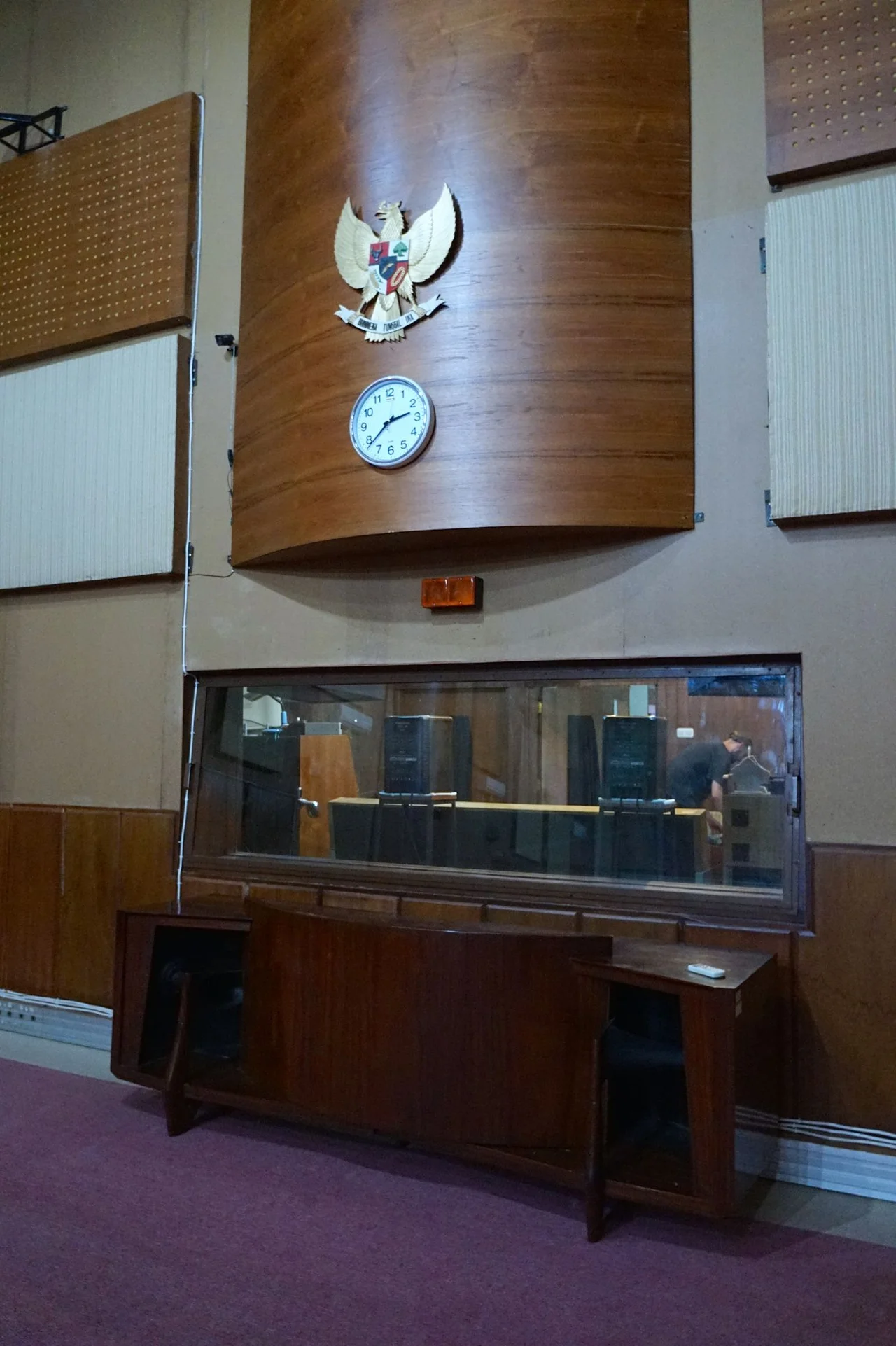
At its peak, Lokananta operated with equipment that rivaled any studio in the region. Its crown jewel was a Trident Series 80B mixing console -- the same line of British-made boards used in studios across Europe and the United States during the 1970s and 1980s. The comparison to Abbey Road Studios, made by Indonesian music writers over the years, was not entirely hyperbolic. Both were state-affiliated recording facilities that shaped a national sound; both became institutions whose cultural importance outstripped their commercial viability. The difference was that Abbey Road survived the digital transition. Lokananta did not. As the music industry shifted from physical media to digital distribution in the 1990s, the label's core business -- pressing vinyl and cassettes for state radio -- evaporated. Private labels with slicker marketing and international distribution deals siphoned away the commercial artists. By 2001, the company was bankrupt, its presses silent, its studio gathering dust.
Futsal on the Studio Floor
What happens to a national treasure when the nation stops paying attention? In Lokananta's case, the answer was pragmatic and a little heartbreaking. To generate revenue, the company converted portions of its facility into futsal courts -- the indoor soccer variant wildly popular across Indonesia. The rental fees kept the lights on. Nineteen employees remained, a skeleton crew maintaining an archive of 40,000 recordings that represented the sonic history of post-independence Indonesia. Efforts to revive the label have surfaced periodically. Plans to transform Lokananta into a music museum have been discussed in Indonesian media since at least 2013. The company has attempted to remaster portions of its archive onto CDs, DVDs, and digital formats, and newer artists have occasionally recorded at the studio, drawn by its history and acoustics. But government support has been inconsistent, and the path from "national heritage" to "sustainable institution" remains unclear.
What the Archive Holds
The real value of Lokananta was never its commercial catalog. It is the archive -- those tens of thousands of recordings that document how Indonesian music sounded in the decades after independence, before globalization smoothed out regional differences and before digital recording made everything technically perfect and culturally interchangeable. The wayang recordings alone represent an irreplaceable resource: complete performances by master dalangs whose art was improvisational, meaning no two shows were identical. The karawitan recordings preserve gamelan tunings and ensemble configurations specific to Surakarta and Yogyakarta, traditions that differ subtly but meaningfully from region to region. Philip Yampolsky, a scholar at the University of Wisconsin, published a comprehensive discography of Lokananta's output from 1957 to 1985, treating the label's catalog as a primary source for understanding Indonesian cultural history. The building still stands in Surakarta, down the road from the kraton whose gamelan gave it its name. Whether it becomes a museum, a working studio again, or simply a futsal venue with excellent acoustics remains one of Indonesian culture's open questions.
From the Air
Lokananta is located at approximately 7.56S, 110.80E in Surakarta (Solo), Central Java, within the dense urban core of the city. The facility sits close to the Kraton Surakarta (royal palace) from which it took its name. The nearest major airport is Adisumarmo International Airport (ICAO: WARQ), roughly 10 km northwest. Surakarta occupies a flat basin surrounded by volcanic peaks: Mount Merapi (2,968m) and Mount Merbabu to the west-northwest, and Mount Lawu (3,265m) to the east. The Bengawan Solo River -- the same river celebrated in Gesang's famous song recorded at Lokananta -- flows through the city's southern districts.
Nearby Stories
- The Monument Between Mountain and Sea 6 km away
- Fort van den Bosch 9 km away
- Cepu Forest Railway 17 km away
- Tidar Valley: Where Indonesia Forges Its Officers 20 km away
- The School That Gave Itself Away 22 km away
- The Language That Built an Archipelago 25 km away
- Forty Thousand Hills 38 km away
- Dieng Temples: Java's Oldest Stone Shrines, Named for Heroes Nobody Built Them For 54 km away