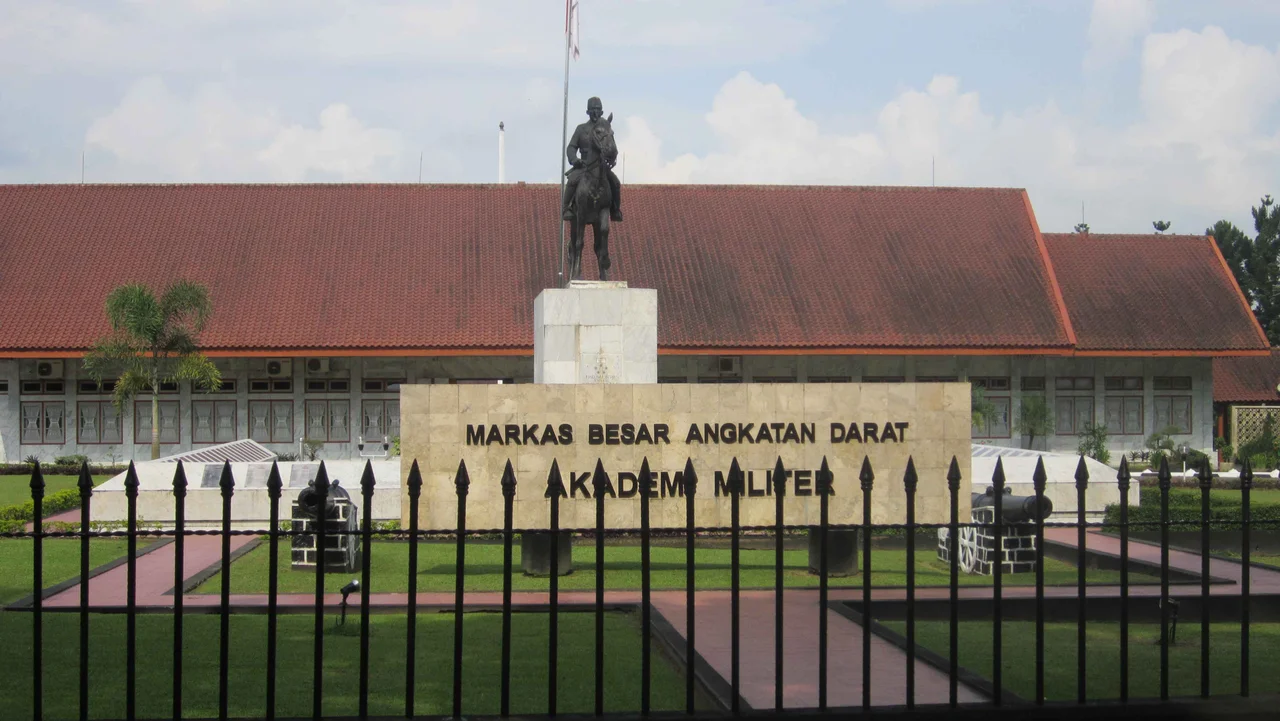

Tidar Valley: Where Indonesia Forges Its Officers
Every July, the graduating cadets of the Indonesian Military Academy march across the parade ground in Magelang, Central Java, then travel to Jakarta to receive their commissions at the Independence Palace. The top graduate receives a Second Lieutenant's shoulder board directly from the President of Indonesia. In recent decades, several of those presidents were themselves graduates of the same academy. This circularity is not accidental. The Military Academy, known as Akmil, has shaped Indonesian political and military life since the country's earliest days as a republic, producing not just generals but heads of state, cabinet ministers, and the entirety of the army's senior leadership for over three decades.
Born in Revolution
The academy traces its origins to October 1945, just two months after Indonesia declared independence from Japan. Chief of Staff Oerip Soemohardjo ordered the creation of a military academy in Yogyakarta, called the Militaire Academie, borrowing the Dutch name even as the country fought to free itself from Dutch colonial rule. The early years were chaotic. Class 2, admitted in 1946, had 200 cadets. By Class 3 in 1949, after a ceasefire with the Dutch armed forces, enrollment had collapsed to just nine. The academy closed in 1950, and the remaining students were sent to the Dutch Koninklijke Militaire Academie in Breda. For several years, Indonesia's officer training fractured across multiple ad hoc schools, a patchwork system for a military still finding its shape.
The Valley Takes Shape
In 1957, Army Chief of Staff Abdul Haris Nasution reopened the institution as the National Military Academy, establishing it on a campus in Magelang that includes the slopes of Mount Tidar. The location earned the academy its lasting nickname: Lembah Tidar, or Tidar Valley. Nasution modeled the new institution on the United States Military Academy at West Point, aiming to transform what had been a guerrilla force into a professional national army. The first class graduated in 1960, with 59 officers. Consolidation followed quickly. In 1961, the Army's technical academy in Bandung merged with the Magelang campus. By 1965, the Naval Academy, Air Force Academy, and Police Academy were all integrated under the umbrella of AKABRI, the Armed Forces Academy. The police separated again in 1999, but the three military branches remain unified in the structure to this day.
Sounds of Heaven
One of the academy's most distinctive traditions is its Corps of Drums, known as Canka Lokananta, a Sanskrit phrase meaning "sounds of heaven." Established in April 1959, the corps fields approximately 182 drummers, fifers, and trumpeters, all drawn from the cadet ranks. A separate 36-member regimental band, staffed by active-duty musicians, completes the academy's musical contingent. Together, they perform at military ceremonies, national events, public concerts, and television broadcasts. The corps is led by a Senior Drum Major and four Assistant Drum Majors, or Penatarama, who direct the formation with long ceremonial maces. Among the corps' former members is Susilo Bambang Yudhoyono, who played tenor drum during his cadet years. When Yudhoyono, by then the sixth President of Indonesia, visited the academy in June 2014, he reunited with fellow alumni from the 1973 graduating class to play with the corps once more.
A Campus of Consequence
The academy's alumni roster reads like a directory of modern Indonesian power. Prabowo Subianto, the eighth President of Indonesia, graduated from Akmil, as did his predecessor Yudhoyono. Try Sutrisno, the sixth Vice President, was an alumnus who later founded the nearby Taruna Nusantara preparatory high school in 1990 to funnel talented young Indonesians toward the academy. Wiranto, Luhut Binsar Pandjaitan, and Ryamizard Ryacudu all passed through Tidar Valley before ascending to ministerial positions. Every Indonesian Army Chief of Staff since 1988 has been an Akmil graduate. In 2017, the academy graduated its first female cadets, among a class of 225. The institution maintains exchange programs with military academies in the United States, Canada, Singapore, the Philippines, Vietnam, and the Netherlands, preserving ties to its Dutch colonial roots through a continuing link with the Koninklijke Militaire Academie in Breda.
Three Years on the Hill
Life at Akmil follows a structured arc. New cadets arrive in September for Reception Day, beginning a demanding first year alongside students from the naval, air force, and police academies. In January, a recognition ceremony marks their full acceptance into the corps, complete with the presentation of ceremonial daggers. Cadets are classified not as freshmen through seniors but as fourth through first class, a system borrowed from West Point. Regardless of their chosen major, whether defense administration, management, or technologies, all cadets earn a Bachelor of Applied Defense Science degree. The second and third years add combat arms training at schools across the country, and selected cadets travel abroad for exchange programs. When graduation arrives, the march across the Magelang parade ground is the last act before Jakarta, where the oath of office echoes through the Independence Palace and a new generation of officers joins the Indonesian Army.
From the Air
The Indonesian Military Academy (7.50S, 110.21E) sits in Magelang, Central Java, on the slopes of Mount Tidar. Adisucipto International Airport (WARJ) in Yogyakarta is approximately 45km to the southeast. The campus is identifiable by its large parade grounds and institutional buildings against the hillside. Mount Merapi volcano is visible roughly 30km to the east. Terrain is hilly with tropical vegetation. Hot and humid year-round, with the wet season running November through March.
Nearby Stories
- Gamelan From Heaven 11 km away
- Sasana Wiratama 16 km away
- The Fort That Changed Hands 23 km away
- A King's Canal, Carved in Stone 29 km away
- Forty Thousand Hills 35 km away
- The Language That Built an Archipelago 37 km away
- The Fortress That Buried Itself 74 km away
- Kraton Kasepuhan 134 km away