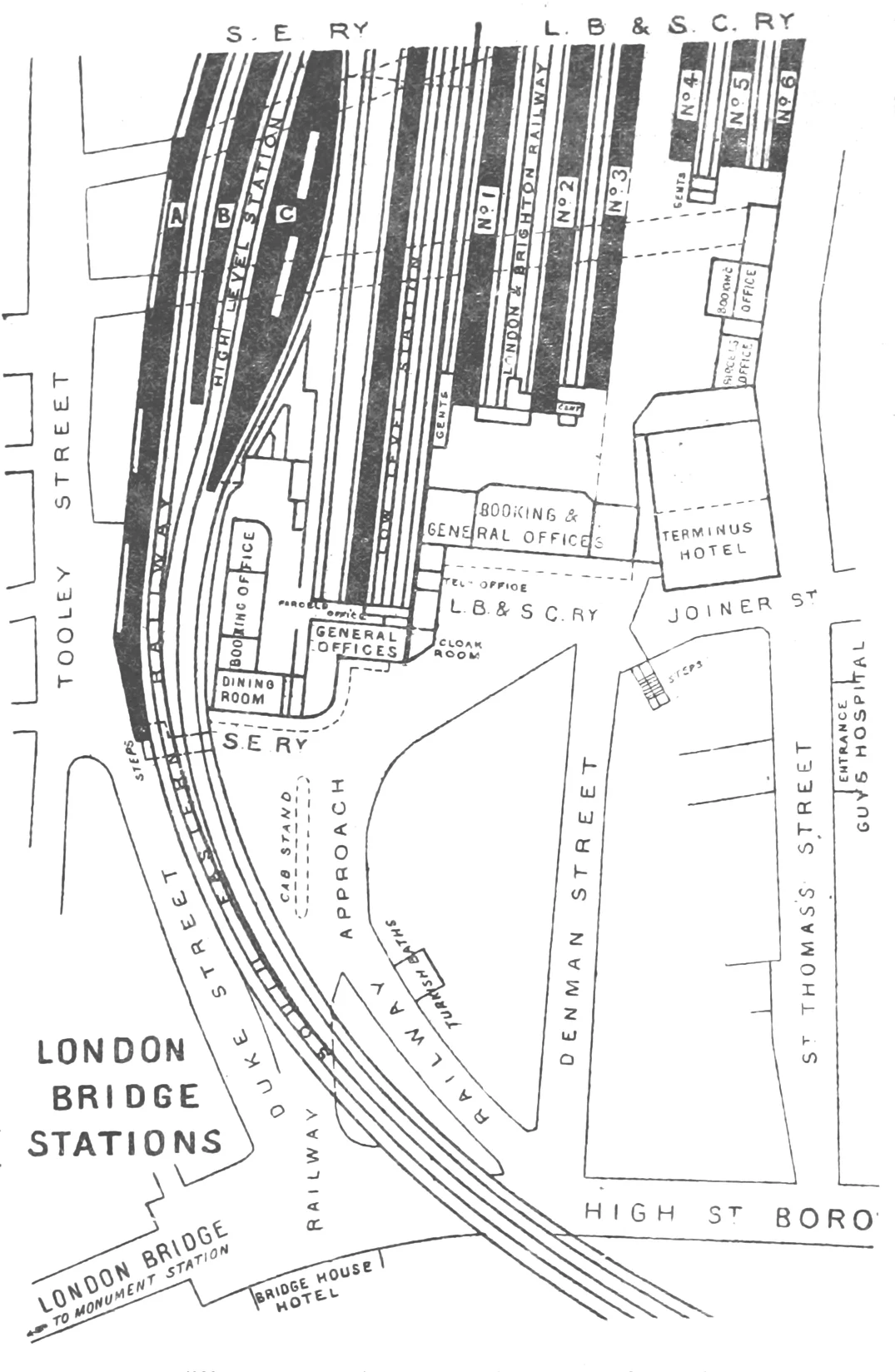
_p143_-_London_Bridge_station_(plan).jpg)
London Bridge station
There's a Victorian pipe organ on the concourse at London Bridge station. They call it Henry, and anyone is allowed to sit down and play it. Office workers do, on the way to lunch. So do strangers passing through, and small children, and the occasional retired church organist who knows exactly what they're doing. The organ was installed in October 2022 after being rescued from a closing church. It's a small touch, but a deliberate one — a moment of grace inside a station that handles 63 million passenger entries and exits in a normal year. London Bridge is the oldest railway terminus in London. It was first opened in 1836. Nearly two centuries later, it has finally, after one of the most disruptive engineering projects in the city's history, become a station that people actually like.
The Day the Fives Stopped
By the 1930s, London Bridge had a famous rush-hour ritual. Between 5:00 and 5:05pm every weekday evening, a glut of long commuter trains would depart almost simultaneously: 12-car services to Brighton, to Eastbourne, to Littlehampton, all clearing the platforms within five minutes. They called it 'The Fives.' It survived the Southern Railway era (the 'Big Four' grouping formed in 1923 brought all of southern England's railways under one company), the steam-to-electric conversion of the late 1920s, and even the Blitz, when both halves of the station were badly damaged by bombing in December 1940 and early 1941. The Terminus Hotel didn't survive — declared unsafe and demolished — but The Fives kept running. The ritual lasted until the mid-1970s, when increasing congestion and changing patterns of work finally broke it apart. For four decades, every weekday evening, you could set your watch by the simultaneous departure of seven commuter trains.
Underground Roman London
When engineers dug the new Jubilee line tunnels under London Bridge in the late 1990s, they found Roman London. Pottery, mosaic fragments, the buried evidence of the small settlement that grew at the southern end of the very first London Bridge two thousand years ago. Some of these finds are now on display in the station itself — embedded into the fabric of the modern transport hub, archaeology and infrastructure occupying the same vertical column of earth. The Jubilee line platforms opened on 7 October 1999 as part of the Jubilee Line Extension. They were fitted with platform screen doors, like every below-ground station on the extension. The Northern line platforms above had been there much longer; London Bridge tube station opened on 25 February 1900 as part of the second section of the City & South London Railway, replacing the badly placed King William Street station that had proved unworkable due to a steep incline coming up from under the Thames.
A Thousand Days of Mess
Between 2009 and 2017, Grimshaw Architects rebuilt London Bridge station from the platforms up. The terminal platforms shrank from nine to six. The through platforms grew from six to nine. Every platform was extended to handle 12-car trains. Two new street-level entrances were opened — on St Thomas Street to the south, on Tooley Street to the north. A new underground concourse was constructed by demolishing brick vaults between Stainer and Weston Streets. The Shard opened next door in 2012, which meant the station had to be rebuilt with one eye on Western Europe's tallest building (309 metres) rising directly above it. Through most of the worst of the construction, services were progressively diverted: Charing Cross trains stopped calling for most of 2015 and 2016 while their platforms were rebuilt, then Cannon Street trains skipped through during 2016 and 2017. Thameslink services didn't stop here at all between 2015 and May 2018. Commuters spent years getting off at the wrong stations to walk in. When it was finished, Prince William opened it on 9 May 2018. The £1 billion project made the Stirling Prize shortlist for excellence in architecture in 2019.
The Bombs and the Knives
London Bridge has been the site of more than one act of violence. On 28 February 1992, the Provisional IRA detonated a bomb at the station, injuring 29 people. On 3 June 2017, eight people were killed when three Islamist attackers drove a van into pedestrians on London Bridge itself before attacking diners in nearby Borough Market with knives; the station was closed for hours. On 29 November 2019, in a separate attack, two people — Jack Merritt, 25, and Saskia Jones, 23, both volunteers at a prisoner-rehabilitation conference at Fishmongers' Hall — were fatally stabbed by an attendee. The attacker was tackled by bystanders, including one wielding a narwhal tusk taken from the wall of the hall, before being shot by police on London Bridge itself. The station has reopened every time. The flow of commuters has resumed. The trains keep running.
Sixteen Trains an Hour to Charing Cross
Today, the typical weekday off-peak service from London Bridge runs sixteen trains an hour to Charing Cross alone — one every three minutes and 45 seconds. The platform configuration splits services neatly: platforms 1-3 to the southeast and Kent, platforms 4-5 for Thameslink running north through the city, platforms 6-9 for through services to Charing Cross and Cannon Street, platforms 10-15 as terminating bays for Southern services to south London and the south coast. The station is the third-busiest in the country, behind Waterloo and Victoria. The Northern and Jubilee lines arrive below. The buses arrive at the new station forecourt. The Shard looms above. And Henry the organ waits on the concourse for the next person who knows how to make it sing.
From the Air
London Bridge station sits at 51.505°N, 0.0861°W on the south bank of the Thames, immediately east of London Bridge itself. From the air, the unmistakable landmark is The Shard rising directly above the station — at 309 metres (1,016 feet), Western Europe's tallest building, with its tapered glass spire visible from across the city. The curved roof of the station's terminal platforms sits at its base. HMS Belfast moors in the Thames just to the north. Nearest airport: London City (EGLC), 4 miles east. Best viewed at low altitude on Thames-following approaches.
Nearby Stories
- Stevenage 5.7 km away
- Malling Abbey 5.7 km away
- 1952 Farnborough Airshow Crash 7.7 km away
- Ingatestone Hall 8.2 km away
- Hellfire Caves 9.1 km away
- The Carrington Event: The Solar Storm That Could Happen Again 9.8 km away
- Bletchley Park 16 km away
- Castle Hedingham 23 km away