_by_Claes_Van_Visscher.jpg)
London Bridge
In 1968, an American businessman named Robert P. McCulloch paid $2.46 million for a bridge that was sinking into the Thames. He had each granite block numbered, shipped 10,000 tons of stone through the Panama Canal to California, trucked them across the desert to Arizona, and reassembled the bridge over an artificial channel in Lake Havasu City, where it stands today as one of the strangest tourist attractions in the American Southwest. There's a persistent myth that McCulloch thought he was buying Tower Bridge — the photogenic one with the towers and the bascules. The myth was denied by Common Council member Ivan Luckin, who actually sold him the thing. McCulloch knew exactly what he was getting: John Rennie's elegant 1831 stone-arched bridge, slowly subsiding into the riverbed at the rate of about an inch every eight years.
The Romans Made London Because of the Bridge
Until a bridge was built here, London did not exist. There were scattered Neolithic, Bronze Age, and Iron Age settlements nearby, and the Thames was a major trade route to the Continent from at least the 9th century BC, but no permanent town. The first London Bridge — possibly a pontoon, more probably a timber structure — was built by Roman military engineers somewhere around AD 50, as part of the road network being built to consolidate the conquest of Britain that began in AD 43 under Emperor Claudius. A small trading settlement took root on the higher dry ground at the northern end and grew into Londinium. The bridge was probably destroyed along with the town during Boudica's revolt in AD 60, but Londinium was rebuilt and the crossing with it. By the height of Roman Britain, the bridge linked four major arterial roads north of the Thames with four to the south. London exists because a bridge was here. Take away the bridge, and there is no reason for the city.
Five Hundred and Fifty Years of Houses on a Bridge
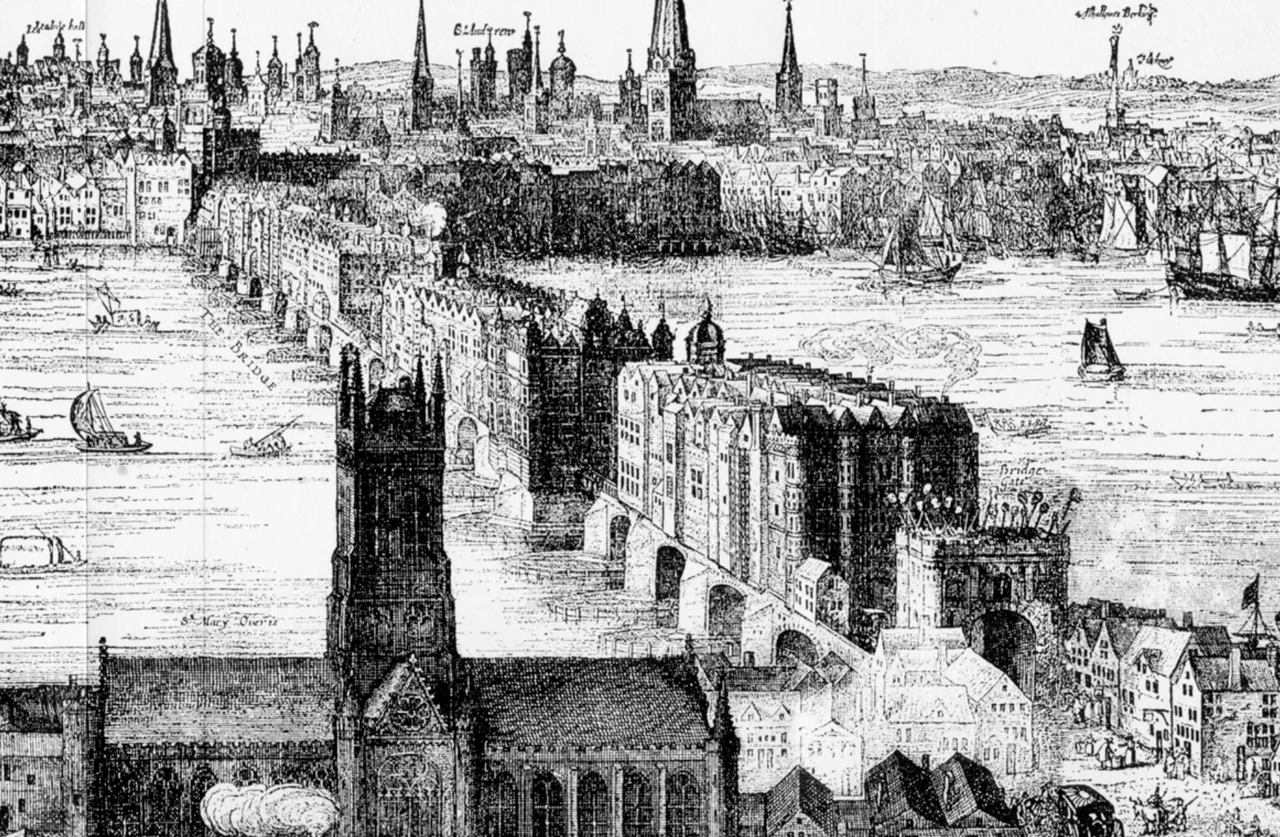
King Henry II, doing penance for the murder of Thomas Becket, commissioned a new stone bridge with a chapel dedicated to Becket at its centre. Construction began in 1176 under the supervision of Peter of Colechurch and was completed by 1209. The bridge that resulted was one of the strangest urban structures in medieval Europe — a stone span with up to 140 houses built directly on top of it, four or five storeys tall, with shops on the ground floor and chambers, kitchens and garrets above. By 1605 the houses had been merged into 91 larger dwellings. Pin makers, needle makers, booksellers, haberdashers and grocers traded across what was effectively a working high street suspended over the river. The narrow arches restricted the Thames flow so dramatically that water levels could differ by six feet between the upstream and downstream sides; the rapids in between were called the starlings, and 'shooting the bridge' — steering a boat through them at flood — was dangerous enough that a saying emerged: the bridge was for wise men to go over and fools to go under. In hard winters the restricted flow made the upstream Thames freeze solid, producing the famous Frost Fairs.
The Heads on the Spikes
The drawbridge tower at the southern end of Old London Bridge had a grim function: it displayed the severed heads of traitors, dipped in tar to preserve them against the weather and impaled on iron spikes. The first recorded head belonged to William Wallace, exhibited in 1305 after his execution under Edward I. Over the next three and a half centuries, the heads accumulated: Jack Cade in 1450, after his failed rebellion against Henry VI; Thomas More in 1535, executed by Henry VIII for refusing to recognise his break with Rome; Bishop John Fisher in the same year, for the same reason; Thomas Cromwell in 1540, undone by the same king he had served so loyally. In 1598 a German visitor named Paul Hentzner counted over thirty heads on the bridge. The last head was installed in 1661, after the Restoration. The Reformation, the Civil War, the constant churn of religious and political enemies — for 356 years, the people in power placed the heads of their defeated rivals above the southern gatehouse, where every pilgrim and trader and Londoner walking south to Canterbury had to pass beneath them.
The Bridge That Drove on the Left
By the late 17th century, the bridge had 551 residents living on it and the traffic was a permanent problem. From 1670, attempts were made to keep traffic in each direction to one side — first a keep-right policy, then in 1722 a keep-left policy. The 1722 decision has been suggested as one possible origin for the practice of left-hand driving in Britain. (Other explanations exist; this was one of the earliest formal rules.) Houses began to subside. Fires in 1633 (which incidentally saved the rest of the bridge from the 1666 Great Fire of London by creating a firebreak), 1725, and others kept damaging the structure. In 1745 the last houses were rebuilt, designed by George Dance the Elder; within a decade they were sinking. In 1761 the houses were all demolished after 552 years on the bridge, the last tenant departing in 1761. The roadway was widened to 46 feet, given a balustrade in the Gothic taste, and equipped with 14 stone alcoves where pedestrians could shelter from carts. The structure didn't long survive the alterations.
The Concrete Bridge Nobody Notices
John Rennie's elegant 1831 stone bridge — five granite arches, 928 feet long — outlasted the medieval one but was undone by simple weight. By 1924 the east side had sunk three to four inches lower than the west side. By 1968 it had to go. After McCulloch took it to Arizona, the current London Bridge, designed by Lord Holford with engineers Mott, Hay and Anderson, was built between 1967 and 1972 — three spans of prestressed-concrete box girders, 833 feet long, opened by Queen Elizabeth II on 16 March 1973. It is, by deliberate design, the bridge that nobody notices. After two thousand years of dramatic architecture — Roman timber, medieval stone with houses on top, Rennie's neoclassical granite — the city built something practical, smooth, and quiet. The most famous river crossing in Britain became architecturally invisible. On 3 June 2017, three pedestrians were killed by a van in a terrorist attack on the bridge; eight died in total in the combined attack on the bridge and Borough Market. Security barriers were installed to separate the pavement from the road. And the commuters keep flowing across, north to south, south to north, the way they have since the Romans built the first crossing nearly two thousand years ago.
From the Air
London Bridge sits at 51.5081°N, 0.0878°W, crossing the Thames between the City of London (north bank, with St Magnus-the-Martyr at its northern approach) and Southwark (south bank, where Southwark Cathedral marks the southern approach). From the air, it is the simple flat-decked concrete span between the more visually dramatic Tower Bridge to the east and Cannon Street Railway Bridge to the west. The Shard rises immediately to the south. Nearest airport: London City (EGLC), 4 miles east. Best viewed at low altitude on Thames-following approaches; the Pool of London begins at its eastern side.
Nearby Stories
- Stevenage 5.7 km away
- Malling Abbey 5.7 km away
- 1952 Farnborough Airshow Crash 7.7 km away
- Ingatestone Hall 8.2 km away
- Hellfire Caves 9.1 km away
- The Carrington Event: The Solar Storm That Could Happen Again 9.8 km away
- Bletchley Park 16 km away
- Castle Hedingham 23 km away