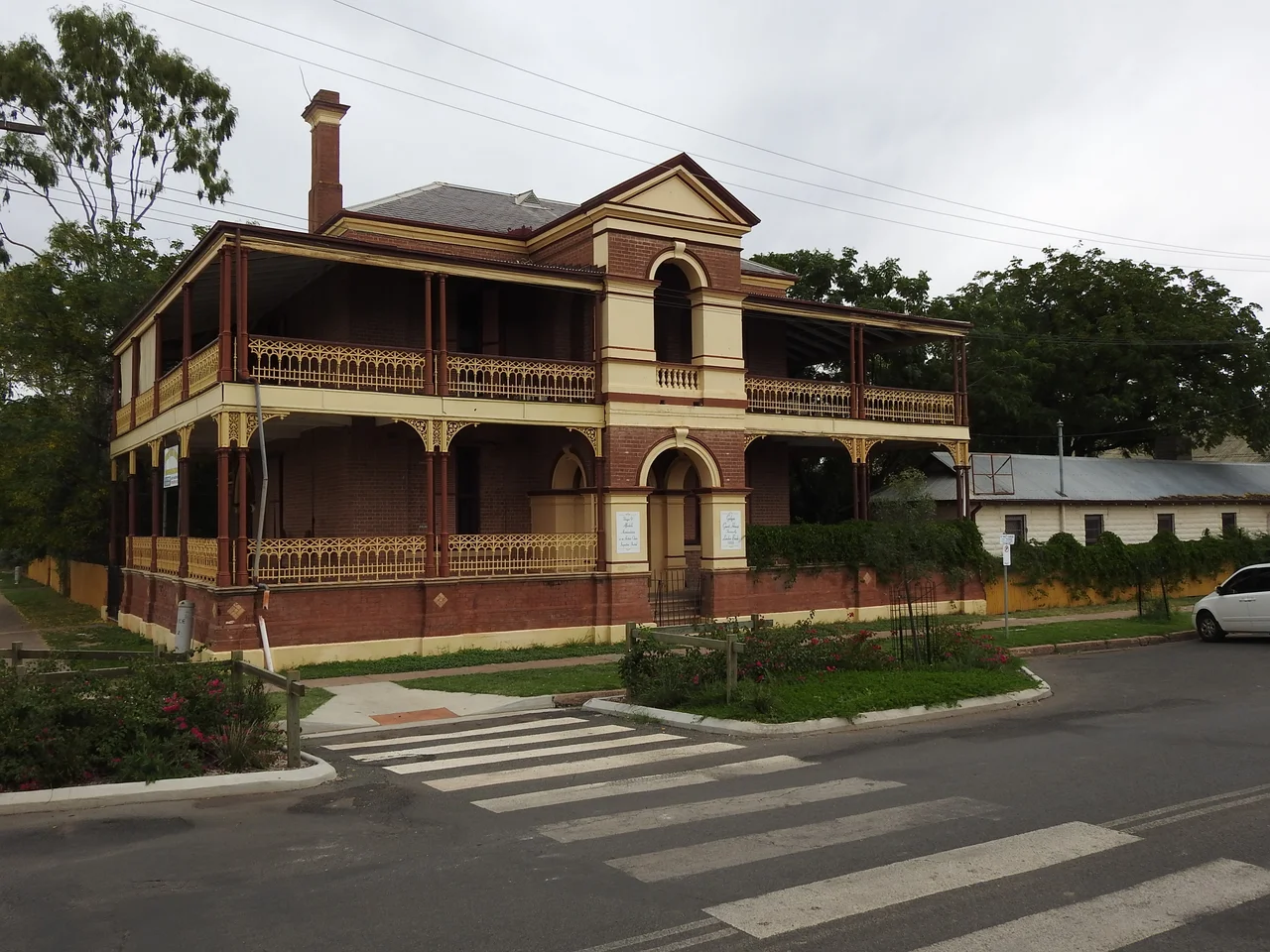

London Chartered Bank of Australia Building, Bourke
Banks do not usually build palaces in the desert. Yet here, on Sturt Street in Bourke, stands a substantial brick building raised between 1886 and 1888 by the London Chartered Bank of Australia - a company so confident in this outback river port that it commissioned a Melbourne architectural firm to design a fitting home for its money. Bourke was booming then, its wharves heavy with wool, and the bank that handled those fortunes wanted a building to match the optimism. Today it survives as the Gidgee Guesthouse, where travellers sleep in rooms that once housed bank managers sent to the very edge of settled Australia.
Money in the Mulga
By the 1880s, Bourke was one of the largest inland wool ports in the world, and where wool money flowed, banks followed. The London Chartered Bank of Australia established itself here in the early 1880s, and in 1887 it bought the Sturt Street property to build something permanent. The site sat among the very first parcels of land in Bourke - ground beside the river punt where, back in 1862, the town's earliest hotels and stores had appeared. To put up a building this solid, this far from anywhere, was a statement of faith in the river trade. The bank was betting that Bourke's prosperity would last. For a time, it did.
Architecture Against the Heat
The Melbourne firm of Terry and Oakden designed the building, with construction credited to local builders Perry and Hawken. Their challenge was less about grandeur than survival - how to make a dignified bank work in a place of searing summers and choking dust. Their answers are written into the structure: a deep verandah to shade the walls, sliding timber shutters to block the worst of the sun, and closable wall vents to coax a breeze through on still, baking afternoons. These were not afterthoughts but the central logic of the design, the practical wisdom of building in country where the heat can be merciless. The result is broadly representative of regional bank architecture of the late nineteenth century, adapted intelligently to one of the harshest corners of New South Wales.
The Manager's Frontier
A country bank was more than a vault and a counter. The manager and his family lived on the premises, and for many of them a posting to Bourke was their first taste of life in the far west - the isolation, the floods and droughts, the long distances to anywhere familiar. The building carries that human history quietly. For the families who passed through it, this was home as much as workplace, a comfortable island in unforgiving country. The bank stood as proof that the institutions of the colony - credit, investment, the machinery that financed pastoral expansion - had reached even here, binding the remote interior into the wider economy of the nation.
A Second Life
The boom did not last forever. Banking consolidated, the river trade faded, and grand old buildings across the outback found themselves searching for new purpose. The Old London Bank found one. Restored and adapted, it reopened as the Gidgee Guesthouse, offering visitors a place to stay inside a genuine relic of Bourke's golden age. Its survival into the present - listed on the New South Wales State Heritage Register in 1999 - speaks to a town that values its past. Few buildings tell the story of Bourke's brief, intense prosperity as plainly as this one: a bank built for a river fortune, still standing long after the paddle-steamers stopped running.
From the Air
The Old London Bank Building stands at 17 Sturt Street in central Bourke, at approximately 30.09 degrees south, 145.94 degrees east, near the Darling River in northwestern New South Wales. From the air, Bourke appears as a small grid of streets beside the river's dark, looping channel; Sturt Street runs toward the old wharf at the river's edge. Bourke Airport (YBKE), about 7 km north of town with a sealed 1,830 m runway, is the practical arrival point; Cunnamulla (YCMU) lies further north in Queensland. Outback air is usually clear, with heat haze likely in summer and crisp visibility in autumn and winter. Recommended viewing altitude 1,000-2,000 ft AGL over the township.
Nearby Stories
- Toorale Station 20 km away
- Gundabooka National Park 36 km away
- Louth, New South Wales 42 km away
- Murrawarri Republic 103 km away
- Royal Mail Hotel, Hungerford 148 km away
- Roxy Theatre and Peters Greek Cafe Complex 383 km away
- Bingara 384 km away
- Captain Thunderbolt's Death Site 465 km away