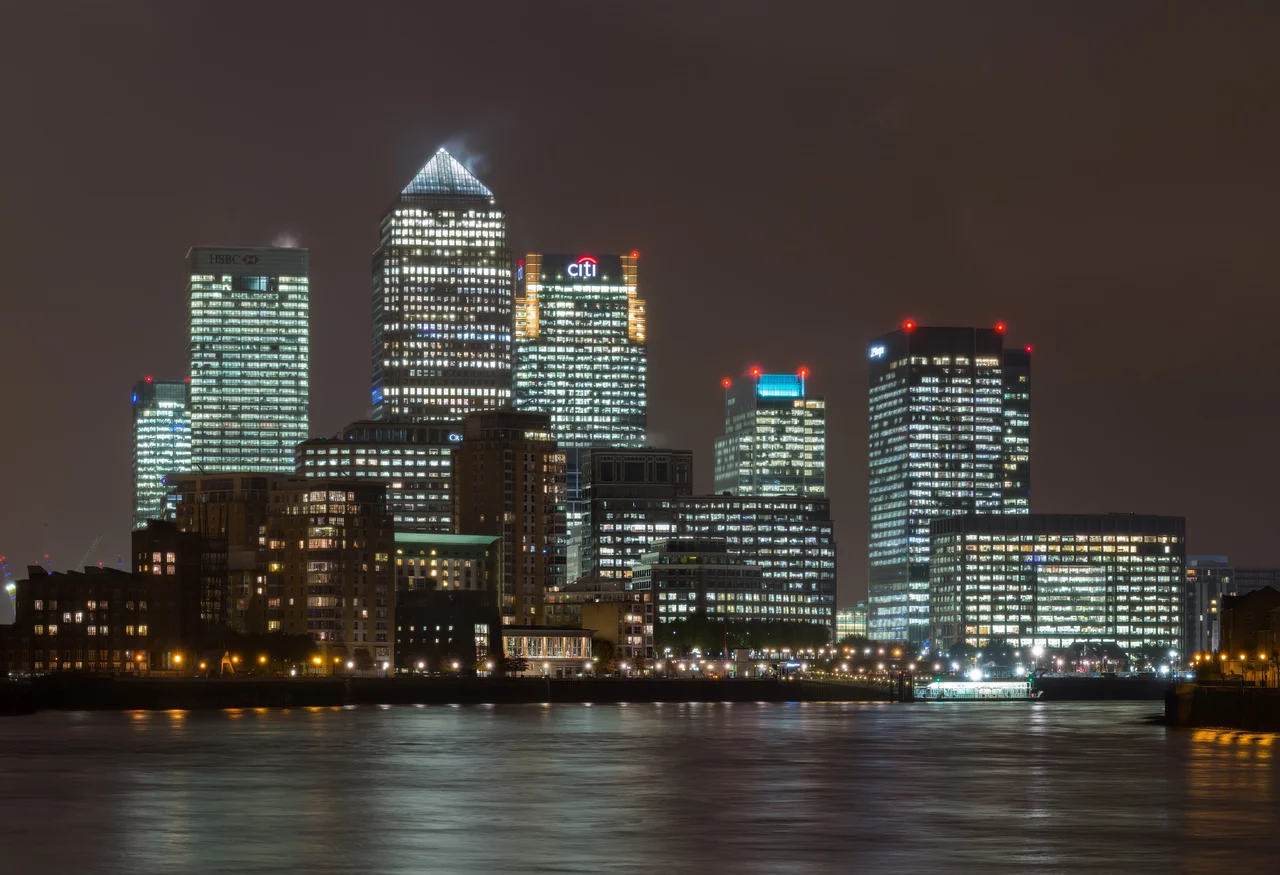

London Docklands
When the Surrey Docks burned on the night of 7 September 1940, 380,000 tons of timber were destroyed in a single night. The Blitz targeted the Docklands specifically because it was the heart of the British war effort's supply chain — timber, grain, rubber, wool, sugar, all moving through a network of specialized docks that had taken two centuries to build. The docks survived. They rebuilt. And then, in the 1960s and 1970s, containerisation made them obsolete almost overnight. The men who had worked these docks — lightermen, deal porters, casual labourers who assembled at certain pubs each morning waiting to be picked, lives lived by the luck of a foreman's nod — found themselves redundant.
The World's Largest Port
The docks that would become the Docklands began with the Howland Great Dock in Rotherhithe in 1696, which could shelter 120 large vessels in a secure, sheltered anchorage — a major improvement on the exposed quays where ships had previously docked in the Pool of London. The Georgian expansion followed in rapid sequence: the West India Docks opened in 1802, the London Docks in 1805, the East India Docks in 1806, the Surrey Docks in 1807, and so on through the century. The Victorian docks — Royal Victoria in 1855, Millwall in 1868, Royal Albert in 1880, King George V in 1921 — pushed further east. Each dock specialized in particular cargoes: the Surrey Docks handled timber, Millwall handled grain, St Katharine handled wool, sugar, and rubber. The Port of London, managing all of this from 1909, was at its peak the largest port in the world. Entire communities formed around the work, tight-knit and isolated by geography — the Isle of Dogs could only be reached by two swing bridges, and local sentiment ran so strong that a campaigner named Ted Johns once unilaterally declared the area independent, set up an Island Council with himself as leader, and blocked the access roads.
Collapse and Crime
Containerisation changed cargo handling so completely and so rapidly that the docks could not adapt. The equipment required for container ships needed space that the old dock configurations could not provide; the new facilities were built further east at Tilbury, and the upstream docks closed one by one through the 1960s and 1970s. By the 1980s, the Docklands were largely derelict. The dock workers who had made ends meet through petty and not-so-petty criminality — theft from uncontainerized cargo, smuggling, fencing — had already established what one source called 'centres of excellence for criminal practice.' Many of Britain's most accomplished criminals of the 20th century learned their trade in the Docklands, including those who later organized the Great Train Robbery, the Brink's-Mat robbery, the Hatton Garden heist, and the Tonbridge cash depot robbery. The same isolation that had created the close communities also created the conditions for professional crime.
Regeneration and Its Costs
The London Docklands Development Corporation, established in 1981, began what became one of the largest urban regeneration projects anywhere in the world. Its first phase cost only £77 million — cheap because it reused derelict railway infrastructure and brownfield land. The LDDC also built the Docklands Light Railway, contributed to the development of London City Airport (which opened in October 1987 on the spine of the Royal Docks), and eventually saw the Jubilee line extended east in 1999 to serve Canada Water, Canary Wharf, and beyond. Canary Wharf emerged as one of Europe's biggest clusters of skyscrapers and a major extension of London's financial services district. But the regeneration also produced what became some of the most striking disparities visible anywhere in Britain: luxury executive apartments built immediately alongside run-down public housing estates, the old communities squeezed out by a property boom they could not participate in. In February 1996, an IRA bomb exploded at South Quay — ending an IRA ceasefire, killing two people, injuring forty, and causing an estimated £150 million of damage. The target was symbolic as much as strategic: the Docklands had become a symbol of Thatcher's Britain.
What the Docklands Became
The Docklands today are a study in layered time. The water has mostly stayed — many of the original docks survive as marinas or watersports centres — but almost everything else has changed. The towers of Canary Wharf dominate east London's skyline in a way that the warehouses they replaced never did. The Telehouse campus in the Docklands, which opened in 1990, became one of the world's leading internet exchange hubs, hosting the majority of the London Internet Exchange's peering traffic across more than 73,000 square metres of data centre space. A symphony orchestra, Docklands Sinfonia, formed in 2009 and based at St Anne's Limehouse, performs in a neighbourhood where dock workers once assembled in pubs waiting for work. The Surrey Commercial Docks are largely filled in. Large ships occasionally still visit the old docks, but all commercial traffic moved east long ago. The bargees, the lightermen, the deal porters famous for their acrobatic skills — they belong to a world that containerisation ended in less than a generation.
From the Air
London Docklands is located at approximately 51.505°N, 0.018°W in inner east London, spanning the boroughs of Tower Hamlets, Newham, Southwark, Lewisham, and Greenwich. From the air, the area is dramatically visible: the cluster of Canary Wharf skyscrapers rises prominently from the Isle of Dogs, surrounded by the distinctive rectangular geometry of the old dock basins, many still filled with water. London City Airport (IATA: LCY) sits within the Royal Docks at 51.504°N, 0.055°E — aircraft on approach to LCY pass directly over the area. Recommended viewing altitude: 1,000–3,000 feet for the full extent.
Nearby Stories
- Stevenage 5.7 km away
- Malling Abbey 5.7 km away
- 1952 Farnborough Airshow Crash 7.7 km away
- Ingatestone Hall 8.2 km away
- Hellfire Caves 9.1 km away
- The Carrington Event: The Solar Storm That Could Happen Again 9.8 km away
- Bletchley Park 16 km away
- Castle Hedingham 23 km away