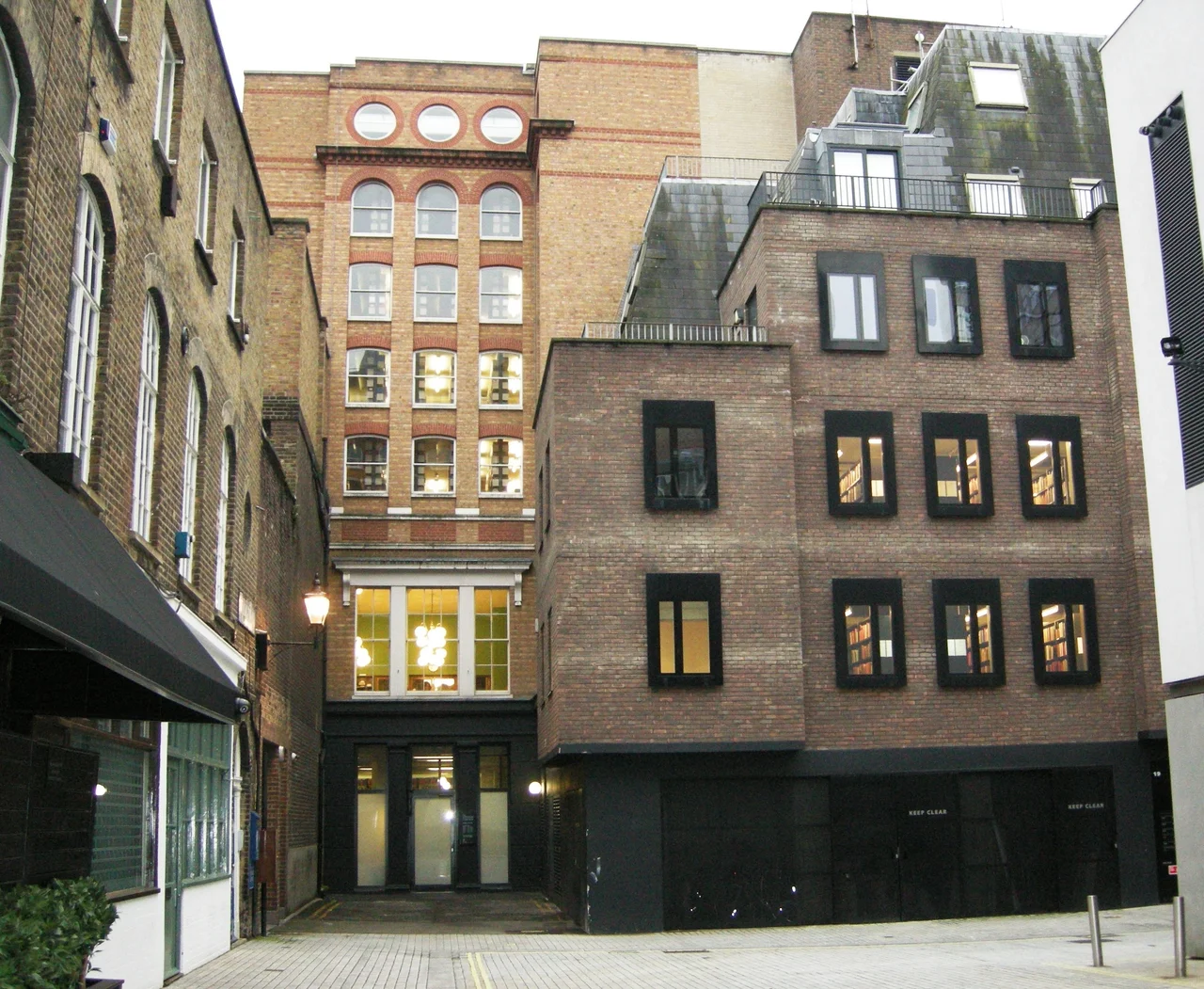

London Library
Thomas Carlyle suffered, on visits to the British Museum reading room, what he called a 'museum headache.' He couldn't find a seat. He sometimes had to perch on ladders. He found the enforced proximity of his fellow readers physically oppressive. He developed an intense dislike for the Keeper of Printed Books, Anthony Panizzi — despite the fact that Panizzi had quietly given him privileges denied to other readers — and he was particularly outraged that the books couldn't be borrowed. In 1841, Carlyle and a group of influential friends decided to do something about it. They founded their own library. They put it at 14 St James's Square. It is still there.
An Eccentric Founders' Committee
The first president of the London Library was George Villiers, 4th Earl of Clarendon. The first auditor was the novelist William Makepeace Thackeray. William Gladstone — the four-time Prime Minister — sat on the first committee. The Belgian freedom fighter Sylvain Van de Weyer, formerly a librarian at Louvain, served as vice-president from 1848 to 1874; his father-in-law Joshua Bates would later found the Boston Public Library. Charles Dickens was a founder member. In later Victorian times, Richard Monckton-Milnes — Lord Houghton, friend of Florence Nightingale — was a vigorous presence. Kenneth Clark, the art historian who fronted Civilisation on the BBC, served as president in the twentieth century. So did T. S. Eliot, who declared in a 1952 address that 'whatever social changes come about, the disappearance of the London Library would be a disaster to civilisation.' He meant it. He was on the way to making it happen.
The Times of Crisis
In 1957 Westminster City Council suddenly demanded business rates from the library, despite its charitable status. The Inland Revenue piled in. A final appeal was lost in 1959, and on 5 November of that year T. S. Eliot and the Chairman Rupert Hart-Davis wrote a letter to The Times asking the public for help. Winston Churchill wrote in reply that 'the closing of this most worthy institution would be a tragedy.' Donations reached £17,000. An auction on 22 June 1960 raised another £25,000 — enough to clear the £20,000 in debts and legal expenses. The sale included some of T. E. Lawrence's items, donated by his brother, which fetched £3,800; Eliot's own copy of The Waste Land went for £2,800; Lytton Strachey's Queen Victoria for £1,800. Queen Elizabeth II donated a book from Queen Victoria's library. The Queen Mother contributed a Sheffield plate wine cooler. The library survived. In 1944, more catastrophically, a German bomb had destroyed 16,000 volumes from the northern bookstacks, including most of the Biography section.
A Million Books You Can Touch
The London Library now holds over a million items, with around 8,000 new books and periodicals added each year. Ninety-five percent of the collection sits on open shelves — anyone can walk in, find a book, take it down, take it home. Most of the other five percent is rare-book storage. The contrast with the British Library, where you order books and wait, is the entire founding point. Colin Wilson described his first visit in the mid-1960s with characteristic intemperance: 'I have always had an obsession about books, and in this place I felt like a sex maniac in the middle of a harem.' Arthur Koestler used it in 1972 to research the Spassky–Fischer chess championship for a magazine assignment. James Bond uses it in Ian Fleming's On Her Majesty's Secret Service to research heraldry. A. S. Byatt opens Possession in its bookstacks. Dr Watson goes there in 'The Adventure of the Illustrious Client' to brush up on Chinese pottery so he can pose as an expert.
The Building Behind the Square
Number 14 St James's Square started life as Beauchamp House, built in 1676 — described in 1895 by the architectural historian A. I. Dasent as 'admittedly the worst house in the Square.' The library rented it from 1845, bought the freehold in 1879, and rebuilt it almost entirely between 1896 and 1898 to designs by James Osborne Smith. The Portland stone façade survives as the front of today's building, executed in what the Survey of London called a 'curiously eclectic' Jacobethan style. The architects Mewès & Davis added the northern extension in 1932-34. The Anstruther Wing, a nine-storey building on a small footprint for rare books, was built in 1995. In 2004 the library acquired Duchess House next door, renamed it T. S. Eliot House in 2008, and used the redevelopment by Haworth Tompkins to refit the whole complex. The toilets, by some particularly British arrangement, were designed in collaboration with the Turner Prize-winning artist Martin Creed. The building has been Grade II listed since February 1958.
The Reader Who Was Caught
In the 1990s, an English serial book thief named William Jacques targeted the London Library along with other academic and specialist collections. Several rare books from the library kept turning up at auction. The police, alerted, investigated; Jacques was prosecuted and convicted. The library improved its security. Today's annual subscription is £615 — a long way from the £3 it cost in 1903, or the £4 4s it cost throughout the 1930s and into the 1950s. There are around 7,500 members. The royal patron, since the line was first established under Prince Albert, has now reached Queen Camilla. Prime Ministers have read here. Novelists have written here. The library has appeared in detective stories and TV murder mysteries. (In a 2010 episode of New Tricks called 'It smells of books,' someone is murdered in the bookstacks.) Carlyle, who started the whole thing because the British Museum gave him a headache, has long since ascended to portrait status on the wall. He looks, in Robert Scott Tait's 1854 photograph, like a man who has won an argument with the world.
From the Air
The London Library sits at 51.5074°N, 0.1369°W, at 14 St James's Square in the City of Westminster — in the elegant network of streets between Piccadilly to the north and Pall Mall to the south. From the air, look for the green rectangle of St James's Square itself, just east of Green Park, with St James's Palace and Marlborough House to the west. Nearest airport: London City (EGLC), 8 miles east. Heathrow (EGLL) sits 15 miles to the west. Best viewed at low altitude on approaches to either.
Nearby Stories
- Stevenage 5.7 km away
- Malling Abbey 5.7 km away
- 1952 Farnborough Airshow Crash 7.7 km away
- Ingatestone Hall 8.2 km away
- Hellfire Caves 9.1 km away
- The Carrington Event: The Solar Storm That Could Happen Again 9.8 km away
- Bletchley Park 16 km away
- Castle Hedingham 23 km away