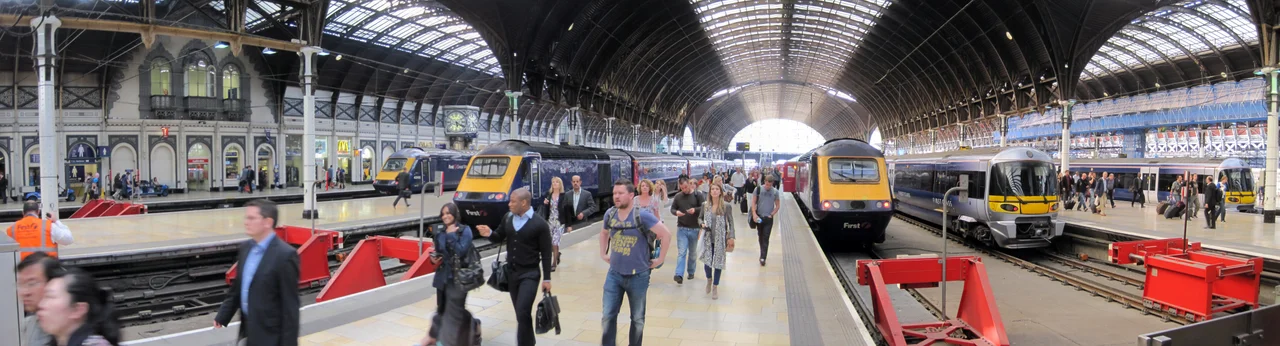

London Paddington Station
Isambard Kingdom Brunel announced the construction of a railway from Bristol to London on 30 July 1833. He intended it to be the best railway in the country. When it came time to build the London terminus, he rejected any compromise: nothing less than a grand station dedicated entirely to the Great Western Railway would do. The glazed roof he designed — three spans of wrought iron arches, the widest reaching 102 feet across, the whole structure 699 feet long — took inspiration from Joseph Paxton's Crystal Palace and the Hauptbahnhof in Munich. It opened in January 1854. In the year ending March 2025, an estimated 69.9 million people passed through it, making Paddington the third busiest station in Great Britain.
Brunel's Shed
The train shed that stands today is substantially the one Brunel designed, though it has been modified and expanded in the century and a half since. The original three spans were joined by a fourth span of 109 feet in 1906–1915, added parallel to the others in a similar style. The glazed roofs let in daylight — a condition that was briefly lost when a false ceiling was installed in 1996 but restored after a renovation completed in 2011. The architectural detailing throughout was handled by Brunel's associate Matthew Digby Wyatt, who gave the ironwork its decorative character. The Great Western Hotel on Praed Street, built in front of the station from 1851 to 1854, completes the composition: a French-chateau design by Philip Charles Hardwick that opened with 103 bedrooms and 15 sitting rooms, with a tower at each corner. Network Rail, which had once proposed demolishing the fourth span to build offices over it, was successfully challenged by the preservation organization Save Britain's Heritage.
War, Steam, and Survival
During the Second World War, Paddington was attacked multiple times. On 17 April 1941, a parachute mine hit the departure side of the station. On 22 March 1944, two 500-pound bombs destroyed the roof between platforms 6 and 7. Yet passenger traffic increased dramatically throughout the war — evacuation trains, holiday-makers heading west away from the endangered coasts, troops. On 29 July 1944, the platforms were so saturated with passengers that the station closed for three hours; the following August bank holiday required mounted police to manage the queues along Eastbourne Terrace. The station survived. Steam locomotives ran from Paddington until 11 June 1965, when the last regular long-distance steam train departed. The last steam service attracted significant attention; the railways had been a steam operation for 127 years. A bronze statue of Brunel, sculpted by John Doubleday, was erected on the station concourse in 1982. It was funded by the Bristol and West Building Society.
A Bear from Peru
Under the clock on platform 1, beside Brunel's statue, stands another figure: Paddington Bear, the creation of author Michael Bond. In Bond's stories, the small bear was found at the station having arrived from 'deepest, darkest Peru,' with a note attached to his coat reading 'please look after this bear, thank you.' The statue, by Marcus Cornish based on Peggy Fortnum's original drawings, gave a face to a character who had been part of British cultural life since 1958. Paddington station has accumulated fictional associations beyond the bear: Sherlock Holmes departed from here in The Hound of the Baskervilles; Agatha Christie's '4.50 From Paddington' begins with a murder witnessed on a train leaving the station; Supertramp recorded the train sounds for their song 'Rudy' in the station in 1974. The station is also home to the Great Western Railway Paddington Band, described as the last railway band in England, which plays on Friday evenings on the main concourse.
The Station Now
In the year ending March 2025, Paddington handled 69.9 million entries and exits — third in Great Britain after London Liverpool Street and London Waterloo. The opening of the Elizabeth line in May 2022 significantly increased the station's reach: underground platforms A and B connect Paddington westward to Reading, Heathrow Terminal 4, and Heathrow Terminal 5, and eastward across central London to Abbey Wood and Shenfield. The Heathrow Express, running non-stop to the airport, departs from here on a premium fare. The station also remains the terminus for Great Western Railway services to Bristol, South Wales, Cornwall, and the West Country — the same routes Brunel designed his railway to serve. Four London Underground lines serve two separate tube stations at Paddington, reflecting the accumulated complexity of more than 160 years of extension and connection. Despite this complexity, Brunel's design remains legible beneath it all: the four great spans, the light falling through the glass, the sense of scale that announces arrival in a city that means business.
From the Air
London Paddington station is located at 51.5167°N, 0.1772°W in the City of Westminster. From the air, the station is identifiable by the distinctive curved glazed roof of the train shed, set in a shallow cutting that runs southwest from the station throat near Ladbroke Grove. The Great Western Hotel on Praed Street forms the visible street facade. The Paddington arm of the Grand Union Canal runs along the east side of the station. Nearest airports: Heathrow (LHR) 24km west, London City (LCY) 17km east. The Heathrow Express connects directly to LHR from the station. Recommended viewing altitude: 1,000–2,000 feet.
Nearby Stories
- Stevenage 5.7 km away
- Malling Abbey 5.7 km away
- 1952 Farnborough Airshow Crash 7.7 km away
- Ingatestone Hall 8.2 km away
- Hellfire Caves 9.1 km away
- The Carrington Event: The Solar Storm That Could Happen Again 9.8 km away
- Bletchley Park 16 km away
- Castle Hedingham 23 km away