.jpg)
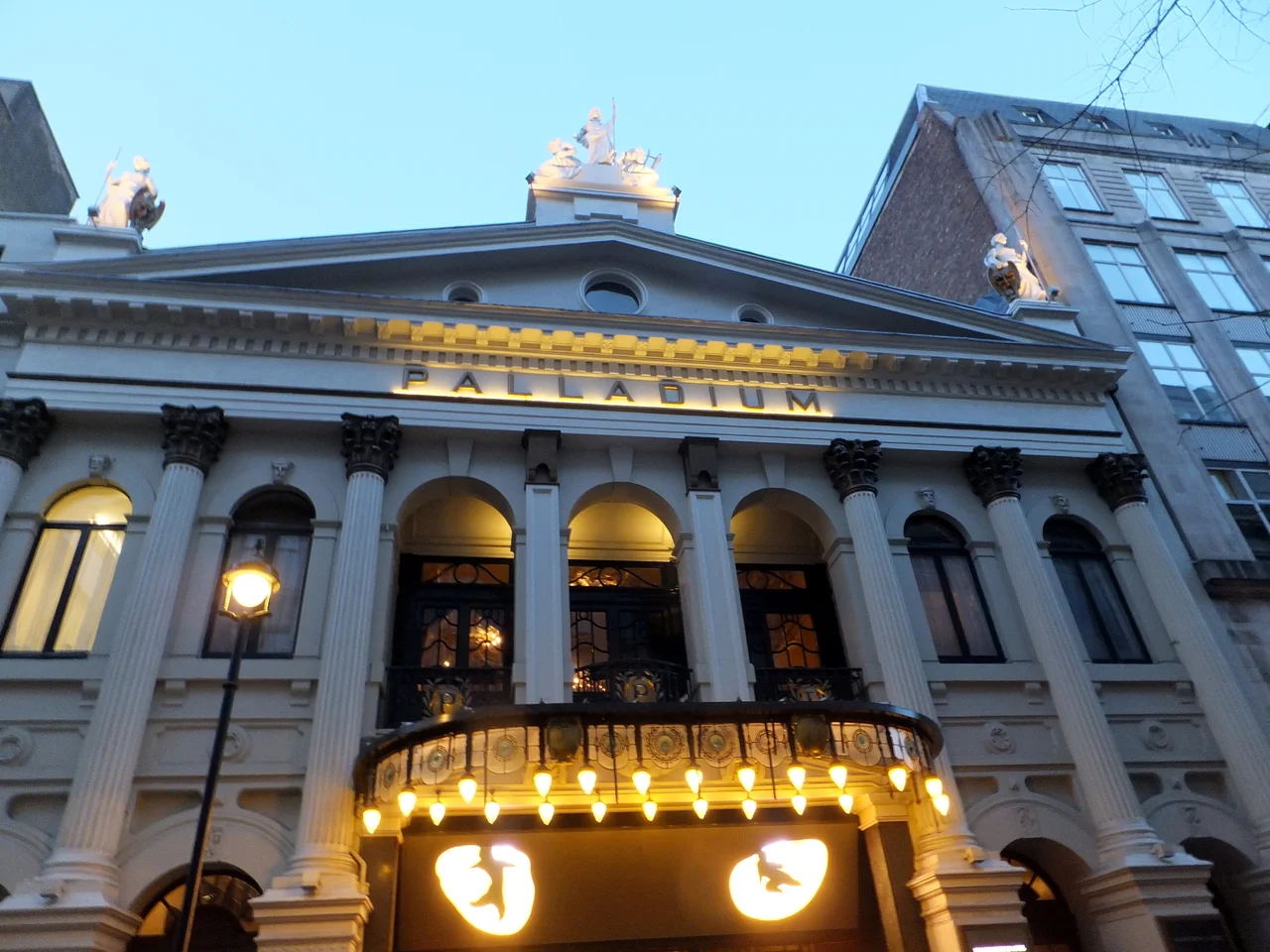
London Palladium
On the night of 13 October 1963, around eighteen million Britons tuned in to ITV to watch Sunday Night at the London Palladium, and a newspaper headline writer searching for a phrase to describe the screaming crowds outside Argyll Street settled on a word that has not aged: Beatlemania. The Beatles played for less than ten minutes. The building they played inside had already been a circus arena, a real ice rink, and the largest variety theatre in Britain, and it would survive a German parachute mine that fell through its roof in 1941 and stopped ticking just long enough for a Royal Navy bomb disposal team to defuse it. The Palladium has been on Argyll Street since 1910 — a Grade II* address that has hosted nearly every star who mattered in twentieth-century light entertainment.
The Architect Who Built Britain's Stages
Before the Palladium was a theatre, the Argyll Street site held a temporary wooden building called the Corinthian Bazaar, complete with aviary, then Hengler's Circus (a flooded ring for aquatic displays, a tightrope walker's son in charge), then the National Skating Palace, a real-ice rink that failed. When the rink fell into bankruptcy, the developers brought in Frank Matcham, the man who had already designed the London Coliseum and would design or remodel more than seventy British theatres in his career. Matcham finished the Palladium in 1910 with a 2,286-seat auditorium, an early revolving stage, and — a detail that would have astonished Edwardian London — a private telephone system so the occupants of the boxes could call one another between acts. It is the building's bones to this day, retained nearly intact through the Grade II* listing of 1960.
The George Black Years
In 1928 the Palladium was nearly bankrupt and had tried, briefly, to become a cinema. On 3 September of that year an impresario named George Black walked in as the new managing director and went back to first principles. Variety, with a capital V. Black brought over American acts at a time when most West End venues stuck to British performers — Duke Ellington gave his first ever concert-hall performance here on 12 June 1933, with Louis Armstrong, Adelaide Hall, and Ethel Waters following. In 1935 Black created the annual Crazy Gang revues, which ran at the Palladium until they moved to the Victoria Palace in 1940 and which remain his most-remembered legacy. The climax of Alfred Hitchcock's 1935 spy thriller The 39 Steps was filmed inside this building. Black ran the Palladium until his death in 1945.
The Mine That Didn't Go Off
On 11 May 1941, during the worst single night of the London Blitz, a German parachute mine smashed through the Palladium's roof and lodged itself directly above the stage. A Royal Navy bomb disposal team was dispatched. The fuse began ticking the instant it was touched. The team withdrew at speed. The mine did not detonate. After a long pause, two men cautiously returned, turned the locking ring, extracted the fuse, and disarmed the bomb. Sub-Lieutenant Graham Maurice Wright received the George Medal for the night's work. He was killed three months later, on 19 August 1941, when the troopship SS Aguila was torpedoed en route to Gibraltar. The Palladium reopened. The stage he saved went on to host Judy Garland, Frank Sinatra, Sammy Davis Jr, Bing Crosby, Bob Hope, Liza Minnelli, Ella Fitzgerald, and Lena Horne in the years that followed.
Sunday Night and the Birth of a Word
From 1955 to 1967 the Palladium was the source of the most-watched programme on British television. Sunday Night at the London Palladium aired live every week on ATV, produced by Val Parnell, owned by Lew Grade — and hosted in turn by Tommy Trinder, Bruce Forsyth, Norman Vaughan, and Jimmy Tarbuck. The Rolling Stones played the show. Petula Clark, Cliff Richard, the Beatles. On 13 October 1963, the Beatles appeared for the first time. Their publicist Tony Barrow later said Beatlemania took off in Britain the moment that broadcast went out — and a national newspaper coined the actual term in its headlines that week. The Palladium has hosted thirteen Royal Variety Performances since 1930. Bruce Forsyth, who hosted the show in the late 1950s, had his ashes laid to rest at the theatre after his death in 2017.
What Still Plays Here
The Palladium has settled into a working rhythm that mixes long musical runs with extraordinary one-night concerts. Madonna played here on her Madame X Tour in early 2020. Bob Dylan brought his Rough and Rowdy Ways tour in October 2022. Adele filmed her television comeback special An Audience with… Adele here in 2021. The current pantomime tradition is one of the oldest in London — booking writers, directors, and stars from across the British entertainment industry — and the long-running shows have included Joseph and the Amazing Technicolor Dreamcoat, Disney's Beauty and the Beast, and the Jamie Lloyd-directed Evita with Rachel Zegler in 2025, where the title number was famously delivered from the balcony to passers-by in the street below. Step out of the stage door and you are on a quiet pedestrianised stretch of Argyll Street, with the pub opposite — the Argyll Arms — still trading on a name older than the theatre.
From the Air
The London Palladium sits at 51.514°N, 0.140°W on Argyll Street, immediately north of Oxford Circus in Soho. From altitude it disappears into the dense theatre district of the West End. London Heathrow (EGLL) lies due west under both easterly and westerly approach patterns; London City (EGLC) sits east. Northolt (EGWU) and Biggin Hill (EGKB) are within general-aviation range. The Palladium is roughly a kilometre north of Trafalgar Square.
Nearby Stories
- Stevenage 5.7 km away
- Malling Abbey 5.7 km away
- 1952 Farnborough Airshow Crash 7.7 km away
- Ingatestone Hall 8.2 km away
- Hellfire Caves 9.1 km away
- The Carrington Event: The Solar Storm That Could Happen Again 9.8 km away
- Bletchley Park 16 km away
- Castle Hedingham 23 km away