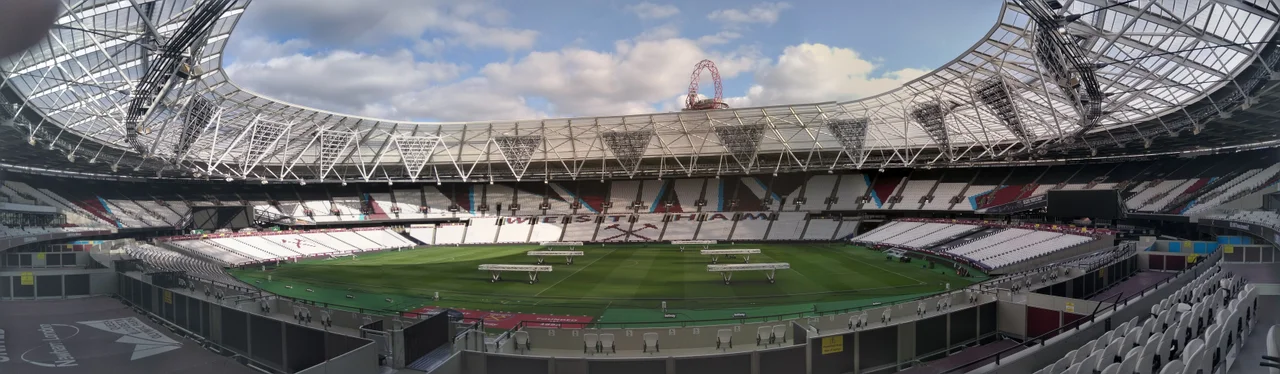

London Stadium
On the evening of 9 August 2012, the Kenyan runner David Rudisha stepped onto the track at the Olympic Stadium in Stratford to run the 800 metres final. He led from gun to tape. He ran the distance in 1 minute 40.91 seconds. He became the first man in history to break the 1:41 barrier. There was no pacemaker — Rudisha set the pace himself, from the front, the way you do when you know exactly what your body is capable of and you trust it more than you trust the field. The London 2012 Athletics meet would produce more world and Olympic records than any single Olympics had produced in athletics for years. Usain Bolt ran the second-fastest 100 metres of his career here. The American women's 4×100 metres relay team broke the East German record from 1985 that everyone had assumed would never fall. The stadium they did it in was supposed to come down afterwards. It is still standing.
Built on a Nuclear Reactor Site
The stadium sits on former industrial land in the Lower Lea Valley, on what is functionally an island formed by the River Lea and several of the Bow Back Rivers. During the planning stages it was discovered that the site had been host to Queen Mary College's department of nuclear engineering, including a small research nuclear reactor. (The reactor was decommissioned long before construction began.) Land preparation started in mid-2007. Construction officially began on 22 May 2008. The design by Sir Robert McAlpine and Populous was for a stadium that could come apart after the Games — a permanent lower bowl of 25,000 seats sunk into the soft clay, with a lightweight demountable steel and pre-cast concrete upper tier rising up to add another 55,000 for the Olympics. The structure used roughly a quarter of the steel that had gone into the 2008 Beijing 'Bird's Nest' stadium. Surplus pipes from completed North Sea gas pipelines were repurposed for the compression truss. The low-carbon concrete in the base tier had 40 percent less embodied carbon than conventional concrete. The whole thing was, by stadium standards, austere — which the architecture critics noticed.
Magnificent or a Bowl of Blancmange?
Initial reviews ran from 'magnificent' to 'a bowl of blancmange.' Tom Dyckhoff in The Times called the design 'tragically underwhelming.' Building Design's Ellis Woodman accepted the principle of dismountability as 'an obvious interest in establishing an economy of means' but argued it was 'not an architectural achievement.' Piers Gough, Amanda Levete and Charles Jencks wrote in The Guardian that 'it's an Ikea stadium.' Rowan Moore acknowledged the austere logic but pointed out that austerity is hard to sell at £486 million. The criticism wasn't unfair: where Beijing's stadium had been an instant architectural icon, London's was determinedly utilitarian. The defence, made by the design team, was that London 2012 was the antithesis of Beijing 2008 by design — a deliberately modest, deliberately temporary, deliberately sustainable answer to the spectacle. The stadium was nominated for the 2012 Stirling Prize and lost to the Sainsbury Laboratory at Cambridge. The world records went up anyway.
The Largest Video Screen Ever Built
During the opening ceremony of the 2012 Games, Danny Boyle's production used the stadium's grandstands as one continuous video display. The system was developed by Tait Technologies: 70,500 individual 'paddles,' each containing nine LED pixels, were installed between every seat. A central control system synchronised them to display video content wrapped around the entire bowl — 634,500 individual sources of light moving as one image. The Guinness Book of World Records recognised it as the largest landscape video display ever constructed. The same technology was later used at the Pyeongchang Olympic Stadium for the 2018 Winter Olympics. For an opening ceremony that included a Queen's Royal Navy parachute jump (well, a stunt double's), a James Bond cameo, Mr Bean playing Chariots of Fire, an industrial revolution emerging from a pastoral British landscape, and the lighting of a cauldron made from 204 copper petals raised by athletes from every competing nation, the stadium was, however briefly, the most theatrical room on the planet.
What Happens After the Party
The post-Olympic future of the stadium became one of the long-running British public policy disasters of the 2010s. The original plan was to downsize to a 25,000-seat athletics venue. West Ham United had been interested in the stadium since well before the bid. Tottenham Hotspur put together a competing bid in 2010 that proposed knocking the Olympic Stadium down and building a football-only ground in its place, with Crystal Palace refurbished for athletics. Leyton Orient — geographically the closest professional club to the stadium — argued that West Ham's occupancy would breach FA rules and could bankrupt them. The first bidding process collapsed in October 2011 amid legal challenges and a complaint to the European Commission about state aid. A second process resulted in West Ham being named anchor tenant in December 2012. The redevelopment cost roughly £200 million on top of the original £486 million. The conversion involved removing the demountable upper tier, adding a vast new transparent roof of 45,000 square metres covering every seat, installing retractable seating, and rebuilding the floodlights so they hung from the roof rather than sat on top of it. West Ham moved in for the 2016-17 season.
The Stadium Has Become Many Stadiums
Today, London Stadium is one of the few venues in the world to hold both UEFA Category 4 status (allowing it to host football's biggest matches) and World Athletics Category 1 status. West Ham play their home Premier League fixtures here at an expanded football capacity of 62,500. UK Athletics hosts the annual London Diamond League meeting — known variously as the Anniversary Games or the London Grand Prix — for two weeks each summer, when the retractable seating is rolled back to expose the running track. Major League Baseball brought the Boston Red Sox and the New York Yankees here on 29-30 June 2019 for the first-ever MLB regular season games in Europe, drawing on a configuration that gave the stadium a 66,000-seat baseball capacity. The Cubs and Cardinals came in 2023; further series followed. The 2015 Rugby World Cup played four pool matches and the bronze final here. The 2015 Race of Champions, Monster Jam in 2022-24, FIM World Supercross in 2025. The seats are now claret, blue and white instead of the Olympics' black-and-white shard pattern. A statue of Bobby Moore, Geoff Hurst and Martin Peters — the 1965 European Cup Winners' Cup-winning trio — stands outside in an area called Champions Place; Peters' ashes are in the statue's foundation. The stadium that nobody could decide what to do with has become, in its quiet way, almost everything.
From the Air
London Stadium sits at 51.5386°N, 0.0164°W in the southern part of Queen Elizabeth Olympic Park in Stratford, east London, about 6 miles east of the City. From the air, the unmistakable feature is the broad circular bowl with its huge white roof (one of the largest single roof structures in Europe), set among the network of Bow Back Rivers waterways. Look also for the spiral red curves of the ArcelorMittal Orbit observation tower immediately to the north, and the curved roof of the London Aquatics Centre on the eastern bank of the Waterworks River. Nearest airport: London City (EGLC), 6 miles south. Stansted (EGSS) is 26 miles north-northeast.
Nearby Stories
- Stevenage 5.7 km away
- Malling Abbey 5.7 km away
- 1952 Farnborough Airshow Crash 7.7 km away
- Ingatestone Hall 8.2 km away
- Hellfire Caves 9.1 km away
- The Carrington Event: The Solar Storm That Could Happen Again 9.8 km away
- Bletchley Park 16 km away
- Castle Hedingham 23 km away