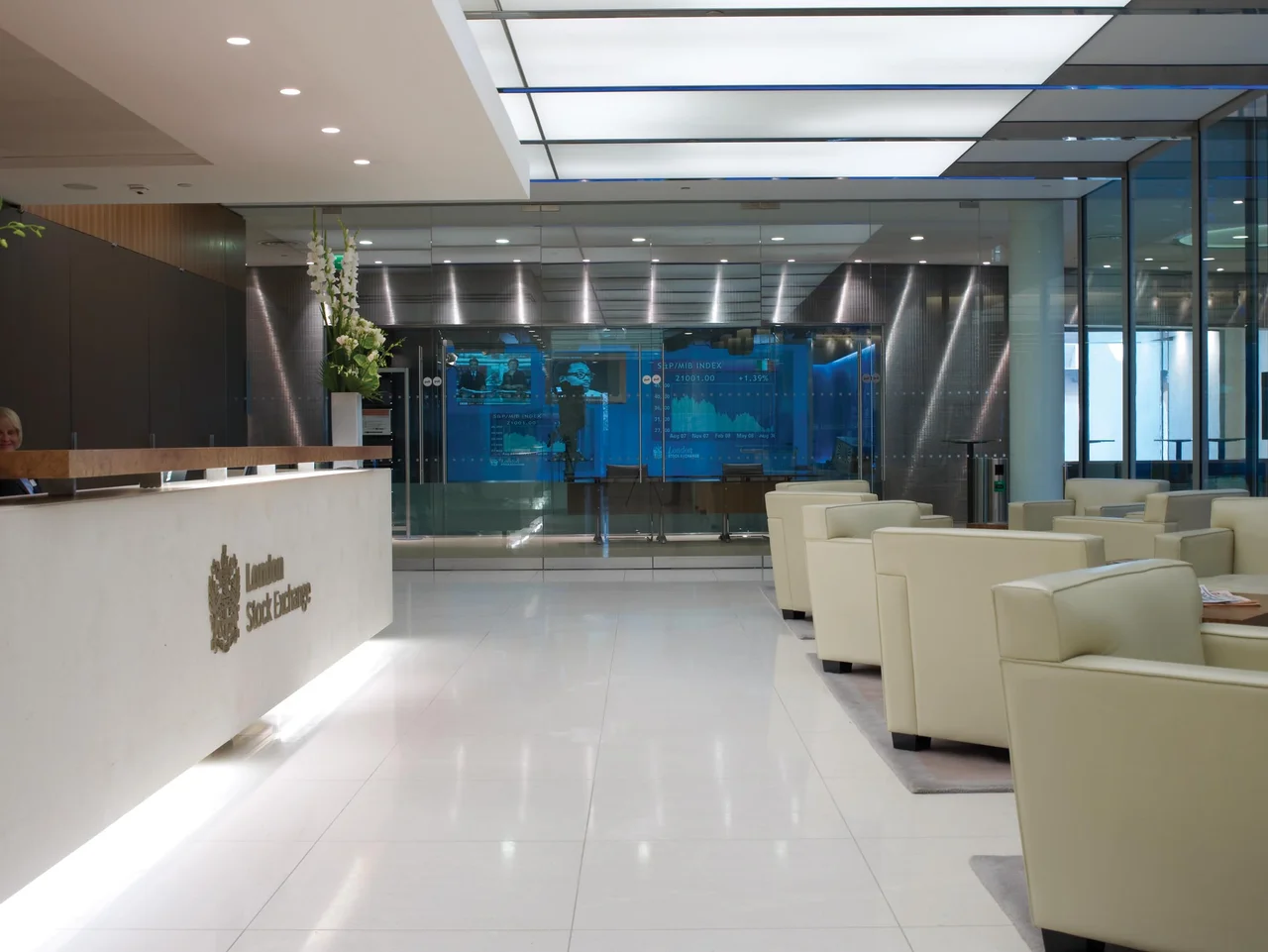

London Stock Exchange
Auctions in 17th-century London ran for the length of a candle. The bidding was open for as long as a fixed piece of tallow stood and burned. When the flame went out, the deal was done. They called it selling 'by inch of candle.' At Jonathan's Coffee-House on Change Alley in the 1690s, a broker named John Castaing started keeping a list of commodity prices — salt, coal, paper, exchange rates — published a few days a week. It wasn't yet a stock exchange. It was a coffee house with a list. From this list, this candle, and these brokers — banned from the actual Royal Exchange for what was politely called their 'rude manners' — the London Stock Exchange would grow. As of July 2024, it has a total listed market capitalisation of around US$3.4 trillion.
Exchange Alley and the South Sea Bubble
By the early 18th century, the brokers thrown out of the Royal Exchange had set up shop in the streets and coffee houses around it — Exchange Alley, Change Alley, the lanes between Cornhill and Lombard Street, conveniently close to the Bank of England. Parliament tried to regulate them with a 1697 Act that levied heavy penalties on unlicensed brokers and capped the legal number at 100. The cap kept getting raised as the trade grew. Then came the South Sea Bubble — the 1720 collapse of the South Sea Company, the first great speculative bust in English financial history, which left countless investors ruined and politicians implicated. Traders became wary of 'bubbles.' Parliament passed a clause preventing 'unchartered' companies from forming. After the Seven Years' War (1756–1763), trade revived. In 1773, 150 brokers formed a club and opened a new and more formal Stock Exchange in Sweeting's Alley. There was a set entrance fee. The candles, finally, went out. The Subscription Room, created in 1801, was the first regulated exchange in London — though on opening day, non-members had to be expelled by a constable.
Capel Court and Capital Punishment
William Hammond laid the first foundation stone for a permanent building at Capel Court on 18 May 1801. By 30 December that year, 'The Stock Exchange' was incised on the entrance. The first codified rule book emerged from a General Purpose Committee report in February 1812. The Exchange grew quickly as the British government, fighting the wars against Napoleon, needed astronomical sums to keep its armies and navies in the field — and used the organised market it had once derided to raise them. By June 1853 the Exchange had outgrown its space; Thomas Allason was appointed architect and a new brick building, inspired by the Great Exhibition, opened in March 1854 with twice the floor space. The technologies that would transform the work — telephone, telegraph, ticker tape — arrived in the late 19th century. The Exchange's motto, granted with its own coat of arms in 1923, was Dictum Meum Pactum: 'My word is my bond.' For a place that started as bankers banned for rudeness, the dignity was hard-won.
Closed for Six Months
When World War I broke out at the end of July 1914, the Exchange closed almost immediately. Prices had surged on fears that foreign banks would call in loans. The August Bank Holiday was extended by Parliament to prevent a run on the banks. The committee shut the trading floor entirely. It did not reopen until 4 January 1915 — nearly six months — and even then under heavy restrictions: transactions in cash only. Nearly a thousand members quit between 1914 and 1918. In December 1940, during the Blitz, the Exchange's trading floor was hit by incendiary bombs; they were extinguished quickly, but trading thereafter moved largely to telephone to reduce casualties. The Exchange only closed for one additional day during the entire Second World War — in 1945, after damage from a V-2 rocket. Trading continued from the basement. The building, like the city, kept working through everything that was thrown at it.
The Bomb in the Visitors' Gallery
On the morning of 20 July 1990, the Provisional Irish Republican Army telephoned Reuters with a warning. They said a bomb had been placed at the London Stock Exchange. Police evacuated the relevant area. At 8:49 a.m., the bomb went off in the men's toilets behind the visitors' gallery, ripping a hole in the 23-storey Stock Exchange Tower on Threadneedle Street and sending glass and concrete down to the street below. The warning meant nobody was injured. Police later said that without it, the casualty toll would have been very high. The visitors' gallery reopened briefly but closed permanently in 1992 — partly because of security, but mostly because the long-term shift to electronic trading was already making physical visits to the trading floor a vestige. The bomb didn't kill the gallery. The screens did. The IRA had only accelerated what was already happening.
Big Bang and What Followed
On 27 October 1986, the UK financial markets were deregulated in a single coordinated set of changes. The phrase 'Big Bang' was coined for it. Fixed commission charges were abolished. The distinction between stockjobbers (who held inventory) and stockbrokers (who served customers) was eliminated. Open-outcry trading on the floor was replaced by electronic, screen-based trading. The Stock Exchange Tower's 23,000-square-foot trading floor, opened by Queen Elizabeth II on 8 November 1972, became largely redundant within months. Foreign ownership of British firms was permitted. The City of London transformed in roughly five years from an old-boys'-network closed shop into one of the most aggressively internationalised financial centres in the world. The Alternative Investment Market (AIM) launched in 1995 for smaller and growth-focused companies. The Electronic Trading Service (SETS) launched in 1997. In 2000, the Exchange itself became a public limited company. In 2004 it moved to its current home at Paternoster Square, near St Paul's Cathedral. In 2007 it merged with Borsa Italiana to form the London Stock Exchange Group. In October 2011, Occupy London tried to occupy Paternoster Square; police sealed off the entrance — the square is private property — and the protesters moved to St Paul's instead. In April 2019, thirteen Extinction Rebellion activists glued themselves into a chain across the LSE's entrances, blocking access. In March 2022, the Exchange suspended trading in GDR securities for Russian firms following the invasion of Ukraine. The candle is long out. The market keeps trading.
From the Air
The London Stock Exchange sits at 51.5153°N, 0.0992°W in Paternoster Square, immediately north of St Paul's Cathedral in the City of London. From the air, look for the unmistakable dome of St Paul's — the Exchange occupies the modern stone-and-glass blocks just to its north, in a deliberately understated paved square. The Bank of England and the dense glass towers of the City's eastern edge sit to the east. Nearest airport: London City (EGLC), 6 miles east. Best viewed at low altitude on approaches into London City or on Thames-following routes.
Nearby Stories
- Stevenage 5.7 km away
- Malling Abbey 5.7 km away
- 1952 Farnborough Airshow Crash 7.7 km away
- Ingatestone Hall 8.2 km away
- Hellfire Caves 9.1 km away
- The Carrington Event: The Solar Storm That Could Happen Again 9.8 km away
- Bletchley Park 16 km away
- Castle Hedingham 23 km away