
Lubang Buaya
The name means "crocodile pit," and it was literal. A Betawi cleric named Syarif Hidayatullah dug a water hole here and found the swamp teeming with reptiles. For centuries, Lubang Buaya was nothing more than a patch of wetland on Jakarta's eastern outskirts, known only to locals who understood why crocodiles gathered where the water pooled. Then came the night of September 30, 1965, when a group of soldiers carried out one of the most consequential acts of violence in Indonesian history -- and this forgotten swamp became a name that every Indonesian would learn to recognize.
The Fifth Force
By mid-1965, Indonesia was a political pressure cooker. President Sukarno, the charismatic founding father who had led the country since independence, called on May 31 for the creation of a "fifth force" -- armed workers and peasants who would stand alongside the Army, Navy, Air Force, and police. Army commander Lieutenant General Ahmad Yani opposed the idea fiercely. But training began anyway, in the swampy ground near Halim Perdanakusuma Air Force Base, under the control of Major Sujono, commander of the base's ground defense. Among the trainees were members of Pemuda Rakyat, a youth organization affiliated with the Indonesian Communist Party, or PKI. The location of their training camp was the place the locals called Lubang Buaya.
A Night of Abductions
In the early hours of October 1, 1965, groups of soldiers moved through Jakarta in trucks, targeting the homes of senior army generals. Six generals and one lieutenant were seized. Ahmad Yani, the man who had stood against the fifth force, was shot at his home when he resisted. The other officers were brought to Lubang Buaya, where they were killed and their bodies thrown into an abandoned well. The 30 September Movement, as the conspirators called themselves, announced over the radio that they had acted to protect President Sukarno from a council of generals plotting a coup. Within hours, Major General Suharto -- who had not been on the abduction list -- rallied loyal army units and began taking control. The seven dead officers became known as the Pahlawan Revolusi, the Revolution Heroes, and their deaths became the justification for a political upheaval that would consume hundreds of thousands of lives.
What the Monuments Tell
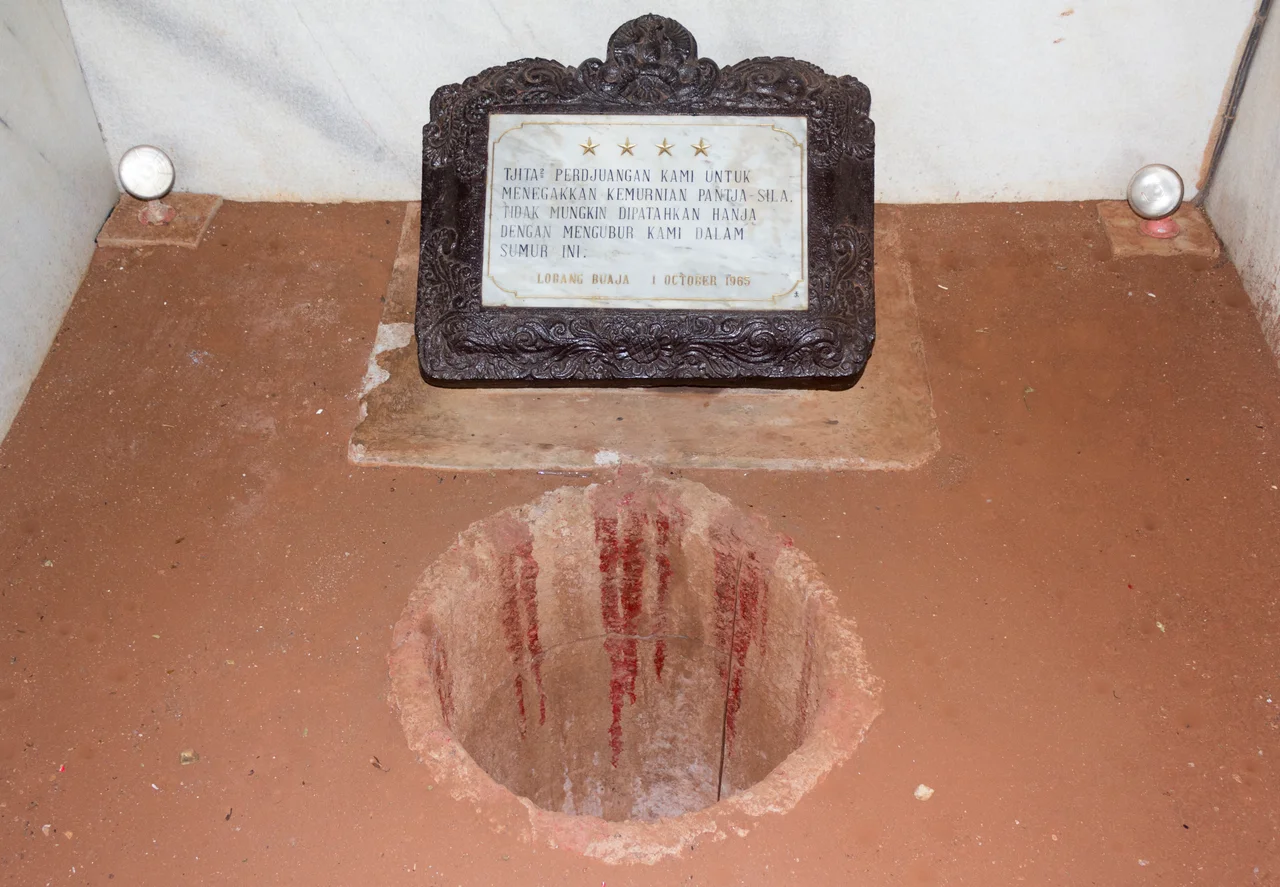
Today, Lubang Buaya is a memorial complex saturated with the official narrative of the New Order regime that Suharto built in the aftermath. The well where the generals' bodies were recovered is protected by a pavilion. A plaque bears a defiant inscription attributed to the fallen: "It is not possible that the aspirations of our struggle to uphold the purity of Pancasila will be defeated by merely burying us in this well." Nearby stands the Sacred Pancasila Museum, opened by Suharto on October 1, 1981, with nine dioramas depicting the events before and after the coup attempt. A separate Museum of PKI Treason, built in 1990, contains 34 dioramas portraying acts allegedly committed by the Communist Party throughout Indonesian history. Life-sized dioramas depict the alleged torture of the kidnapped generals. Four vehicles sit preserved on the grounds: Yani's official car, the jeep Suharto used during the crisis, a truck used by the kidnappers, and a Saracen armored car that transported the recovered bodies.
Contested Memory
For decades under the New Order, October 1 brought an annual ceremony to Lubang Buaya, attended by the president and senior officials. Schoolchildren watched a dramatized film of the events every year on television. The narrative was singular and enforced: the PKI planned and executed the murders, and Suharto saved the nation. But historians have long questioned this version. The events of that night triggered one of the twentieth century's largest episodes of mass violence, as the army and allied militias killed an estimated 500,000 to over one million people accused of communist sympathies across Indonesia in the months that followed. Scholars like John Roosa have argued that the coup attempt served as a pretext for this purge. The people who died in those months -- farmers, teachers, union members, ethnic Chinese Indonesians -- had no monuments, no pavilions, no preserved vehicles. At Lubang Buaya, the story told is one of seven murdered generals. The larger story, of the hundreds of thousands who perished in the violence that followed, remains largely uncommemorated in Indonesia's physical landscape.
From the Air
Lubang Buaya is located at 6.29S, 106.90E on the eastern outskirts of Jakarta, adjacent to Halim Perdanakusuma Air Force Base (WIHH). The memorial complex is visible as a green patch amid dense urban development. Approaching from the east, you'll see the Halim runway and the memorial grounds just to its south. Soekarno-Hatta International Airport (WIII) lies 35 km to the northwest. Best viewed at 2,000-3,000 feet AGL for context of the site's proximity to the airbase.
Nearby Stories
- Battle of Kalijati 9.1 km away
- The Ciliwung: A River That Built and Broke a Capital 23 km away
- Lion Air Flight 610 24 km away
- The Crossing at Silebu 33 km away
- The Cruiser That Wouldn't Stop Fighting 45 km away
- Battle of Tjiater Pass 59 km away
- Ujung Kulon National Park 134 km away
- The Islands That Vanished from Sight 313 km away