
Sixty Thousand Experiments on Eighteen Acres
Luther Burbank commuted to work by bicycle. Every morning, the most famous horticulturist in America pedaled seventeen miles round trip from his home in Santa Rosa to an eighteen-acre farm outside Sebastopol, California, in a district the locals called Gold Ridge. He did this for forty years. The farm was his laboratory - not the tidy, climate-controlled kind, but the sprawling, dirt-under-the-fingernails kind where 60,000 plant experiments ran simultaneously and a crew of fifteen to twenty workers tended rows of trees, shrubs, and perennials that Burbank was crossing, grafting, and selecting with the patient urgency of a man who believed he could improve nature itself. Today, three of those eighteen acres survive. The rest became senior housing. But those three acres still hold over 250 living specimens of Burbank's work - plants he bred more than a century ago, still growing, still bearing fruit.
Why Sebastopol
Burbank bought the Gold Ridge Farm in 1885, a decade after arriving in California. His four-acre nursery in Santa Rosa had been enough for early experiments, but perennial plants, fruit trees, and shrubs required space his city lot could not provide. He chose Sebastopol for a reason that reveals how carefully he thought about growing conditions: the Gold Ridge District offered subtle variations in environment, exposure, and elevation across a relatively small area. A south-facing slope behaved differently from a north-facing one. A hollow caught frost that a hilltop avoided. These microclimates allowed Burbank to test how the same plant varieties performed under slightly different conditions - a natural laboratory that no greenhouse could replicate. He started with ten acres, added five more in 1904, and another three in 1906, eventually working eighteen acres at the farm's peak.
The Scale of Ambition
The numbers that emerged from Gold Ridge Farm border on the unbelievable. At its peak, Burbank maintained over 60,000 concurrent plant experiments across the property. He was developing new varieties of plums, peaches, quinces, and berries alongside ornamental flowers, grasses, and even spineless cacti intended as livestock feed for arid regions. One apple tree on the property - still alive today - produces twenty-five different varieties of apples, each grafted onto the same rootstock, blossoming and ripening at different times throughout the season. It is a single tree that functions as an orchard. Burbank's methods were empirical rather than genetic: he crossbred vast numbers of plants, observed the results, and ruthlessly culled anything that did not meet his standards. For every variety he introduced, thousands were discarded. The farm was less a garden than a factory of possibility, and Burbank was both its foreman and its artist.
Decline and Rescue
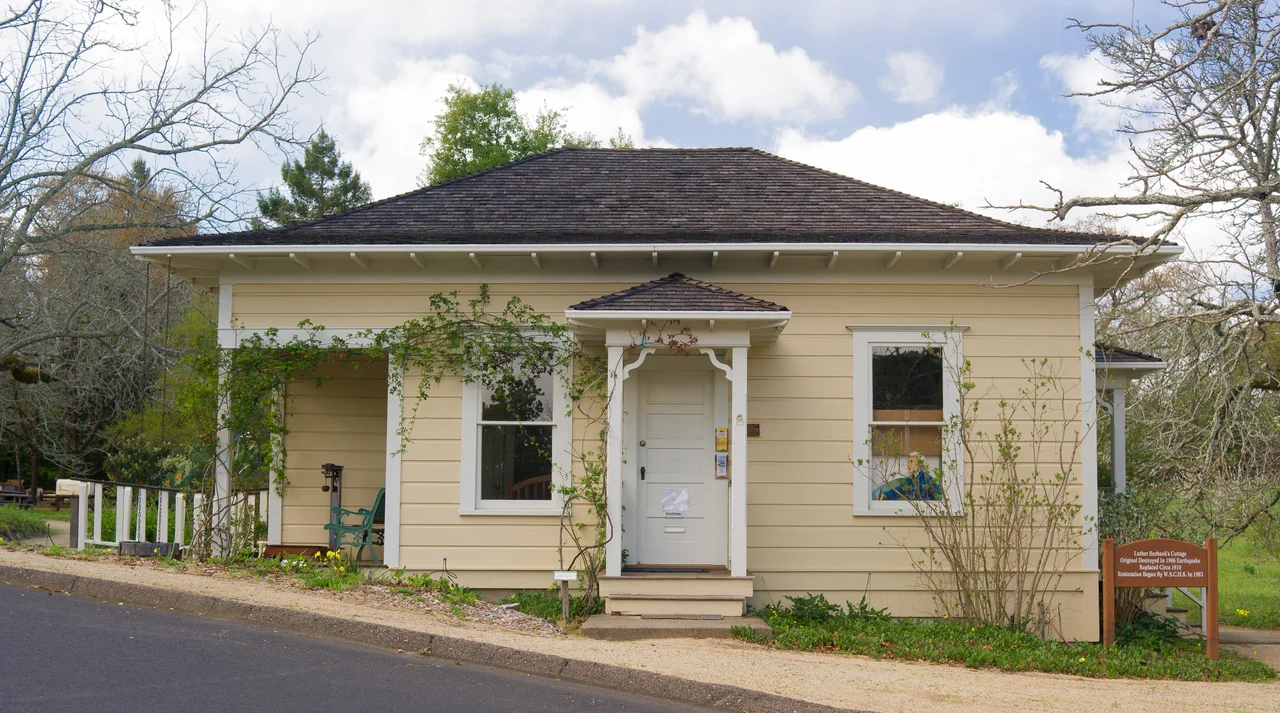
Failing health forced Burbank to sell roughly three acres of his holdings in 1923. He died three years later, on April 11, 1926, and the farm began a slow slide into neglect. Representatives from Stark Brothers Nursery in Missouri - one of Burbank's most influential commercial clients - traveled to Sebastopol to catalog the remaining plants, but after that inventory, the property fell into disuse. Decades passed. The potting shed burned in the late 1960s. The original caretaker's cottage had already been lost to the 1906 San Francisco earthquake and replaced a year or two later with a simpler structure. By the mid-1970s, the farm was a shadow of what Burbank had built. Then Elizabeth Waters Burbank, Luther's widow, intervened. In 1974, she donated the remaining fifteen acres to the Sebastopol Area Housing Corporation for senior and low-income housing - but with a crucial stipulation: three acres containing the caretaker's cottage, the barn, and over 250 living specimens of Burbank's work must be preserved as a historical and horticultural area, undisturbed, for future generations.
Living Legacies
The Western Sonoma County Historical Society formed specifically to honor Elizabeth Burbank's stipulation. Local volunteers banded together with the original mission of preserving and maintaining Gold Ridge Farm, and their stewardship has held for half a century. The property was placed on the National Register of Historic Places in 1978, and in 1995, the City of Sebastopol acquired the title, leasing the farm back to the historical society for management. Today, visitors walk the three remaining acres at 7777 Bodega Avenue, about a mile west of downtown Sebastopol, on docent-led or self-guided tours. They encounter Burbank-era plants that are still producing: Santa Rosa plums, freestone peaches, Shasta daisies, Chinese quinces, and a trifoliate orange tree from China that can withstand temperatures its tropical relatives cannot. These are not museum replicas. They are the original plants - or their direct descendants - tended by the same soil and Sonoma County light that Burbank chose them for. The man his contemporaries called "The Plant Wizard" has been dead for a century, but his experiments at Gold Ridge are still running.
From the Air
Located at 38.40°N, 122.83°W in Sebastopol, California, at 7777 Bodega Avenue, approximately one mile west of downtown. The three-acre preserved farm is a small green parcel surrounded by the senior housing development built on the remainder of Burbank's original eighteen acres. Nearest airports: Charles M. Schulz-Sonoma County Airport (KSTS) approximately 10 nm north-northeast; Gnoss Field (KDVO) in Novato approximately 28 nm southeast. Best viewed below 2,000 feet to distinguish the farm from surrounding development. The rolling terrain of the Gold Ridge District is visible, with orchards and vineyards typical of western Sonoma County in all directions.
Nearby Stories
- The Bottle That Humbled France 1.8 km away
- The Bay on the Fault Line 2.9 km away
- Dry Creek Rancheria Band of Pomo Indians 3.6 km away
- The Sea Ranch 6.8 km away
- The Cipher at the Crosshairs 7.7 km away
- Yocha Dehe Wintun Nation 20 km away
- Gualala River 42 km away
- ʻAkaka Falls State Park 3668 km away