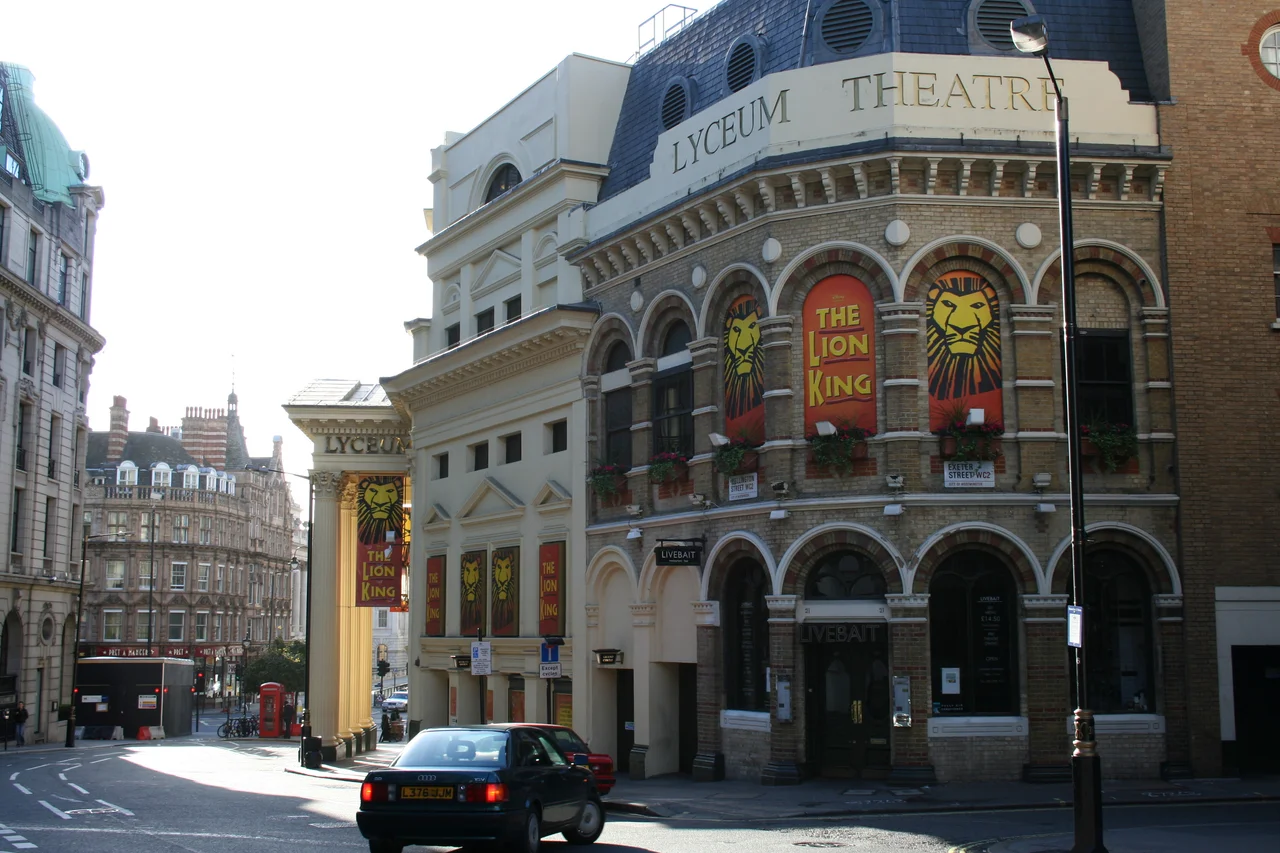

Lyceum Theatre, London
The man who inspired Dracula spent twenty-four years on this stage. Henry Irving, the great Victorian tragedian with his sweeping gestures and gentlemanly menace, ran the Lyceum from 1878 to 1902. His business manager - the Irishman who handled the books and the touring schedules and the temperamental leading actors - was Bram Stoker. Watching Irving night after night in villain roles, watching that long pale face and those theatrical hands, Stoker found his Count. He hoped Irving would play the part in a stage adaptation of the 1897 novel. Irving never agreed. But the play was produced at the Lyceum anyway, and the Wellington Street theatre off the Strand became, in a roundabout way, the birthplace of every vampire that followed.
Before Irving
The site has been hosting performances since 1765, when James Paine built a room for the Society of Artists with its entrance on the Strand. The artists' exhibitions failed and the building was rented out for whatever turned a profit: musical entertainments by Charles Dibdin, performances by David Garrick, a circus brought by Philip Astley when his amphitheatre at Westminster burned down, a chapel, a concert room, the first London showing of Madame Tussauds' waxworks in 1802. The composer Samuel Arnold rebuilt the interior in 1794 and again in 1816, opening it as the English Opera House. It was here, on 9 May 1811, that Mozart's Cosi fan tutte received its London premiere, and on 6 August 1817 that British theatre saw its first stage lit by gas. Fire took it all in 1830.
The Present House
Samuel Beazley designed the building that stands today, set slightly to the west of the original site with its frontage on Wellington Street. It opened in 1834 as the Theatre Royal Lyceum and English Opera House, cost £40,000, and had a quirk you can still see: a balcony that overhangs the dress circle, an arrangement nearly unique in London. Peto and Grissell, the partnership that built it, would later go on to construct Nelson's Column and Trafalgar Square's fountains. The early house staged adaptations of Dickens novels - Martin Chuzzlewit ran for over a hundred performances in 1844-45 - and James Planche's fairy extravaganzas, riots of trapdoor magic and painted scenery that fed Victorian London's hunger for spectacle. Dickens himself consulted on Tom Taylor's 1860 adaptation of A Tale of Two Cities, fresh from the press.
Irving Years
In 1871 Henry Irving arrived under the management of the Batemans, opening in The Bells as a ghost-haunted burgomaster. The play ran 150 nights, a freakish length for the time. Charles I followed for 180, Hamlet in 1874 for 200. When old Mr Bateman died, Irving made it clear to his widow that he wanted actors, not dolls; she gave way and went to Sadler's Wells. From 1878 Irving ran the theatre himself, and from that same year he was on stage with Ellen Terry, the partnership lasting until 1902. Their Merchant of Venice in 1879 ran 250 nights. Much Ado, Romeo and Juliet, King Lear, Macbeth with incidental music by Arthur Sullivan, Henry VIII, Becket by Tennyson - the bill reads like a course in Victorian Shakespeare. When the pair toured America from 1883 onward, the Lyceum hosted Sarah Bernhardt, Eleonora Duse, Mrs Patrick Campbell. The 1898 summer brought Coquelin's Cyrano.
From Ballroom to Lion King
Thomas Barrasford bought the place in 1904, gutted everything but the facade and portico, and had Bertie Crewe redecorate the interior in rococo curls and gilding. Music hall and variety failed against the Coliseum, so the Lyceum settled back into drama, and from 1909 to 1938 the Melville Brothers ran spectacular melodramas. The London County Council bought the building in 1939 to demolish it for road widening; John Gielgud, Ellen Terry's great-nephew, closed the theatre with Hamlet that year. The road never came. By 1945 the place was a ballroom hosting big bands; Miss World was crowned here every year from 1951 to 1968; T. Rex, the Sex Pistols, Bob Marley, The Clash, Led Zeppelin, Queen, U2, Pink Floyd and The Smiths all played the same boards Irving had paced. Restored as a theatre by Holohan Architects in 1996, the Lyceum reopened with Jesus Christ Superstar. Since 24 September 1999, the Disney production of The Lion King has lived here. Its tenth anniversary celebration packed 250 former cast members onto the stage with director Julie Taymor and James Earl Jones, the original animated film's Mufasa. The orchestra pit flooded twelve feet deep during lockdown in May 2020. The show came back in July 2021.
From the Air
The Lyceum sits at 51.5116° N, 0.1198° W on Wellington Street, just off the Strand in central London. From above, look for the wedge between the Strand and Covent Garden Market, with the curve of Aldwych to the east. London Heliport (EGLW) handles the city's helicopter traffic; London City (EGLC) lies east, Heathrow (EGLL) west. Central London airspace is Class A; recommended only as a sightseeing target from authorised tour helicopters. From ground level, the easiest landmark is the grand portico - one of the only original Beazley details that has survived continuous redevelopment since 1834.
Nearby Stories
- Stevenage 5.7 km away
- Malling Abbey 5.7 km away
- 1952 Farnborough Airshow Crash 7.7 km away
- Ingatestone Hall 8.2 km away
- Hellfire Caves 9.1 km away
- The Carrington Event: The Solar Storm That Could Happen Again 9.8 km away
- Bletchley Park 16 km away
- Castle Hedingham 23 km away