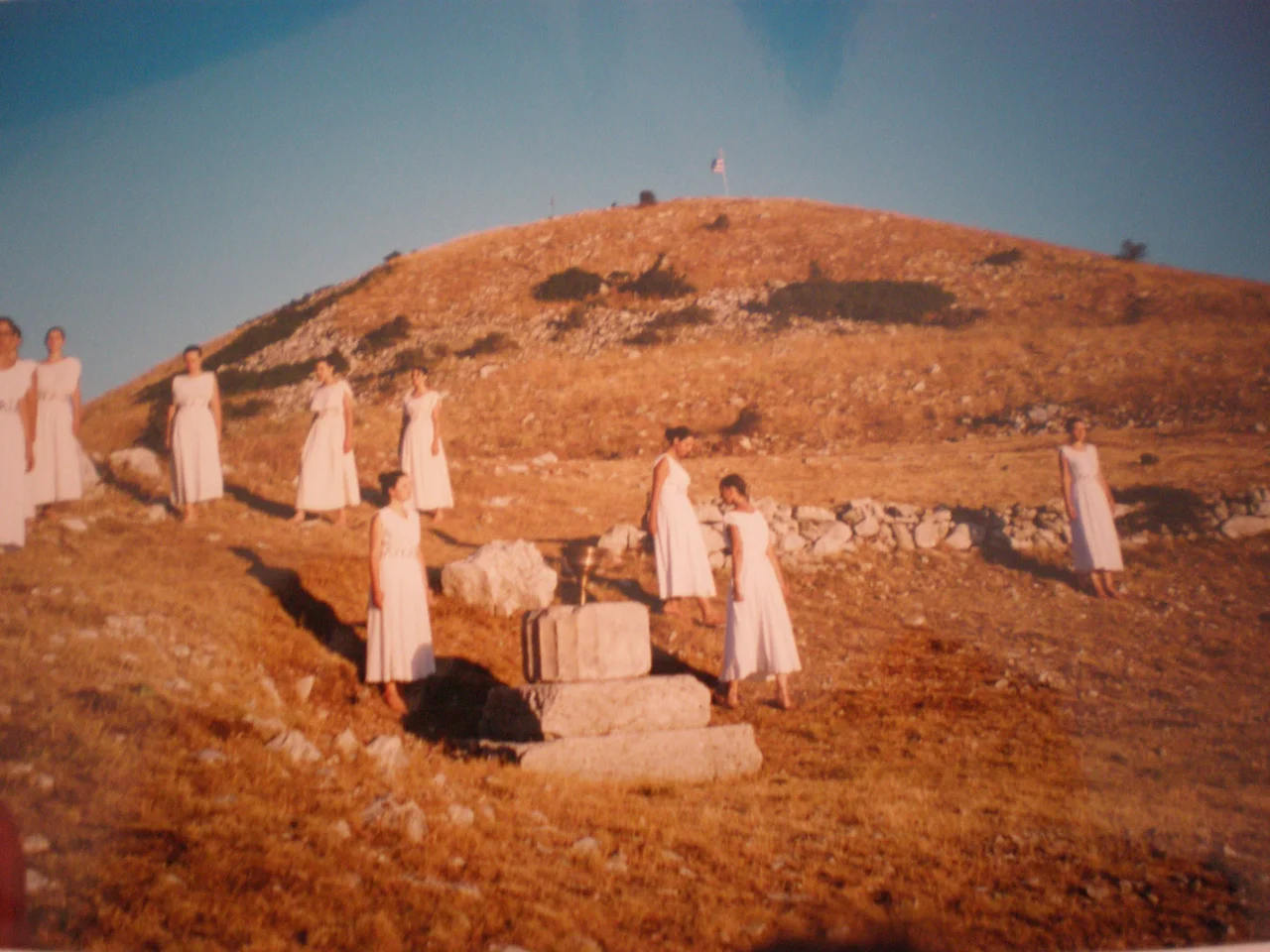

Lykaia
The festival had a rule that almost no Greek festival had: outsiders were not allowed to watch. When the traveler Pausanias visited Mount Lykaion in the 2nd century CE, he saw the ash-pile altar at the summit and acknowledged that he could learn nothing further about what happened there. He decided, he wrote, to "let it be as it is and as it was from the beginning." That silence was part of the Lykaia's design. It was one of the oldest festivals in Greece, held every four years on "Wolf Mountain" in the heart of Arcadia, and whatever its inner rites involved, they were protected by a secrecy so complete that even ancient writers could only report rumors.
Zeus Lykaios and the Founding Myth
The epithet Lykaios — "wolf-Zeus" — belongs to Zeus only in the context of the Lykaia, which was the main Arcadian religious festival. The name connects to Lycaon, the mythical king of Arcadia, whose story became one of Greek mythology's most disturbing: he invited the gods to a banquet and served them human flesh to test whether his guests were truly divine. Zeus overturned the table and struck down Lycaon's house with a thunderbolt. In some versions of the myth, Zeus transformed Lycaon into a wolf — an early instance of what later traditions called lycanthropy. The founding myth of the Lykaia therefore carried violence at its center: a god offended by a human transgression, and punishment swift and metamorphic. The festival seems to have retained this founding tension throughout its history.
Rumors, Rites, and the Werewolf Tradition
What ancient Greeks said about the Lykaia's inner rites was always secondhand, always hedged. According to Plato, a particular clan gathered on the mountain every nine years to sacrifice to Zeus Lykaios, mixing a morsel of human entrails with the animal's portions. Whoever ate the human flesh was said to be transformed into a wolf, and could return to human form only if he abstained from human flesh for nine years thereafter. The traveler Pausanias recorded a specific story: the Olympic boxing champion Damarchus of Parrhasia had "turned into a wolf at the sacrifice to Zeus Lykaios, and changed back into a man again in the ninth year thereafter." Scholars have read this tradition as a mythologized rite of passage for adolescent males — the epheboi — in which the nine-year transformation period maps onto a period of social liminality before full adult status. No ancient writer claims to have witnessed the rite directly. The rumors were what circulated. The ritual itself stayed secret.
The Precinct Where No Shadows Fell
Several sites on the mountain were associated with the Lykaia. Near the ash altar at the summit lay a forbidden precinct — the temenos — which humans were said not to enter under any circumstances. Anyone who crossed into it would die within the year. Within the precinct, according to tradition, no creature cast a shadow, human or animal. There was also the cave of Rhea, the Kretaia, where local tradition held that Zeus was born and was tended by nymphs. A sanctuary of Pan stood nearby. The mythological geography of the mountain was dense: creation story, forbidden space, nocturnal sacrifice, and athletic games all overlaid on the same terrain. When the games later moved to Megalopolis in the 4th century BCE — when that city was founded in 371 BCE — the Arcadians continued to sacrifice on the mountaintop, keeping the older ritual alive alongside the reorganized civic festival.
The Modern Lykaia
The ancient Lykaia were one of four major athletic festivals of the Greek world — ranked alongside the games at Elis, Athens, and Argos in terms of antiquity, with debate among ancient writers about their precise order of institution. In 1973, the Ano Karyes Association "O Lykaios Dias" reestablished the games on the same mountain. They take place every four years, usually in early August. The modern ceremony begins with the lighting of a flame on the sacred peak by the Estiades, women who carry the Arcadian flame from the north. A head priestess recites the Lycean Ode by Pindar. A torch-bearer runs to the stadium and lights the altar. Winners receive an olive branch rather than monetary prizes — the motto is "Laurels, not prizes." The 13th modern Lykaia were held from July 31 to August 7, 2022. The games connect a living community to a tradition that is, at its core, more than five thousand years old.
From the Air
The Lykaia festival site is located at approximately 37.457°N, 21.975°E on the slopes and summit of Mount Lykaion in Arcadia, at elevations ranging from the valley stadium (roughly 1,200 m) to the summit ash altar (1,382 m). The mountain's two peaks — Stefani to the north and St. Ilias to the south — are clearly distinguishable from altitude as a prominent ridge rising above the surrounding Peloponnese terrain. The nearest major airport is LGKL (Kalamata International), approximately 80 km to the south-southwest. Approach from the west offers clear views of the mountain profile; the valley between the peaks where the ancient hippodrome and stadium stood is visible in favorable lighting conditions.
Nearby Stories
- Battle of Meligalas 5 km away
- Battle of Picotin 13 km away
- Kastanitsa 13 km away
- Phlius 14 km away
- Cleitor 16 km away
- Pyramid of Hellinikon 16 km away
- Agios Andreas, Katakolo 19 km away
- Strofades 39 km away