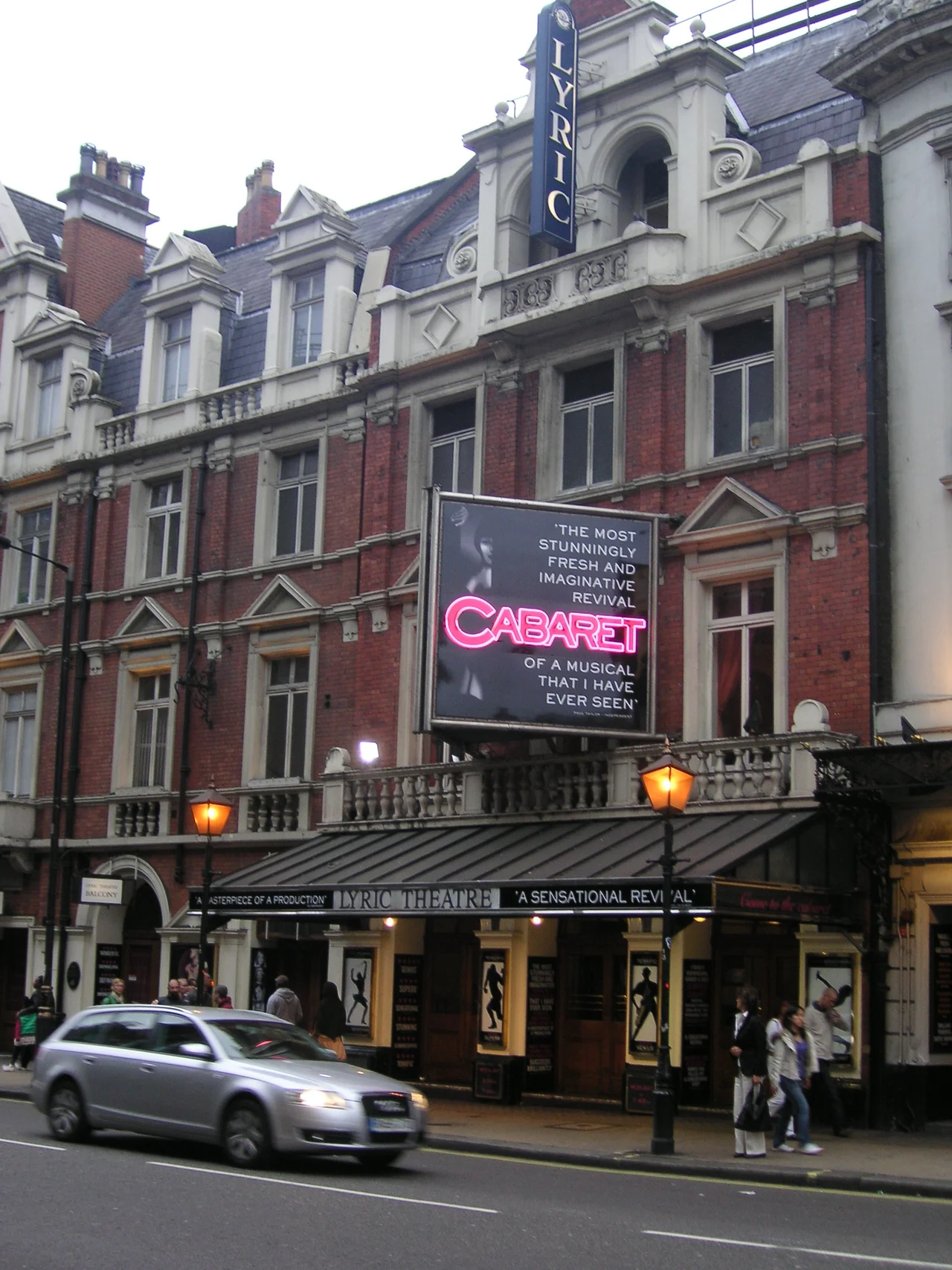

Lyric Theatre, London
Henry Leslie made £100,000 from one operetta and decided to put a theatre on Shaftesbury Avenue. The operetta was Dorothy, by Alfred Cellier and B. C. Stephenson, a light comedy that played 931 performances - an extraordinary run for the 1880s. Leslie commissioned C. J. Phipps, the architect of the Savoy and Her Majesty's, to design him a four-tier house with a capacity of 1,306. On 17 December 1888, the Lyric Theatre opened with the 817th performance of Dorothy, transferred wholesale from the Prince of Wales. Leslie made a curtain speech promising to model himself on the Paris Opera-Comique. He went broke within three years. The theatre, however, is still here - the second built on Shaftesbury Avenue and the oldest surviving.
An Old Wall at the Back
Push through into the rear of the building and you find something strange: an original 1767 house front, preserved inside the structure. It belonged to the surgeon and anatomist Sir William Hunter, whose former house and museum stood here long before any theatre. Phipps wrapped his building around it. The Lyric sits on a corner site between Shaftesbury Avenue, opened in the late 1880s as London's grand new theatrical artery, and the older Georgian street pattern beneath it. The four tiers were later reduced to about 900 seats, but the bones are Victorian. The facade was restored in 1994, and the interior, though refurbished many times, still feels like a theatre that has been a theatre since electricity was new.
Comic Operas and Roman Christians
Horace Sedger, who took over from the bankrupted Leslie, ran the theatre on a then-enormous £6,500 a year rent and gave London Eleonora Duse's first British appearance in 1893. He also produced W. S. Gilbert's Mountebanks with Alfred Cellier in 1892, hoping for Dorothy lightning to strike twice. It didn't, and Sedger followed his predecessor into bankruptcy. The Lyric's most unexpected hit came in 1896: Wilson Barrett's The Sign of the Cross, about a Roman patrician converted to Christianity by a Christian woman's love, ran for 435 performances and brought people into a theatre who had never set foot in one before. Sarah Bernhardt and Gabrielle Rejane played seasons in 1897 and 1898. In 1902, Johnston Forbes-Robertson's Hamlet here drew the critic Max Beerbohm to write: 'He shows us, for the first time, Hamlet as a quite definite and intelligible being.'
The Chocolate Soldier
In 1910 the Lyric staged The Chocolate Soldier, an operetta by Oscar Straus that turned Bernard Shaw's Arms and the Man into Viennese light music. Shaw despised it, calling the result 'that degradation of a decent comedy into a dirty farce.' The public ignored him. The Chocolate Soldier ran 500 performances, and Shaw watched his anti-war satire become exactly the romantic nonsense he had written it to undermine. The pattern recurred. In 1936 J. B. Priestley's Bees on the Boatdeck, directed by and starring Ralph Richardson and Laurence Olivier, flopped. In 1970 Peter Shaffer's The Battle of Shrivings, with John Gielgud as a celibate vegetarian philosopher, was reviewed as 'the biggest flop of his career.' Even in 1984 the dark comedy Loot brought tragedy when its star Leonard Rossiter died in his dressing room mid-performance; the run continued with a replacement.
The Long Runners
The Lyric has carried some of the West End's defining long runs. Irma La Douce opened in July 1958 and stayed until March 1962, racking up 1,512 performances with Elizabeth Seal and Keith Michell. Robert and Elizabeth, a 1964 musical about the elopement of Robert Browning and Elizabeth Barrett, hit 948. Alan Bennett's Habeas Corpus, starring Alec Guinness as the medical philosopher and furtive lecher Dr Wicksteed, played 543. Willy Russell's Blood Brothers had its London debut here in 1983, won the Olivier for Best New Musical, and seeded the long-running revival that followed. The Lyric also briefly hosted Pinter's The Birthday Party in 1975 - the first major London revival since what The Times had called 'its famous flop' in 1958.
Twenty-first Century
Andrew Lloyd Webber's Really Useful Group bought the theatre in 2000; Nimax Theatres took it on in 2005. Ian McKellen played Strindberg's The Dance of Death in 2003 alongside Frances de la Tour. Then in January 2009 the Michael Jackson tribute Thriller - Live opened and stayed, despite being described by The Times as 'about as thrilling as a bowl of cold custard.' The audiences disagreed; the show was still running when London's theatres closed in March 2020 for the pandemic. After Thriller - Live finally finished in 2021, the Lyric hosted Get Up, Stand Up! The Bob Marley Musical (October 2021 to January 2023), a revival of Aspects of Love (May to August 2023, closed early), Peter Pan Goes Wrong (late 2023), and from February 2024, the West End premiere of Hadestown. A theatre built on the back of one operetta has outlasted the Edwardian, Georgian and Elizabethan ages of its own art form.
From the Air
The Lyric sits at 51.5114° N, 0.1336° W on the south side of Shaftesbury Avenue, one block east of Piccadilly Circus and just west of the Apollo and Gielgud theatres. From the air, look for the angled line of Shaftesbury Avenue cutting northeast from Piccadilly Circus through Soho toward Holborn; the Lyric is the easternmost of the four theatres clustered together on its south side. London Heliport (EGLW) is the only central helicopter base; London City (EGLC) lies east. Central London is Class A airspace. Best ground viewing from the corner of Great Windmill Street, looking up at Phipps's facade and the curving 1888 ironwork above the entrance.
Nearby Stories
- Stevenage 5.7 km away
- Malling Abbey 5.7 km away
- 1952 Farnborough Airshow Crash 7.7 km away
- Ingatestone Hall 8.2 km away
- Hellfire Caves 9.1 km away
- The Carrington Event: The Solar Storm That Could Happen Again 9.8 km away
- Bletchley Park 16 km away
- Castle Hedingham 23 km away