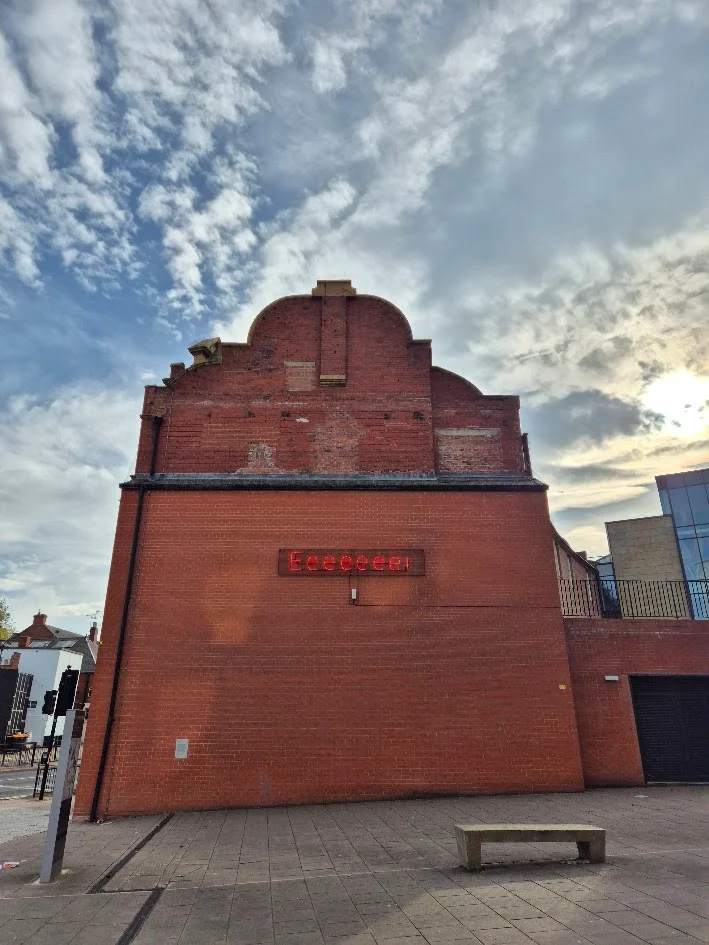

Mackem Shibboleth
Eeeeeee. That's the whole word. Spell it however many e's feel right. It means surprise, disbelief, delight, frustration, the start of a sentence you haven't decided yet. In Sunderland it can stand alone or attach to anything else - Eeeeeee, no! Eeeeeee, really? The Oxford English Dictionary defines it as the northern English form of Oh. A Mackem will tell you that's not quite right, but a Mackem will also tell you a Geordie can't say it properly. That distinction is the entire point.
What a Shibboleth Actually Is
The original shibboleth was a Hebrew word for an ear of corn. In the Book of Judges, the Gileadites used it as a checkpoint - anyone who pronounced it sibboleth was an Ephraimite trying to cross the Jordan in disguise, and was killed on the spot. The word has come to mean any small linguistic test that exposes who belongs and who doesn't. Sunderland and Newcastle sit ten miles apart on the same north-east coast of England. To outsiders they sound identical. To anyone from either city, they don't. The Mackem dialect of Sunderland and the Geordie dialect of Newcastle differ in dozens of small ways - vowel sounds, vocabulary, the rhythm of a question. Eeeeeee is one of them, fully deployed only in Sunderland. To stand in front of the mural is to be tested.
Erin Dickson's Neon
The artist Erin Dickson was born in South Shields, just north of Sunderland - close enough to know what she was doing when she committed Eeeeeee to glass and gas. Dickson's practice combines craft tradition with digital fabrication. Her sculptures, videos, and installations work through themes of home, language, vernacular architecture, and what Britishness actually feels like from the inside. She completed her MA and PhD at the University of Sunderland's Glass and Ceramics department, the same institution that runs the Institute for International Research in Glass. The Mackem Shibboleth, installed in 2023 on the gable end of the university's Hope St Exchange building, monumentalises one of her own region's most untranslatable utterances - a sound she grew up surrounded by, now rendered in tubular neon several metres tall.
City Centre, Permanent
The mural is funded by Sunderland City Council with support from the Sunderland East Area Committee and the University of Sunderland. It was fabricated by North East Neon, the regional specialists who keep the dying craft of glass-bent gas-filled neon alive. The Sunderland Echo declared it one of Sunderland's most popular artworks within months of installation. It glows. It is impossible to misread. It is one syllable of Mackem made architectural. In a city that has spent decades trying to articulate what makes it itself - what makes Sunderland not just smaller Newcastle, not just a port that lost its shipbuilding - the answer turns out to be a sound the Wikipedia editors had to argue about how to spell. Eeeeeee.
From the Air
The Mackem Shibboleth mural is mounted on the Hope St Exchange building at the University of Sunderland city campus, 54.905 N, 1.390 W. Too small to identify from cruising altitude as a feature; useful instead as an anchor for the city centre, which sits south of the River Wear and just east of the Keel Crossing. Cruise at 2,500-3,500 feet for orientation - the wider university campus and Keel Square form the south-bank cluster. Newcastle International (EGNT) lies 17 nautical miles north-north-west; Durham Tees Valley (EGNV) 22 nautical miles south. The mural glows at night, contributing to the city centre's lit silhouette on dark-evening approaches.
Nearby Stories
- Seaton Carew 2.7 km away
- HMS Unity (N66) 6 km away
- George Stephenson's Birthplace 6.1 km away
- Raby Castle 9 km away
- Cragside 15 km away
- Whitby Abbey 21 km away
- German submarine U-2367 46 km away
- Alexander L. Kielland (Platform) 277 km away