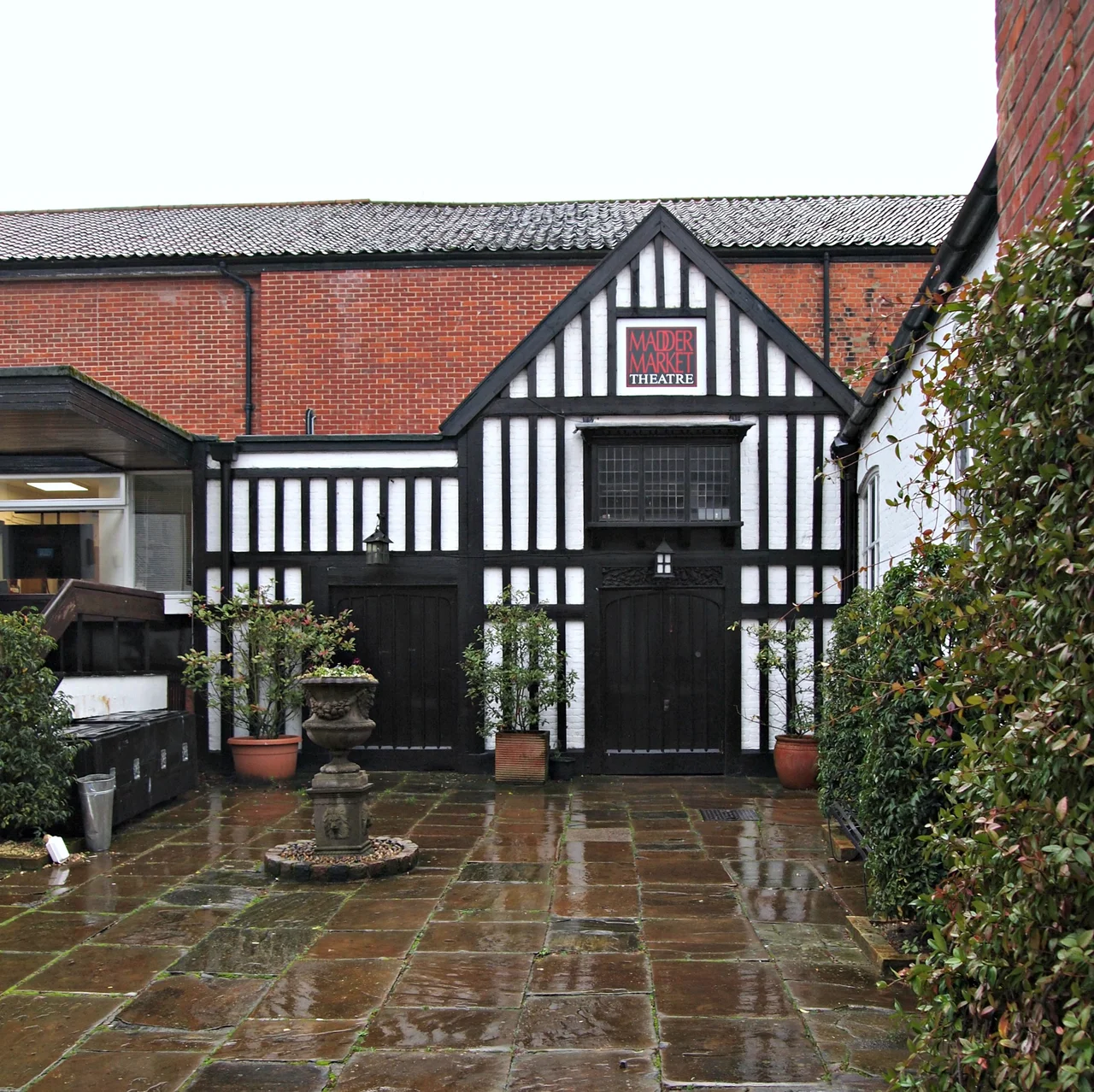

Maddermarket Theatre
Forty feet by forty-six. That was the entire footprint Nugent Monck had to work with in 1921 when he bought a tumbledown chapel in St John's Alley, Norwich, and announced he was going to turn it into an Elizabethan theatre. The building had been a Catholic chapel, then a baking soda factory, then a grocery warehouse, then a Salvation Army hall. It already had a vaulted plaster ceiling with peculiarly fine acoustics and galleries running around three of its walls. Monck and his Norwich Players sealed the doors for six weeks, rehearsed inside while they painted the timbers, and opened the world's first permanent recreation of an Elizabethan playhouse on a budget too small to write down.
Monck's Vision
Nugent Monck had worked with William Poel, the English director who in the late 19th century made it his cause to restore Shakespeare to something like the staging Shakespeare himself would have known - the full text, no cuts, an open stage with no elaborate scenery, an audience close enough to the actors to hear breath. By the early 20th century Monck was running his own group, the Norwich Players, an amateur company that started in his living room and graduated to performances in the Music House on King Street. When he found the disused St John Maddermarket chapel, he saw not a wreck but a half-built playhouse. The galleries were already there. The acoustics were already there. What he needed was a stage, a tiring house, and a way to hang painted curtains for quick scene changes. He used to say the building was a half-scale model of London's Fortune Theatre. Later scholars have suggested Blackfriars - the indoor Jacobean playhouse with its galleries and its candlelit intimacy - is the closer fit. Either way, what Monck was building was a working theatre that resembled the buildings Shakespeare's actors had actually used.
Six Weeks of Rebirth
The conversion was breakneck. Monck had wanted a thrust stage projecting into the audience, the way the Globe had been built, but money and space defeated him. The Maddermarket opened in 1921 with an end-stage instead: a pillared canopy hung with painted curtains, a gallery to the rear of the stage, two entrance doors on either side, and a stage that occupied nearly half the entire interior. The rectangular space measured 40 feet wide by 30 feet long. The plaster barrel-vault overhead did its work; voices carried. The dressing rooms were tucked into the side galleries. Actors literally helped paint the place while they were learning their lines. By autumn the Norwich Players were performing in a building that, despite being smaller than its London ancestors, captured something of the experiment they had been chasing - the audience and the actors sharing the same room, the same light, the same air.
A Century of Tinkering
The Maddermarket has been edited and re-edited every decade since. In the 1950s the pillars supporting the side galleries came out to fit a new steel girder, and the curved galleries were rebuilt straight. The back wall of the stalls came down to allow four more rows of seats. In the 1960s the medieval buildings that had flanked the front of the theatre were demolished and replaced with what the theatre itself now describes as a 'very brutal modern' foyer and bar. The site had once been overgrown with the madder plants that gave the parish its name - the red-dye herb that 15th-century weavers used - and some were donated to Strangers' Hall museum next door. In 2007 Strangers' Hall gave back the theatre its own madder plant. When Dave Harris became Artistic Director the theatre finally got the thrust stage Monck had wanted in 1921, an extra seven feet pushed out as a half-hexagon. The reconstruction also raked the gallery more steeply and restored its original curve. Of all the predictions of empty seats, only ten were actually lost at the back of the gallery. The total seating now sits at 310. The 1930s cinema seats that had been put in long ago were kept everywhere in the house, and the 1960s house-lights were swapped for lanterns to match the rest of the 1920s Tudor decor.
Still Playing
The Maddermarket Theatre is a Grade II listed building today and the Norwich Players are still going - over a hundred years on from those six weeks of paint and panic, still running an Elizabethan-style playhouse out of an 18th-century chapel that has worn at least seven previous lives. In 2020 the author Paula Meir became Chair. The original permanent set, the half-timbered backdrop Monck designed, sits behind whatever production is running. Sometimes it is covered by modern scenic flats. Sometimes, as on the night Bartholomew Fair was first staged after the thrust-stage rebuild, one of Monck's own painted curtains comes out of storage and hangs again over the canopy. Walk through St John's Alley at night, past Strangers' Hall, and the acoustics of a vaulted plaster ceiling will still carry voices out to the cobbles.
From the Air
The Maddermarket Theatre stands at 52.6302N, 1.2926E in St John's Alley, central Norwich, about 300 m west-south-west of the cathedral and just north of City Hall. The tight medieval street pattern makes the theatre itself invisible from cruise altitude, but Norwich's two great landmarks bracket it - the cathedral spire to the east and the castle to the south-east. Norwich International (EGSH) lies about 3 nm north. From 1,500 ft AGL the theatre district is hidden in the tight cluster of roofs around the City Hall clock tower, which is itself the best fix for the area.
Nearby Stories
- Sheringham 2.7 km away
- Wingfield Castle 4.4 km away
- Castle Acre Castle and Town Walls 6.3 km away
- Brancaster 7.1 km away
- West Stow Anglo-Saxon Village 9.3 km away
- Four Days' Battle 80 km away
- Battle of Lowestoft 80 km away
- SM U-97 110 km away