
Magong Chenghuang Temple
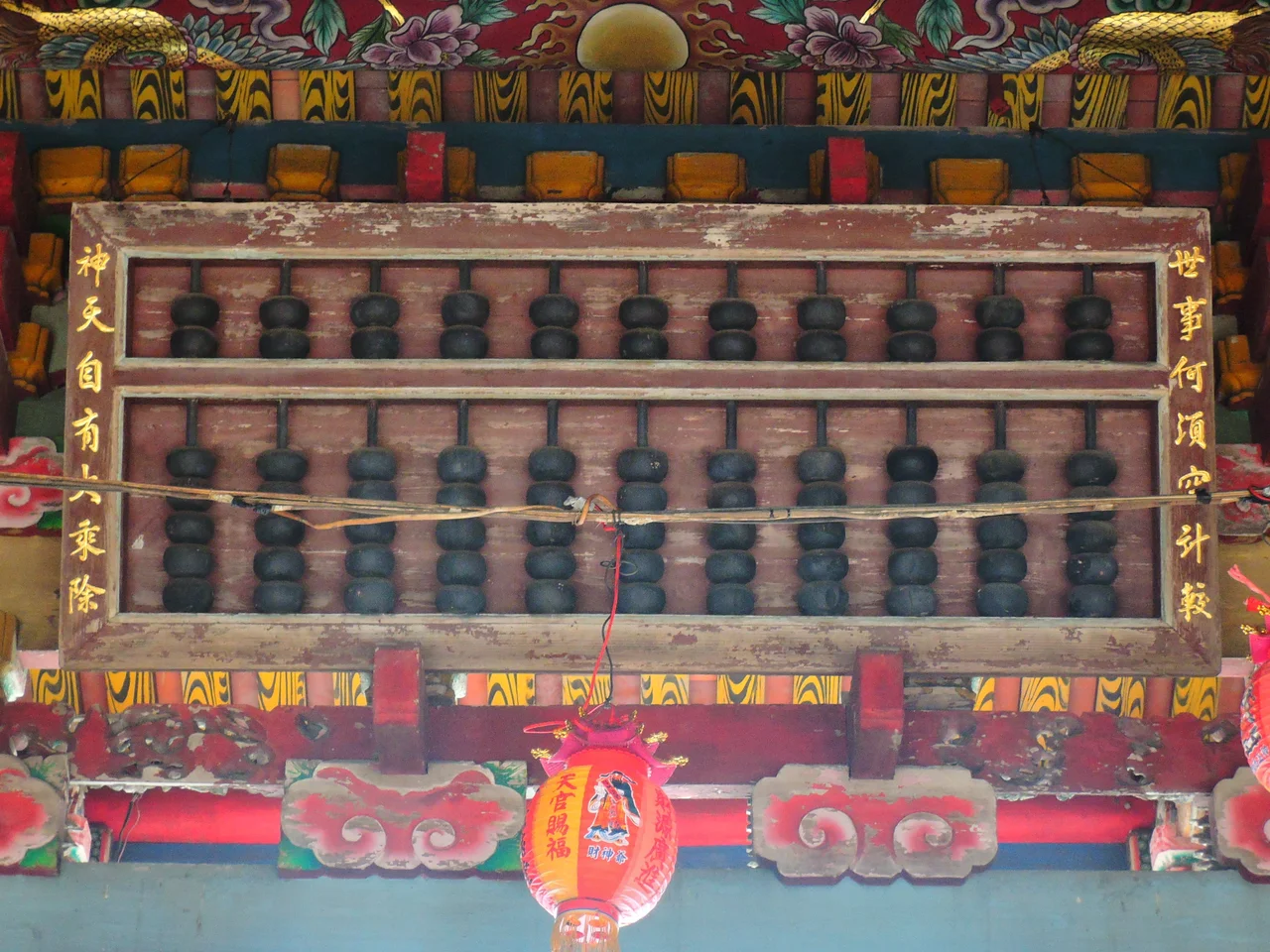
Two wooden signs hang inside Magong Chenghuang Temple, their gilded characters delivering the bluntest possible theology. One reads: 'You come.' The other: 'Repentance comes too late.' Visitors arriving at this temple on the harbor edge of Magong have been meeting that gaze for nearly two and a half centuries — and according to local tradition, the deity within has been watching back, tallying accounts on a giant abacus that hangs in the main hall.
The God Who Keeps the Books
Chenghuangye is the City God of Taoist belief — a divine magistrate who oversees the underworld of a particular administrative district, comparable in role to Hades but operating within a very different moral logic. Where Greek mythology gave the underworld a geography of rivers and judges, the Taoist conception makes the City God a bureaucrat of the afterlife: the keeper of records, the weigher of deeds, the authority to whom souls must answer.
In Chinese tradition, each county or city receives only one Chenghuang Temple, typically positioned near the city hall — a spiritual counterpart to civil governance. Penghu County is unusual. It has two. The original temple stood in Wenao district, site of the old Penghu prefectural office. But as the island's population shifted and Wenao's temple grew too small for the devotional needs of its community, a Qing Dynasty officer named Xie Wei-Qi proposed a second temple for the growing settlement around Magong harbor. Construction began and the new temple was completed in 1779.
War, Smoke, and a Promotion from the Emperor
The Sino-French War arrived at Penghu in 1885, when French naval forces occupied the islands during the wider conflict over influence in Indochina. The fighting damaged the Chenghuang Temple. But island folk memory preserves a different account of those months: that the City God himself was seen moving among the people, offering shelter and steadying those who feared.
When the French navy withdrew in July 1885, the temple was repaired. The following year, according to local stories, the Guangxu Emperor recognized the deity's service with a promotion in divine rank — conferring the title Lin Ying Hou (靈應侯). The three characters carry precise meaning: Lin (靈) for 'spirit,' Ying (應) for 'answer' or 'feel,' and Hou (侯) for a rank of Chinese nobility. Together, the title declares that this City God will make its spirit felt — that prayers sent to this deity will be answered. Whether the imperial promotion was formal or the stuff of oral tradition passed down through generations, the title has stuck. The deity of Magong Chenghuang Temple remains Lin Ying Hou.
What the Walls Remember
Step through the temple gate today and the architecture speaks in layered visual language. Wooden beams overhead carry polychrome paintings — scenes from myth, history, and moral instruction rendered in the rich palette of traditional Taiwanese temple art. The carvings that frame doorways and support structures are not decorative in the Western sense; each figure, each scene, encodes a story or a lesson.
Among the most striking objects is the large abacus hanging in the hall. This is not a working instrument for calculation — it is symbolic, representing the accounting that Chenghuangye keeps on every soul. Good deeds, transgressions, moments of kindness and cruelty: all are entered in the ledger. The abacus makes the divine bookkeeping tangible.
The temple also holds historic steles and sign boards that have accumulated across its two-and-a-half centuries of existence. These inscriptions layer the historical over the devotional, making the temple as much an archive as a place of worship.
Living Practice on the Harbor
Magong Chenghuang Temple sits within a city that still takes its religious landscape seriously. Penghu County hosts a dense concentration of temples — Mazu temples, Guanyin temples, Beiji temples — reflecting an island culture whose relationship with the sea has always been negotiated through spiritual practice. Fishermen pray for safe passage. Families seek guidance at major life transitions. The City God's domain of justice and the afterlife makes Chenghuang temples particularly important moments of reckoning.
The temple stands near the harbor, embedded in the daily life of a city that has seen Qing governance, Japanese colonial administration, and the Republic of China — each era leaving its marks on the streets around it. The temple persisted through all of them, its signs unchanged, its abacus still counting.
From the Air
Magong Chenghuang Temple sits in the urban core of Magong City at approximately 23.566°N, 119.566°E, on the main island of Penghu. Approach Magong Airport (RCQC) from the east; the dense temple district is visible in the city center just west of the harbor. Recommended viewing altitude 1,500–3,000 ft for the harbor-city relationship; the temple's traditional curved roofline is identifiable among lower urban structures. Penghu main island is compact — the airport lies less than 2 nautical miles northeast of the city center.
Nearby Stories
- 1904 Douliu Earthquake 7.1 km away
- Yanshuei District 8.2 km away
- China Airlines Flight 611 9.7 km away
- Fangyuan Lighthouse 12 km away
- Dongji Island 15 km away
- Nanxiong Formation 436 km away
- Daya Bay 483 km away
- Battle of Xiapi 1166 km away