
Mahdist War
In August 1881 two companies of Egyptian infantry climbed off a steamer at Aba Island in the White Nile, each with orders to arrest a village preacher named Muhammad Ahmad. The preacher had declared himself the Mahdi, the Islamic world's promised redeemer, and his talk of renewing the faith and ending foreign rule was spreading faster than Khartoum liked. The two companies approached from separate directions. Arriving simultaneously in the dusk, each mistook the other for the Mahdi's men and opened fire. By the time they stopped shooting at themselves, Muhammad Ahmad's followers had swept in and destroyed them both. That was the first battle. The war that followed lasted eighteen years.
What People Were Fighting For
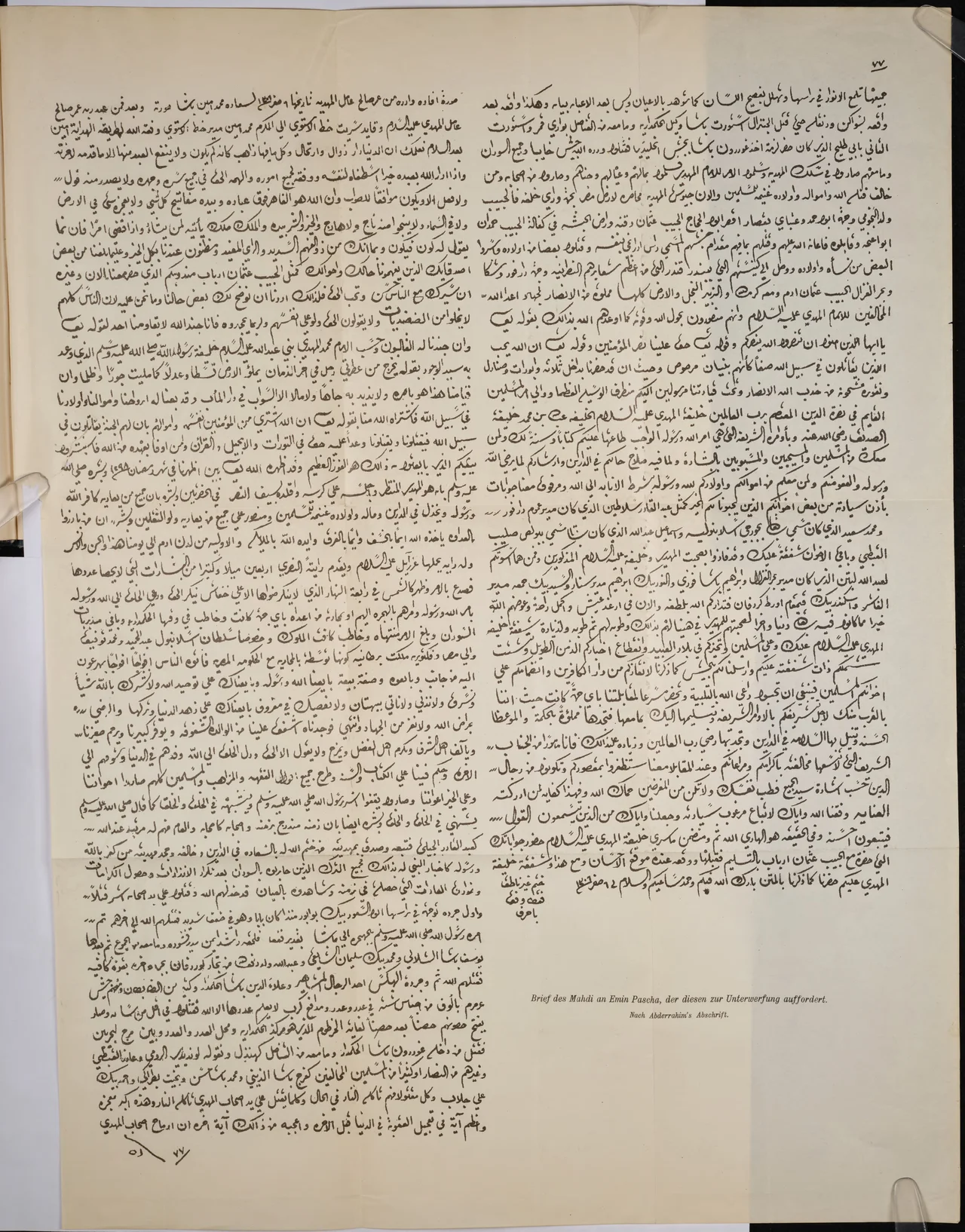
Foreigners later tried to explain the Mahdi's revolt as fanaticism. The Sudanese who fought it had clearer reasons. Turco-Egyptian rule, imposed since Muhammad Ali Pasha's invasion in 1820-1821, meant heavy taxation collected with violence, forced labor, and the appointment of non-Muslims like the British Christian Charles Gordon to govern a Muslim population. For Sufi religious leaders, Egyptian administration represented a dry scholarly Islam they rejected. For merchants and tribal leaders, it meant ruin: Egyptian monopolies had strangled the caravan trade and the abolition of the formal slave market had shaken an entire economy. Muhammad Ahmad offered something that made sense in that context: religious renewal, political liberation from Turkish and British control, and a return to what he presented as authentic early Islam. He framed himself deliberately as a new Muhammad. His followers were called Ansar, like those who welcomed the Prophet to Medina. His retreat to Kordofan he called the hijra.
The Destruction of Hicks's Army
By early 1883 the Mahdi had captured El-Obeid, the chief town of Kordofan. The Egyptian government, already broke from Khedive Ismail's modernization schemes, assembled a relief force under a retired British officer, Colonel William Hicks. Winston Churchill later described it as perhaps the worst army that ever marched to war. It numbered about 8,000 men, poorly trained, unpaid, demoralized. On November 5, 1883, at Sheikan south of El-Obeid, Mahdist forces armed mostly with sticks, stones, and captured muskets surrounded Hicks's column. Almost every man in the Egyptian army died. Hicks died. Twelve European officers died. The Mahdi captured tens of thousands of rifles, millions of rounds of ammunition, and the psychological initiative. London and Cairo had to concede that Sudan was lost.
Gordon at Khartoum
In January 1884 the British sent Charles Gordon to Khartoum to evacuate Egyptian garrisons. Gordon had other plans. He dug in. His orders were to leave quickly and peacefully. Instead, he convinced himself that honor required him to rescue every Egyptian soldier, that the Mahdi had to be crushed rather than allowed to govern, and that British troops must be sent to finish the job. The British government refused. Gordon kept asking. A Mahdist army surrounded Khartoum on March 13, 1884, and the siege lasted 317 days. A British relief column crossed the desert and fought its way up the Nile, but arrived on January 28, 1885. The city had fallen two days earlier on January 26. Gordon died on the palace steps. His death became one of the late Victorian era's great scandals, and turned British opinion toward eventual reconquest.
The Mahdist State and Its Textiles
Muhammad Ahmad died of typhus on June 22, 1885, only five months after his greatest victory. His successor, the Khalifa Abdallahi ibn Muhammad, ruled the Mahdist State from Omdurman for thirteen years. The Mahdists organized their armies by the colored patches on their jibbas, the patched Sufi tunics that became military uniforms. A Tailor of Flags was established in Omdurman to standardize the banners that denoted each rayya, each division of troops. The Mahdist State fought Ethiopia (killing its emperor in 1889), Italy, and the Belgian Congo. It suffered famines and internal rebellions. It preserved Sudanese independence at tremendous cost, and it struggled to govern a territory exhausted by war.
Omdurman and After
In 1896 the British decided to reconquer Sudan. Herbert Kitchener built a railway across the desert, dragged steamers up the Nile, and assembled a modern army equipped with Maxim guns and Lee-Metford rifles. On September 2, 1898, at the Battle of Omdurman, 52,000 Ansar charged Kitchener's positions in the largest Mahdist assault of the war. In five hours, Kitchener's machine guns killed around 10,000 of them. Forty-eight of his own men died. Then, in an act that shocked even some of his officers, Kitchener ordered the desecration of the Mahdi's tomb and, according to Churchill who witnessed it, carried off the Mahdi's skull in a kerosene can. The Khalifa fled to Kordofan and was killed a year later at Umm Diwaykarat. The Mahdist War was over. What followed was Anglo-Egyptian Sudan, which lasted until 1956. But the Mahdist memory, of a Sudanese movement that briefly beat the world's greatest empire, has never left this country.
From the Air
The Mahdist War ranged across Sudan from approximately 10°N to 22°N, with key locations including Aba Island (on White Nile near 12.9°N, 32.7°E), El-Obeid (13.2°N, 30.2°E), Khartoum (15.6°N, 32.5°E), and Omdurman (15.7°N, 32.5°E). The representative coordinate is 15°N, 32°E near Khartoum/Omdurman. Recommended viewing altitude for a survey: 15,000-25,000 feet to see the Nile system connecting these sites. Khartoum International Airport (HSSS), Merowe (HSMN) and El-Obeid Airport (HSOB) are relevant reference points. The battlefield at Kerreri, site of the 1898 Battle of Omdurman, lies just north of Omdurman along the west bank of the Nile.
Nearby Stories
- Al-Khiday 34 km away
- Abushneib 36 km away
- Gezira State 92 km away
- Naqa 125 km away
- Wad Madani 150 km away
- Battle of Shaykan 234 km away
- Banganarti 332 km away