
Al-Khiday
In 2004, an Italian Archaeological Mission surveying the route of a new road on the western bank of the White Nile, not far from Khartoum, began pulling up soil and finding bones. What they had stumbled into was al-Khiday, a cluster of five prehistoric sites, and specifically al-Khiday 2: a multi-phase cemetery where three wholly different peoples had buried their dead across some eight thousand years. Pre-Mesolithic hunters lying extended and face-down. Mesolithic fishers who left no bodies in the mound but left their pottery and their fish bones. Neolithic herders in ritual poses. And finally, much later, Meroitic Sudanese of the classical age, burying infants with feeding cups.
Ninety Bodies Face-Down
The earliest burials are the strangest. Around ninety pre-Mesolithic bodies were excavated at al-Khiday 2, lying extended and prone, face-down. This is an unusual burial position almost anywhere in the archaeological record; the dominant human posture for burial is flexed or supine. Face-down burials at this scale suggest ritual meaning that has not survived into any written record. The bodies lost their collagen long ago, making radiocarbon dating difficult, but stratigraphy and context place them before the Mesolithic occupation roughly ten thousand years ago. Many were disturbed by the later Neolithic and Meroitic burials that overlaid them. Whoever these ancient people were, they came first to this bank of the White Nile, and they left their dead in a way no one since has quite repeated.
Fish, Tubers, and the Savanna That Was
The Mesolithic deposits tell a different story. Around 90 percent of the faunal remains are fish, mostly the shallow-water Clarrid catfish that lived in the Nile shallows and seasonal flood swamps. But the Mesolithic diet was broader than the bones first suggest. The pottery, when modern lipid analysis was applied, turned out to carry the chemical signatures of plant processing: leaf and stem waxes, diacids like cutin and suberin, markers of underground storage organs. In other words, the Mesolithic people of al-Khiday were cooking tubers in clay vessels alongside their fish. The mammalian bones include baboon, hare, warthog, plus rarer finds of elephant, rhinoceros, and hippopotamus. Eight thousand years ago, this corner of central Sudan was a lush savanna with permanent water, rich enough to support large game the modern desert could never sustain.
The Neolithic: Pots, Char, and a Turn to Meat
Roughly thirty-two Neolithic burials, dating from about 4550 to 4250 BC, overlay and disturbed the earlier pre-Mesolithic graves. These were ritual burials with goods, including Shaheinab-style pottery that connects al-Khiday to the broader Neolithic Sudan archaeological tradition. Dental analysis on the Neolithic bodies found the highest proportion of "char" of any period at the site, meaning these were people who ate food cooked directly in fire and smoke. The lipid analysis of Neolithic pots shows a shift: more ruminant animal processing, possibly including minor dairy. The fish bones nearly disappear. Giraffe, antelope, and possibly domesticated animals take their place. A transition from fishing to herding, from flood-swamp hunters to pastoralists, played out on this same riverbank across a few thousand years.
An Iron Arrowhead Beneath a Child's Skull
Fast-forward another three to four thousand years. Forty-three Meroitic graves were identified at al-Khiday 2, dating to the Classical Late Meroitic period of the kingdom that ruled from Meroë. These were deep rectangular shafts dug east-west, sometimes with a circular chamber on the west side. Bodies lay oriented west with faces turned north, on woven mats. Among the grave goods were twelve handmade ceramic pots, anklets, necklaces, and, under the skull of a ten-year-old child, a single iron arrowhead. Whoever buried that child believed, or hoped, that the iron point would help them in whatever came next. Two tiny feeding cups were found with infant burials. The Meroitic people of al-Khiday had low dental caries and high calculus, the signatures of a protein-rich diet. The bones show childhood stress and healed injuries: hard lives, but lives that kept on healing.
Purple Nut Sedge, Across the Millennia
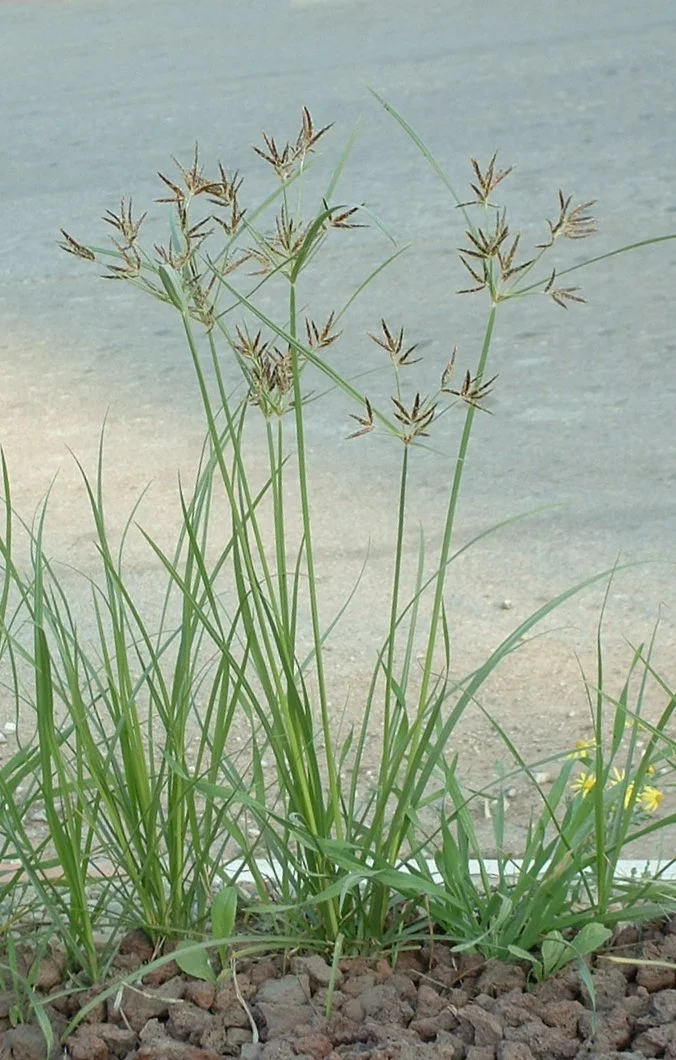
One plant ties the three periods together. Cyperus rotundus, known as purple nut sedge, is a tuberous plant that thrives along the Nile and spreads aggressively. It does not preserve well in burials, so no intact remains have been found. But dental calculus analysis points to it indirectly: chewing purple nut sedge inhibits Streptococcus mutans, and the al-Khiday teeth show suspiciously low levels of this bacterium across all three periods. Why did these people keep eating a bitter tuber even after better C3 crops were available? Possibly because the plant was not only nutritious but medicinal, used as described in Greek medical writings of the classical age. Eight thousand years of continuity on one riverbank, with one stubborn, medicinal, slightly bitter sedge traveling through every diet. The Italian road project had accidentally opened a long window onto a long story.
A Cemetery Still Telling
Al-Khiday is still being excavated, still being analyzed. New techniques, from lipid residue work on pot sherds to isotope studies on teeth, keep pulling more story out of the same soil. One early Holocene man at the site turned out to have prostatic stones, among the oldest ever found; he likely died a painful death some twelve thousand years ago. The site is at its core a reminder that central Sudan, which today feels like a place of loss and war, has been a stage for human life for as long as humans have been human in Africa. Hunters buried face-down. Fishers who cooked tubers in clay pots. Herders who buried their dead with Shaheinab pottery. Meroitic mothers who laid their infants down with feeding cups. And beneath it all, the White Nile going by, as it has always gone by, on its way to join the Blue.
From the Air
Al-Khiday lies at approximately 15.50°N, 32.40°E on the western bank of the White Nile, southwest of Khartoum, Sudan. Nearest airport is Khartoum International (IATA: KRT, ICAO: HSSS). Recommended viewing altitude 4,000-8,000 ft AGL to see the White Nile corridor and the Gezira irrigation grid spreading south toward Wad-Madani. The confluence with the Blue Nile at Khartoum lies just to the north.
Nearby Stories
- Esh Shaheinab 27 km away
- Naqa 56 km away
- Mahdist War 65 km away
- Musawwarat es-Sufra 100 km away
- Gezira State 101 km away
- Northern Sudan 215 km away