
Mansión Seré
Four men climbed out of a first-floor window on the night of March 24, 1978, naked and still wearing handcuffs, and lowered themselves down the wall of a burning-cold mansion in the suburbs of Buenos Aires. One of them was a young goalkeeper named Claudio Tamburrini, who had been seized from his home four months earlier for nothing more than the books he read and the company he kept. The men ran through the rain across open country. Against every probability, they survived - and theirs is remembered as the only escape from a clandestine detention center in all the years of Argentina's last dictatorship. The house they fled was called Mansión Seré, and the regime had given it the codename Atila.
A House Built for Beauty
It had not always been a place of terror. In 1868 a French Basque immigrant named Jean Seré bought fifty-six hectares on the edge of Morón and raised polo horses and cattle there. After his death the land passed to his children, and in 1900 his daughter Leocadia and her husband commissioned a French-style manor of two storeys, its materials shipped from Europe, set among open fields on the border of the towns of Castelar and Ituzaingó. For most of a century it was simply a grand country house. Then the military seized power, and the Argentine Air Force turned the elegant rooms to a purpose their builders could never have imagined: a secret prison, hidden from the law, off every official register.
The Disappeared
From 1976 to 1983, a military junta calling its rule the "National Reorganization Process" abducted, tortured, and killed thousands of Argentines it deemed enemies. The victims became known by a terrible word - los desaparecidos, the disappeared - because they were taken in secret and the state denied all knowledge of them. Mansión Seré was one node in this hidden network, run by the Air Force with help from the local police. The people held inside were not statistics. They were students and workers, union members and ordinary citizens, many guilty of nothing the regime could ever have proven in a real court. They were stripped of their names, their clothes, and their freedom, and subjected to systematic cruelty by their captors. To remember them honestly is to refuse the silence that was the whole point of the place.
The Escape and the Cover-Up
The escape of Tamburrini, Daniel Rusomano, Guillermo Fernández, and Carlos García Muñoz - timed, by grim coincidence, to the second anniversary of the coup - began the end of Mansión Seré. Their flight made the secret unkeepable. Rather than risk exposure, the military set the mansion on fire and dynamited it, leaving only a broken façade, and scattered the remaining prisoners to other prisons. Tamburrini went into hiding, then fled to Sweden, where he watched from exile as his country celebrated the 1978 World Cup. He later became a doctor of philosophy and a professor at Stockholm University, and wrote the memoir that the film Crónica de una fuga - Chronicle of an Escape - would carry to the world. The men the regime tried to erase became the witnesses who would not be erased.
Where Memory Lives
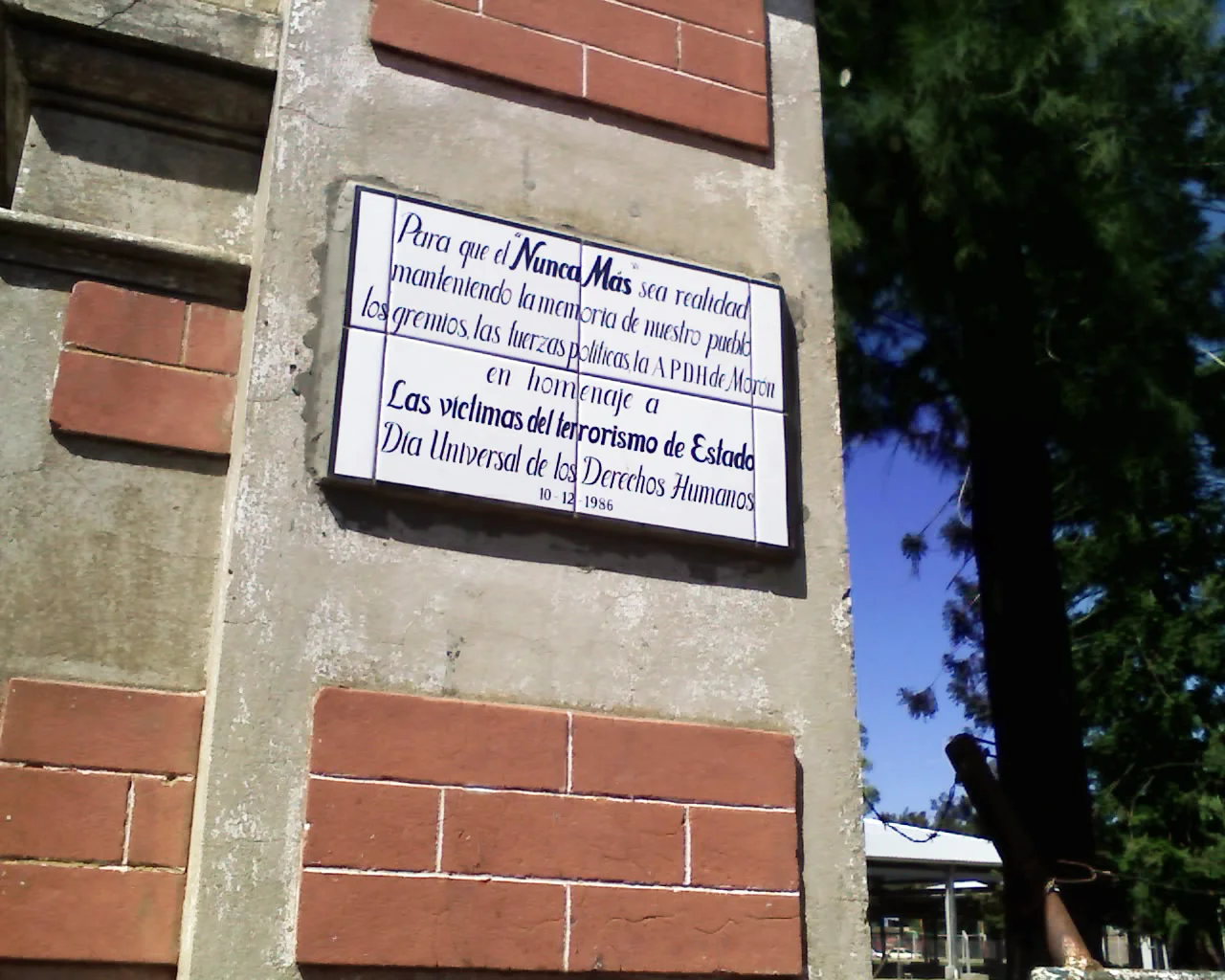
The ruins are gone now, cleared during the building of a municipal sports complex, the Gorki Grana Recreational and Sports Center, on the eleven-hectare site in Castelar. But the ground has not been allowed to forget. It holds a Directorate of Human Rights and a House of Memory and Life, and in 2015 the Argentine state declared the former center a national historic site. Children play and athletes train where prisoners once vanished - not as an erasure, but as an answer. The first commemorative plaque, raised in 1986, invoked the country's two most enduring words about this era: Nunca Más. Never again. The site stands as a promise that the names taken in the dark will keep being spoken in the light.
From the Air
Mansión Seré stood in the western Greater Buenos Aires district of Morón, on the Castelar-Ituzaingó border, near 34.659 degrees south, 58.660 degrees west; the memorial sports complex now occupies the site at 3530 Santa María de Oro Street. From the air, look inland (west) from the city center across the dense suburban grid for the green expanse of the recreation grounds amid the rooftops. Recommended viewing altitude 1,500 to 3,000 feet. The closest field is El Palomar (ICAO SADP), a former Air Force base just a few miles north - a sober note, given the Air Force ran this center. Aeroparque Jorge Newbery (ICAO SABE) lies about 14 nm east toward the river, and Ministro Pistarini / Ezeiza (ICAO SAEZ) about 12 nm to the southeast. Clear daylight gives the best view of the suburban landscape that once hid the house.
Nearby Stories
- Tigre, Buenos Aires 6 km away
- Luján, Buenos Aires 17 km away
- Anchorena National Park 21 km away
- La Plata Museum 22 km away
- Lobos 23 km away
- San Antonio de Areco 43 km away
- Chascomús 82 km away
- Tronador (rocket) 96 km away