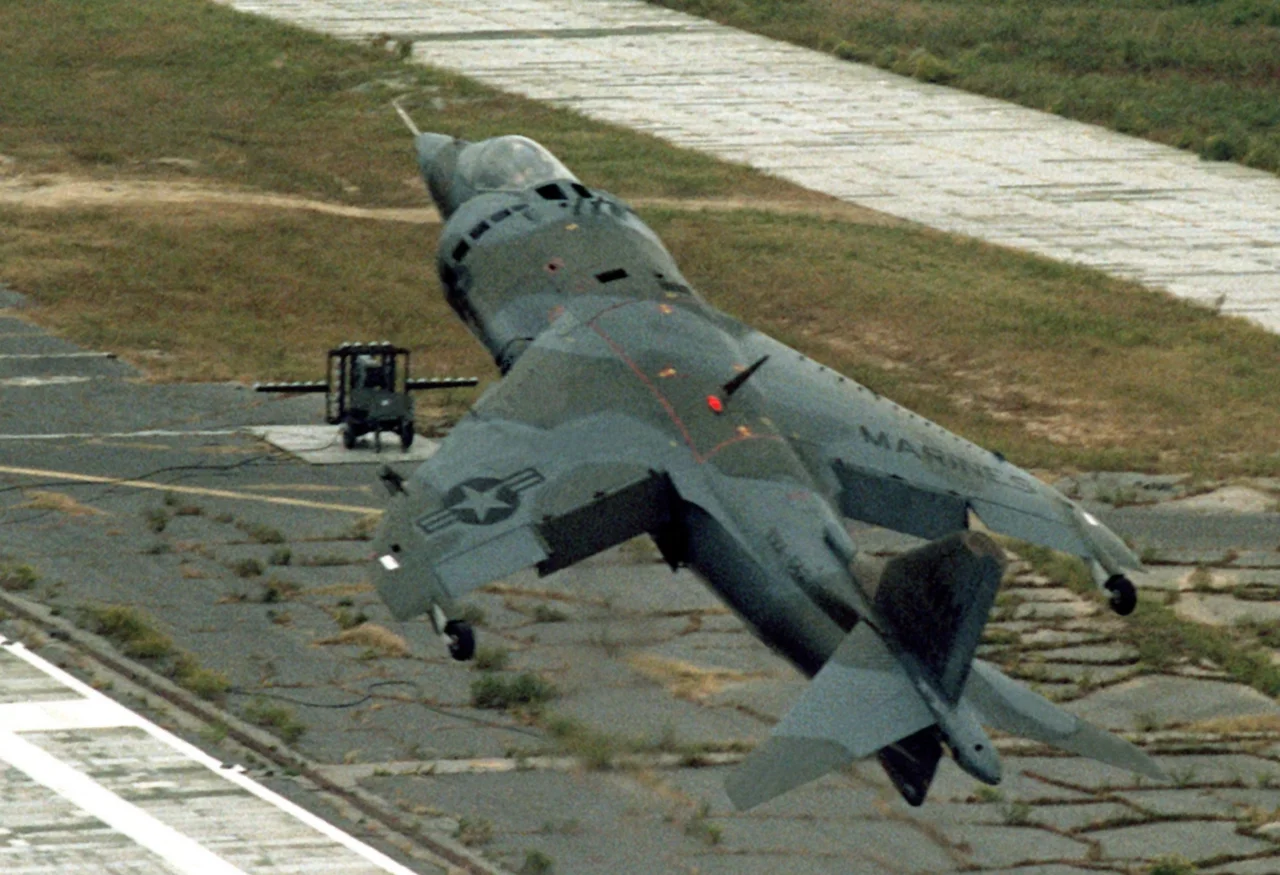

Marine Corps Auxiliary Landing Field Bogue
On a dark night over the central North Carolina coast, somewhere between Swansboro and Emerald Isle, an AV-8B Harrier flies a precise box pattern with its nose lights tilted slightly down. The pilot is rehearsing a landing on a ship that is not there. Down on the ground, the painted outline of an amphibious assault ship's deck waits on the asphalt of Bogue Field, and the pilot will set down inside its lines as if the steel were really beneath the rubber. That is the entire point of MCALF Bogue: to teach pilots how to land on a moving deck by practicing on a fixed one, again and again, until the muscle memory is ironclad.
Bought for War
The United States Navy bought 573 acres of land on Bogue Sound in 1942 and laid three runways of 4,000 feet each. The new field was meant to support Marine Corps Air Station Cherry Point a few miles north in Havelock, giving its squadrons a satellite where dive-bomber crews could practice their attack runs without crowding the main field. Facilities went up for two squadrons and 1,050 personnel. VMSB-331 arrived in 1943 flying the SBD Dauntless, the iconic American dive-bomber of the Pacific. Three squadrons of Marine Aircraft Group 33 followed later that year. The dive-bombing circle targets they used were constructed on nearby islands. A maneuvering target boat on the Neuse River let them practice attacks on shipping.
A Brief Quiet
MAG-33 left for Texas in 1944. MAG-93 stood up at Oak Grove the same year. By then the Marine Corps was transitioning from the Dauntless to the more powerful SB2C Helldiver, and the rhythm of training shifted. A J2F Duck amphibian had been assigned to Bogue for rescuing downed flyers, but the Duck proved unsuitable for open-sea landings; rescue work moved elsewhere. After the war Bogue was decommissioned on 15 June 1947 and became an Outlying Field of Cherry Point, kept on the books but largely quiet. In 1958 the Marines installed their first Short Airfield for Tactical Support system, an experimental deployable catapult and arresting gear meant to let jet aircraft operate from short expeditionary strips. The SATS test cemented Bogue's identity as a place where Marine aviation tries out the next generation of carrier operations on solid ground.
The Harrier Years
Sometime between 1965 and 1976 the Marine Corps reopened Bogue as a satellite airfield for the Vietnam-era demands of MCAS New River and Cherry Point. By the late 1970s the AV-8A Harrier was operating off Bogue's runway, the same short field that gave the strange jump-jet just enough runway to take off conventionally and still hover into a vertical landing. The AV-8B Harrier II carried that mission forward into the 2010s and 2020s. Bogue Field is the primary location for AV-8B practice operations. It supports about 3,500 Field Carrier Landing Practice events per training year. The Harrier shares the field with KC-130 Hercules transports from Cherry Point, F/A-18 Hornets from Beaufort, and helicopters from MCAS New River. The runway itself is made of aluminum panels that can be disassembled and reconstructed anywhere in the world in days by a specialty Marine construction battalion.
Noise and Neighbors
Bogue sits inside Carteret County, surrounded by the resort and retirement communities of Emerald Isle, Swansboro, Cape Carteret, and Morehead City. Harrier engines are extraordinarily loud, particularly during the vertical and short takeoff and landing operations that define the type. In January 2001 a group of residents from those nearby towns formed the Bogue Field Committee to push back against the noise and what they perceived as safety risk. Their stated goal was to make Marine aviation safer by pressing Congress to fully fund the Harrier program; their more pragmatic goal was to get the Corps to stop flying the plane over populated areas. The AV-8B is now nearing the end of its service life, with the F-35B Lightning II taking over its missions. Bogue Field will outlive the Harrier. What it will train next is not yet certain.
Flight Context
MCALF Bogue Field sits at 34.69 degrees north, 77.03 degrees west, on the southern shore of Bogue Sound in Carteret County. View from 1,500 to 2,500 feet AGL to see the active runway, the remains of the two original runways from 1942, and the painted carrier deck outline. The field is military and restricted. Civilian alternates: Beaufort Michael J. Smith Field (KMRH) to the east, Coastal Carolina Regional (KEWN) in New Bern to the north, MCAS Cherry Point (KNKT) to the north. Expect dense Marine training traffic and significant aircraft noise.
From the Air
MCALF Bogue at 34.69 degrees north, 77.03 degrees west, on Bogue Sound. Restricted military airfield. View from 1,500 to 2,500 feet AGL. Civilian alternates: KMRH (Beaufort), KEWN (New Bern), KNKT (Cherry Point). Expect heavy training traffic.
Nearby Stories
- Tornadoes of 1965 5.2 km away
- Harkers Island, North Carolina 8.2 km away
- Figure Eight Island 21 km away
- Beulaville, North Carolina 24 km away
- La Grange Historic District (North Carolina) 37 km away
- Topsail Beach, North Carolina 43 km away
- Portsmouth, North Carolina 54 km away
- Mercury-Redstone 4 774 km away