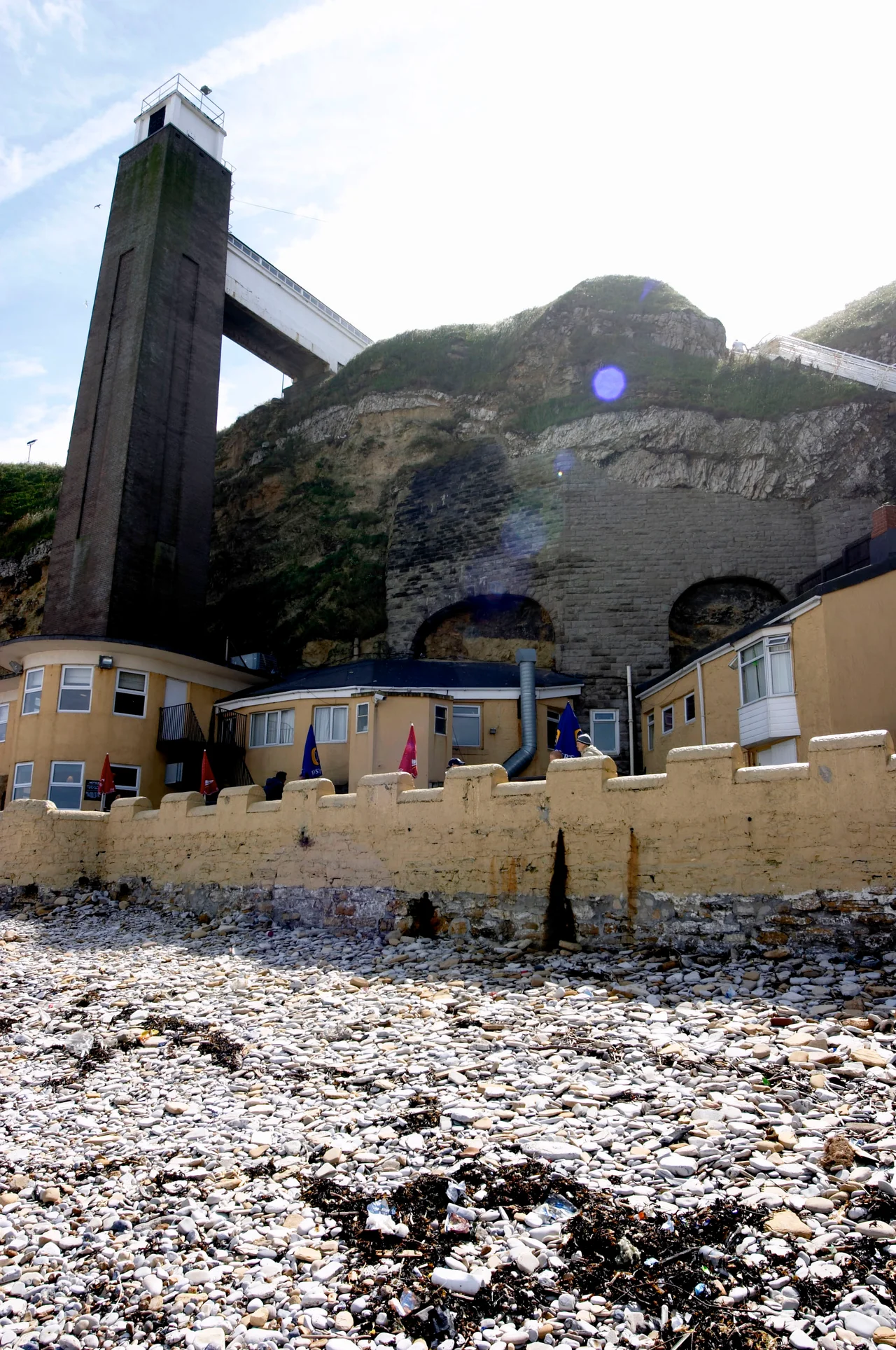

Marsden Grotto
Jack Bates was a lead miner from Allendale who decided in 1782 that he was done with landlords. He moved his wife Jessie into a small natural cave at the foot of Marsden cliff, then borrowed explosives from a nearby quarry and blew the cave open into something liveable. The locals started calling him Jack the Blaster. The hole he made in the limestone is now a pub. The pub is one of the very few cave bars in Europe.
Peter Allan Builds an Inn
Jack the Blaster's cave passed eventually to a man named Peter Allan - Scottish-born, the son of a gamekeeper to Sir Hedworth Williamson, with a small fortune supposedly won at the races. Allan took over what Jack had hollowed out and turned it into a proper home: fifteen rooms including a ballroom and kitchen, dug deeper into the cliff. By the 1840s it had become a working inn. Then John Clay - a Sunderland businessman who would later become the first mayor of South Shields - bought The Leas, the headland above, and decided the land rights gave him authority over the inn below. Allan fought him in court. Allan lost. The judgement against him was £50 in costs and £10 annual rent for twenty years. He sank into depression and died in 1849, leaving a wife, eight children, and parents who outlived him.
John the Jibber in the Barrel
The Marsden Bay cliffs were a smuggler's coast. Caves, coves, tide-cycle timing - the geography hid contraband and the customs men knew it. According to local tradition, an eighteenth-century smuggler named John the Jibber sold information about a planned run to HM Customs and was caught at it by his own crew. They hung him in a barrel in a cave near the present lift shaft and left him to starve. For more than a century, every landlord of the Grotto left a special tankard of ale on the bar overnight. Every morning it was empty. The custom held until Vaux sold the pub in the 1990s. The current management displays a replacement tankard. It is not filled.
The Tankard and the Television Crew
In the 1990s the Newcastle radio host Alan Robson - locally famous for his late-night supernatural call-in show on Metro Radio - decided during a live broadcast to drink from the ghost's tankard. The landlord at the time later told the press that the consequences started immediately. Ashtrays flew across rooms. The cellar flooded after all the beer taps turned themselves on. The landlord quit. In 2001 a UKTV paranormal investigation team claimed to have identified at least seven distinct ghosts on the premises. The Grotto leans into the story now. Whether John the Jibber actually existed in any documentable form is a separate question. The barrel in the cave is the kind of detail that becomes true through repetition.
Vaux, Cliffs, Refurbishments, Closures
Vaux Breweries took over the Grotto in 1898 and ran it for a century, refurbishing the buildings, adding a brick lift shaft that still rises from the beach to the cliff top. When Vaux abandoned brewing for hotels in 1999, no buyer could be found and the Grotto closed. The Sunderland firm Tavistock reopened it as a high-end seafood restaurant. Ownership has rotated since - London Inns and Restaurants in 2003, then Oxford Hotels and Inns Management. In September 2007 South Tyneside Council closed the zigzag cliff staircase for a damaged step, and Tyne and Wear Fire and Rescue ordered the pub closed because the stairs were the only safe evacuation route at high tide. The Grotto reopened on 21 March 2008. The lift still descends from the car park. The cave bar still holds. Outside, Marsden Rock still faces the North Sea exactly where it was the day Jack the Blaster moved in.
From the Air
Marsden Grotto sits at 54.977 N, 1.378 W, dug into the cliff face on the South Shields coast of South Tyneside. Cruise at 1,500-3,000 feet for the best view of the cliff-line and the dramatic limestone coastline that runs from Souter Lighthouse south. The Grotto's distinctive brick lift shaft rises from the beach against the cliff - identifiable from low altitude. Marsden Rock sits directly offshore. Newcastle International (EGNT) is 8 nautical miles west-north-west - closer than to most of the other Wearside sites. Durham Tees Valley (EGNV) about 27 nautical miles south. Coastal haar can shroud the entire cliff in summer; clearest views in westerly weather.
Nearby Stories
- Seaton Carew 2.7 km away
- HMS Unity (N66) 6 km away
- George Stephenson's Birthplace 6.1 km away
- Raby Castle 9 km away
- Cragside 15 km away
- Whitby Abbey 21 km away
- German submarine U-2367 46 km away
- Alexander L. Kielland (Platform) 277 km away