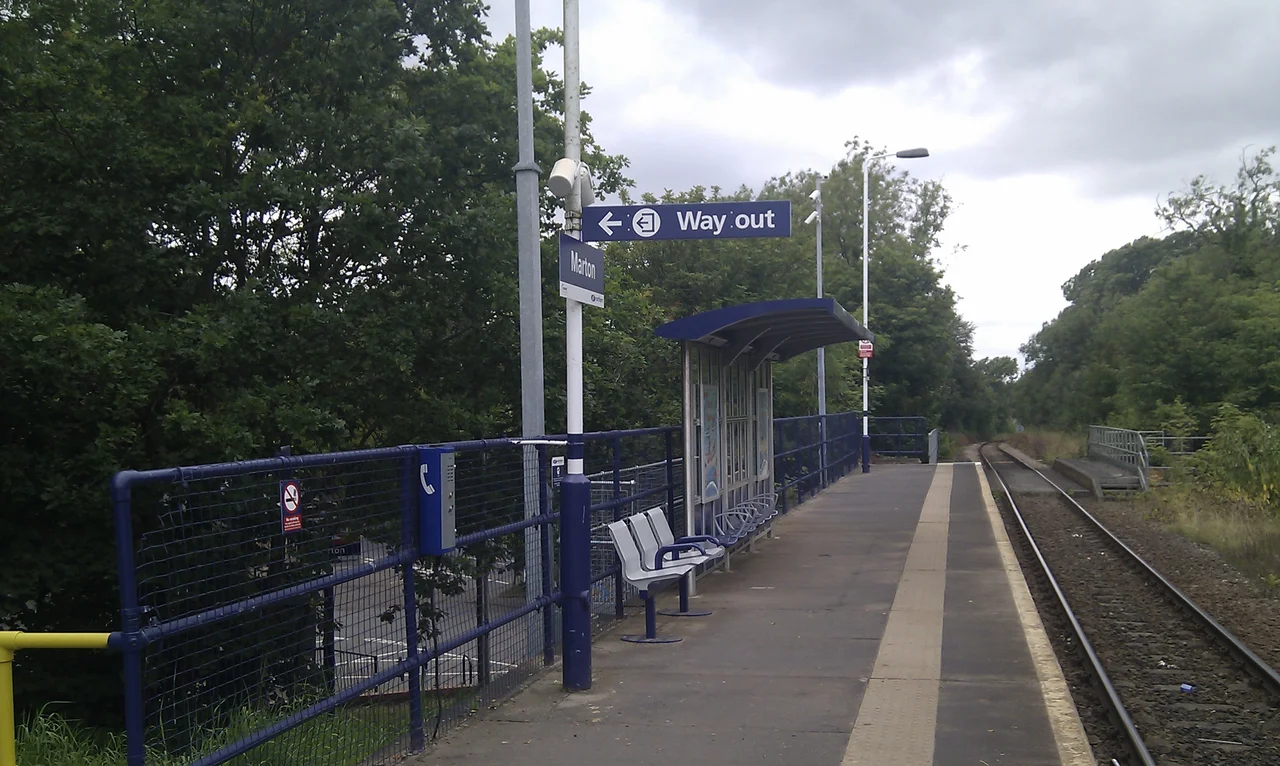

Marton, Middlesbrough
Until the 1950s, Marton was a small Yorkshire village. Then Middlesbrough grew south and absorbed it, and the village became a suburb. The clay cottage where James Cook was born in 1728 had already been gone for more than 150 years by then, levelled in the 1790s by a landowner reshaping the estate around what was then Marton Lodge. The little parish that had held a Norman church, a manor, and a few farms had become a postcode. But the church where Cook was baptised still stands. The site of the cottage is still marked. And the name Marton itself, from the Old English and Old Norse for marsh farm, has somehow survived twelve hundred years and an industrial city moving in next door.
The Boy Who Mapped a Hemisphere
James Cook was born to James and Grace Cook on 27 October 1728 in a clay-built cottage in Marton. He lived in the village only briefly. The family moved to Great Ayton when he was about eight, where his father took work as a farm hailiff. From there Cook went to school, then to Staithes for a shopkeeper's apprenticeship, then to Whitby for a maritime apprenticeship that put him aboard colliers carrying coal down the east coast. The Royal Navy followed. So did the three voyages to the Pacific, the charts of New Zealand and eastern Australia, and his death at Kealakekua Bay on the Big Island of Hawaii in 1779 during a violent attempt to take a Hawaiian chief hostage. Marton remembers him without resolving the contradictions.
St Cuthbert's Church
St Cuthbert's dates from the twelfth century. The overlords of Marton at that time were the de Brus family, ancestors of Robert the Bruce, the Scottish king who would later fight Edward II at Bannockburn in 1314. The de Brus founded Gisborough Priory in 1119, and Marton's church was among their gifts to the priory before 1187. When Henry VIII dissolved Gisborough in 1540, the church reverted to the Crown, then to the Diocese of York in 1545. A major refurbishment in the 1840s, financed by J.B. Rudd of Tollesby Hall, transformed what a parish magazine described as a little whitewashed, flat-ceilinged, sash-windowed, dilapidated edifice into the present beautiful building. James Cook was baptised here as an infant. A stained-glass window now commemorates him.
Stewart Park and the Vanished Hall
In 1859 the Middlesbrough ironmaster Henry Bolckow bought the land where Cook's cottage had once stood and built Marton Hall, a grand new industrial-fortune mansion. Bolckow had already, in 1858, erected a granite urn marking the actual site of the cottage. Marton Hall served as a museum for a brief period, then stood empty for years, and was destroyed during demolition by fire in 1960. Only a stone loggia survives. In 1928 the surrounding land had been given to the people of Middlesbrough by former councillor Dormund Stewart, and Stewart Park has been a public park ever since. In 1978 the Captain Cook Birthplace Museum opened in the park. The granite urn from 1858 is still in place, a grade II listed monument.
Namesakes Across the Pacific
A tiny community called Marton sits in north Queensland, Australia, upstream from Cooktown on the banks of the Endeavour River. It was named after Cook's birthplace in remembrance of his seven-week stay in the area in 1770, when the Endeavour was beached for repairs after striking the Great Barrier Reef. There is also a town in New Zealand called Marton, renamed in 1869 in honour of the same village. Neither place has more than a passing geographical relationship to the Yorkshire original, but both carry the name across the southern hemisphere as a kind of distant echo. Marton-the-Yorkshire-suburb is now home to about 10,000 people, mostly in postwar housing, with three primary schools and a parade of shops on the A172.
Flight Context
Marton is at 54.54 N, 1.21 W, immediately south of central Middlesbrough. From the air it appears as a dense suburban district with Stewart Park as a clear green island near its western edge. The River Tees loops west and north about three miles to the north. The Cleveland Hills rise sharply to the south, with Roseberry Topping's distinctive conical peak about five miles south-east, a clear visual landmark. Teesside International Airport (EGNV) is about 10 miles south-west. The Esk Valley Line railway, running east toward Whitby, passes the eastern edge of Marton at Marton and Gypsy Lane stations. Best viewing is from 1,500 to 3,000 feet AGL on a clear day.
From the Air
Marton is at 54.54 N, 1.21 W, immediately south of central Middlesbrough. Best viewed from 1,500-3,000 feet AGL. Teesside International (EGNV) about 10 NM south-west. Stewart Park is a clear green landmark on the west edge; Roseberry Topping's cone is about 5 NM south-east. River Tees loops past 3 NM to the north.
Nearby Stories
- Raby Castle 3.1 km away
- Crook Hall 3.4 km away
- Middleham Castle 4.8 km away
- Seaham Hall 7.4 km away
- Rievaulx Abbey 9.9 km away
- Whitby 12 km away
- Scampston Hall 17 km away
- German submarine U-2367 48 km away