
Marylebone Cricket Club
The match was advertised in the Morning Herald for 21 May 1787, eleven Noblemen of the White Conduit Club against eleven Gentlemen of Middlesex for 500 guineas a side. The new cricket ground was on a stretch of pasture in Marylebone, leased by a young Yorkshire wine merchant and gifted bowler called Thomas Lord, who had been hired by the aristocratic White Conduit members to find them somewhere private to play - somewhere away from the rough crowds of Islington who had been heckling them at White Conduit Fields. No report of the match survives. But it was the first match on Lord's new ground, and the cricket historian G. B. Buckley called the same paper's notice 'the earliest notice of the Marylebone Club.' The MCC was 239 years old in 2026, and it still owns the same square of north London turf, two grounds along from where Thomas Lord first laid out his pitch.
The Laws
In 1788, a year after the club was founded, the MCC issued a revised set of the Laws of Cricket. It was a presumptuous act for a private members' club - cricket was already played from Hampshire to Kent and beyond - but no one challenged it, and from that moment the MCC became the sport's legislator. The laws covered the size of the bat, the length of the pitch, the dimensions of the wicket, the conditions under which a batter could be given out. They were revised again and again; modern changes are now voted on by the International Cricket Council, but the MCC retains the copyright and the Laws Sub-Committee that drafts them. The MCC also governed the international game itself from the ICC's foundation in 1909 until 1989, with the MCC's Secretary administering it and the MCC President chairing it ex officio.
Thomas Lord and Three Grounds
Thomas Lord moved his ground three times. The first, the one used for that 1787 match, was at Dorset Square in Marylebone. He took a second ground at North Bank near Lisson Grove from 1809, but the Regent's Canal was about to slice straight through it. In 1814 he laid out the present ground, on the Eyre Estate in St John's Wood, having negotiated a rent of £54 a year for an eighty-year lease, free of land taxes and tithes. Lord literally relaid his turf - dug up the grass from his old grounds and transported it to the new site - so that 'the noblemen and gentlemen of the MCC should be able to play on the same footing as before.' It is the only cricket ground in the world named after the man who built it. The grass underfoot is, in a sense, the same grass that was watched in the 1780s.
Letting Women In
For 212 years, women could not be members. They were not even allowed in the Long Room of the Pavilion during play, with one exception: the Queen, as the club's patron. In the 1990s Rachael Heyhoe Flint, the former England captain, applied for membership as 'R Flint', trying to slip her name past the male-only application system. The application was caught. Successive ballots fell short of the two-thirds majority needed to change the rules - the MCC is a conservative institution and its members can be conservative even by its own standards. Colin Ingleby-Mackenzie, becoming President in 1996, made the issue his cause. In September 1998 a 70 per cent majority voted for the change. Ten honorary life members were immediately admitted, with Heyhoe Flint - later Baroness Heyhoe Flint - among them. Five women were elected as playing members the following February. The current waiting list for full membership is around twenty-seven years.
Bacon and Egg
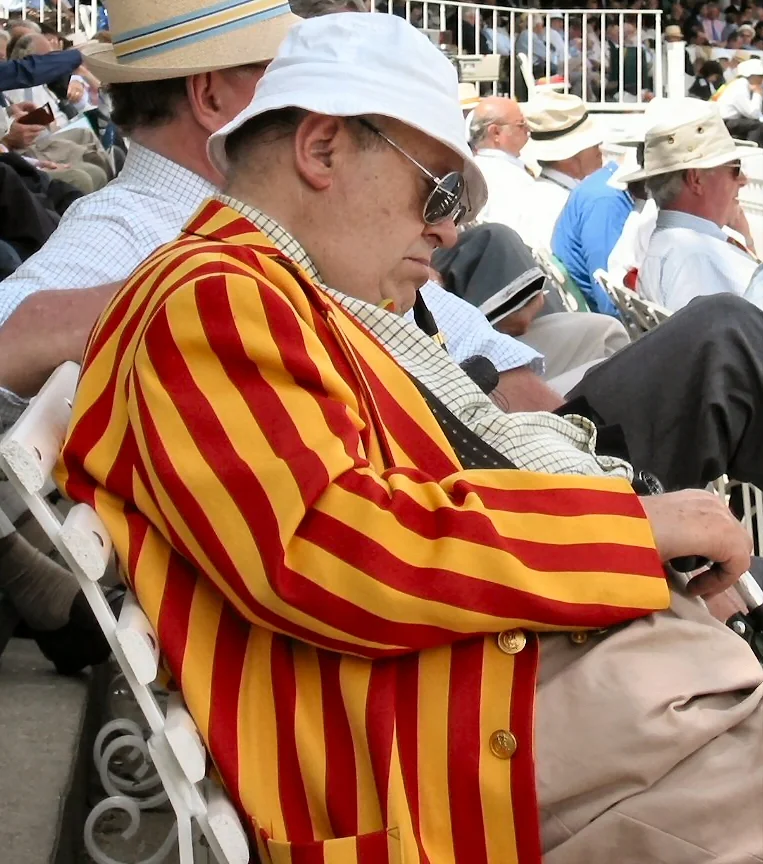
The MCC tie - scarlet and gold stripes, said to look like 'bacon and egg' - is one of the most recognisable in sport. No one is entirely sure where the colours came from. The club originally wore sky blue. One theory traces the red and gold to the racing colours of the Dukes of Richmond, who were early patrons, and Lord Frederick Beauclerk, President in 1826. Another credits William Nicholson, the gin distiller whose company financed the freehold purchase of Lord's in 1866; his family colours were red and yellow. England's Test cricketers wore the stripes officially until the 1976-77 tour of India, and informally as recently as the 1996-97 tour of New Zealand. Today they are seen at Lord's during major matches, knotted around the necks of older members in the Pavilion - a piece of livery that has somehow survived from the era of carriages and four-day matches.
Modern Trouble, Modern Reform
The MCC has not always handled change gracefully. In 2012 the Vision for Lord's redevelopment plan - which would have built residential flats on part of the ground - split the membership; the former Prime Minister Sir John Major resigned from the Main Committee over the way the decision was being taken. During the second Test of the 2023 Ashes, MCC members shouted abuse at Australian players walking through the Long Room after Jonny Bairstow's controversial stumping, despite the dismissal being fair and legal. The club apologised to Cricket Australia and suspended three members. In December 2012 the MCC received a Royal Charter, after two failed attempts, finally making it a legal entity that could own Lord's in its own name. Kumar Sangakkara, the great Sri Lankan batter, became the first Asian President in 2019. Ed Smith was nominated by Lord King of Lothbury as President for 2026. The club has 18,000 full members and 5,000 associate members, fields ad hoc MCC XIs across the country, and still touts its 19th-century Coaching Book as a bible for young players. The Home of Cricket is also, increasingly, the most slowly modernising institution in the sport it created.
From the Air
Lord's Cricket Ground sits at 51.5296° N, 0.1730° W in St John's Wood, just north of Regent's Park. From the air the oval of grass is unmistakable, ringed by the J.P. Morgan Media Centre (the silver pod above the Nursery End), the Edrich and Compton Stands, and the red-brick Pavilion. The ground is two miles north of central London. London Heliport (EGLW) is the only central helicopter base; London City (EGLC) lies east, Heathrow (EGLL) southwest. Central London is Class A airspace. Best ground-level view from the Grace Gates on St John's Wood Road, looking up at W. G. Grace's beard immortalised in iron.
Nearby Stories
- Stevenage 5.7 km away
- Malling Abbey 5.7 km away
- 1952 Farnborough Airshow Crash 7.7 km away
- Ingatestone Hall 8.2 km away
- Hellfire Caves 9.1 km away
- The Carrington Event: The Solar Storm That Could Happen Again 9.8 km away
- Bletchley Park 16 km away
- Castle Hedingham 23 km away