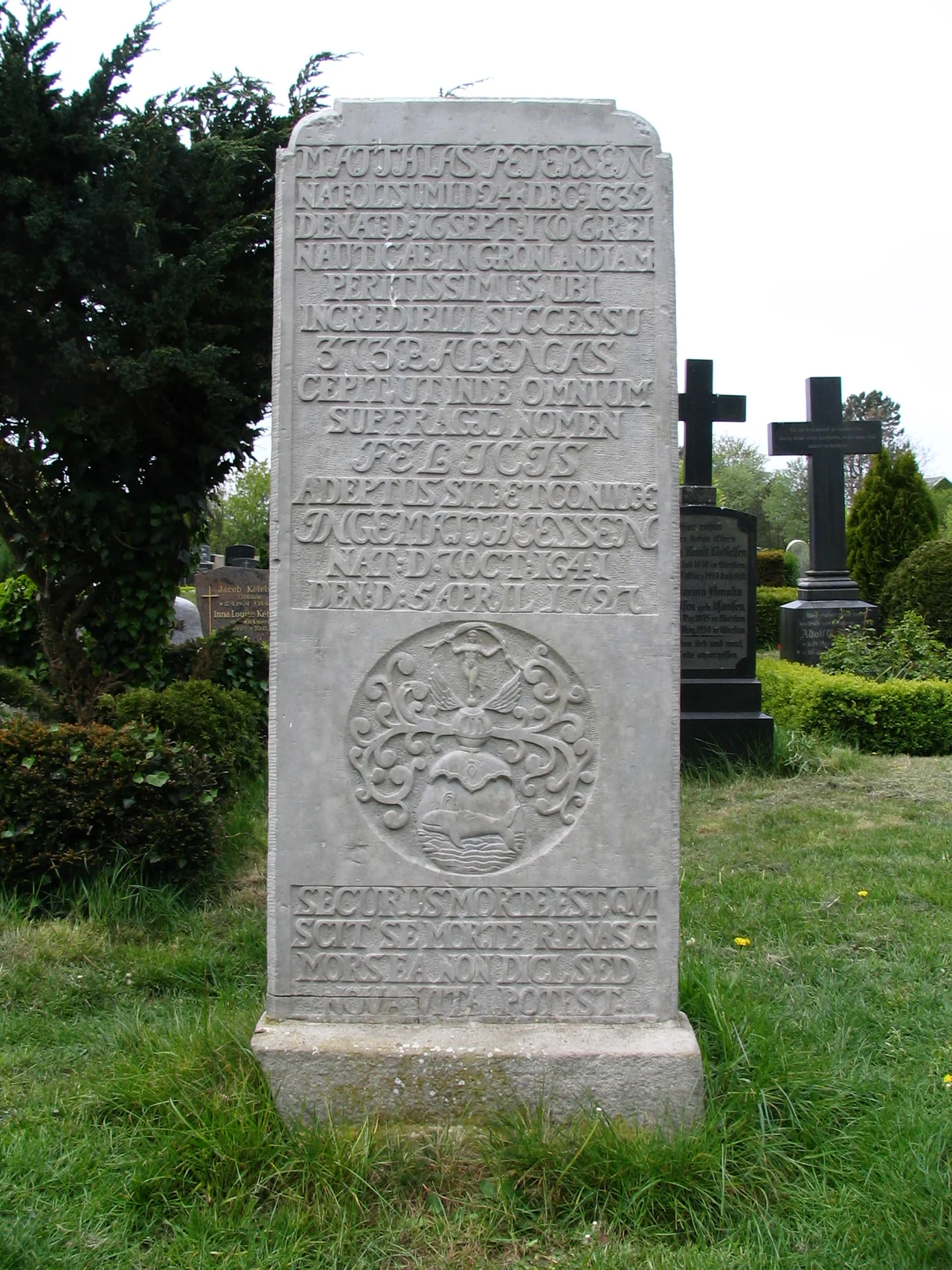

Matthias Petersen
On Christmas Eve of 1632, a boy named Matz Peters was born in the village of Oldsum on the small Frisian island of Föhr. He was the third son of a fisherman, and on Föhr in those years, third sons did not stay on land. At twelve years old, while children elsewhere were learning catechism, Matz climbed aboard a Dutch ship bound for the whaling grounds of the Arctic. By the time he came home for good, he had a new name - Matthias Petersen - and a tally that still startles: 373 whales, killed by his hand and his crews across fifty years at sea.
Lucky Mathew
They called him Glücklicher Matthias - Lucky Mathew - and the surname stuck so firmly that his tombstone records it as something he formally accepted, with everybody's approbation. The luck was real but the catch was also a matter of timing. Petersen sailed during the brief, brutal era of bay fishery, when the bays of Spitsbergen held so many bowhead whales that a competent captain could fill a hold in weeks. The Dutch and the Frisians fell on those bays with harpoons and try-pots, rendering blubber on the rocks until the bays ran red. Petersen was made commander of a whaling vessel at twenty - young, even for that ruthless trade - and across nineteen recorded voyages he amassed the modern equivalent of more than half a million euros. On Föhr, where most men returned from a season with enough to feed a family and not much more, that fortune made him something close to royalty.
Christmas Eve
Read his life by the dates and a pattern emerges. Born on Christmas Eve. Caught his first whales as a teenager. Captained ships through fifty Arctic summers, each one a gamble against ice, storm, and the temper of animals larger than the ships hunting them. Year after year, Matthias came home. His brothers did not always come home. His shipmates did not always come home. The Frisian islands buried captains routinely - drowned, frozen, crushed against floes - and Matthias kept sailing. The nickname was not flattery. On an island where every family had lost someone to the Arctic, surviving five decades of whaling was its own kind of miracle, and the islanders named it plainly.
The Year the Luck Ran Out
Then came 1702. Petersen was seventy years old, still at sea, still in command. Somewhere on his last voyage, a French privateer ran his ship down. The Frisian crew was taken, the cargo seized, and Petersen - the legendary Lucky Mathew - found himself a hostage. He and his men were released only after a ransom of eight thousand Reichsthalers changed hands. In the same year, in separate skirmishes, two of his sons fell in battle against a French pirate. Picture the old captain returning to Oldsum that winter, drained of money and emptied of children. He lived four more years and died at home on Föhr in September 1706, the last of the bay whalers and a witness to the trade's collapse into pelagic chase fisheries that demanded ships he no longer owned.
The Tomb That Got Evicted
Petersen's tombstone stands today in the graveyard of St. Lawrence's church in Süderende, a slab of red sandstone carved with a Latin biography and a coat of arms: the goddess Fortuna riding on the back of a swimming whale. It is the only Latin inscription in the cemetery and the most famous of Föhr's so-called Talking Gravestones. But the slab was not always outside. Petersen had bequeathed a hundred gold florins to the church on the condition that he be buried inside it, and for fourteen years his tomb stood within the walls amid great pomp. His heirs never paid. The parish quarreled, the parish lost patience, and eventually the parish carried Lucky Mathew's monument out into the rain. Fortuna and her whale have weathered three centuries of North Sea wind in the churchyard ever since.
The Bloodline
Petersen's wealth bought his sons books and tutors, which on Föhr in the 1600s was nearly as rare as the wealth itself. One son, Clement, became a preacher and is believed to have written the Latin verse on his father's tomb. Another, Peter Matthiesen, studied at Jena and became bailiff of three islands at once. A grandson of the same name was made mayor of Copenhagen in 1771 by Count Struensee - and survived politically when Struensee was executed for treason. Three centuries later, in the late 1980s, the American naturalist and novelist Peter Matthiessen flew to Föhr to walk the graveyard at Süderende and read the Latin on Lucky Mathew's stone. His family chronicle traced him directly to Petersen's son Jung-Ocke. The whaler's luck, it turned out, was a fairly portable inheritance.
From the Air
Oldsum and Süderende sit on the western half of Föhr at roughly 54.72N, 8.44E, in the German Wadden Sea. The island lies between Amrum to the southwest and Sylt to the north. Nearest airport is Wyk auf Föhr (EDXY) on the eastern shore; Sylt (EDXW) handles regional traffic from Hamburg. At 2,000 to 4,000 feet on a clear day the whole island shows in one frame, with Lucky Mathew's tomb at the center of the western parish.
Nearby Stories
- Amrumbank West 26 km away
- German Bight 34 km away
- HMS Ariel (1911) 38 km away
- Stalag X-B 123 km away
- Tvindkraft Wind Turbine 138 km away
- Teufelsmoor 164 km away
- Clausholm Castle 175 km away
- Battle of Jutland 219 km away