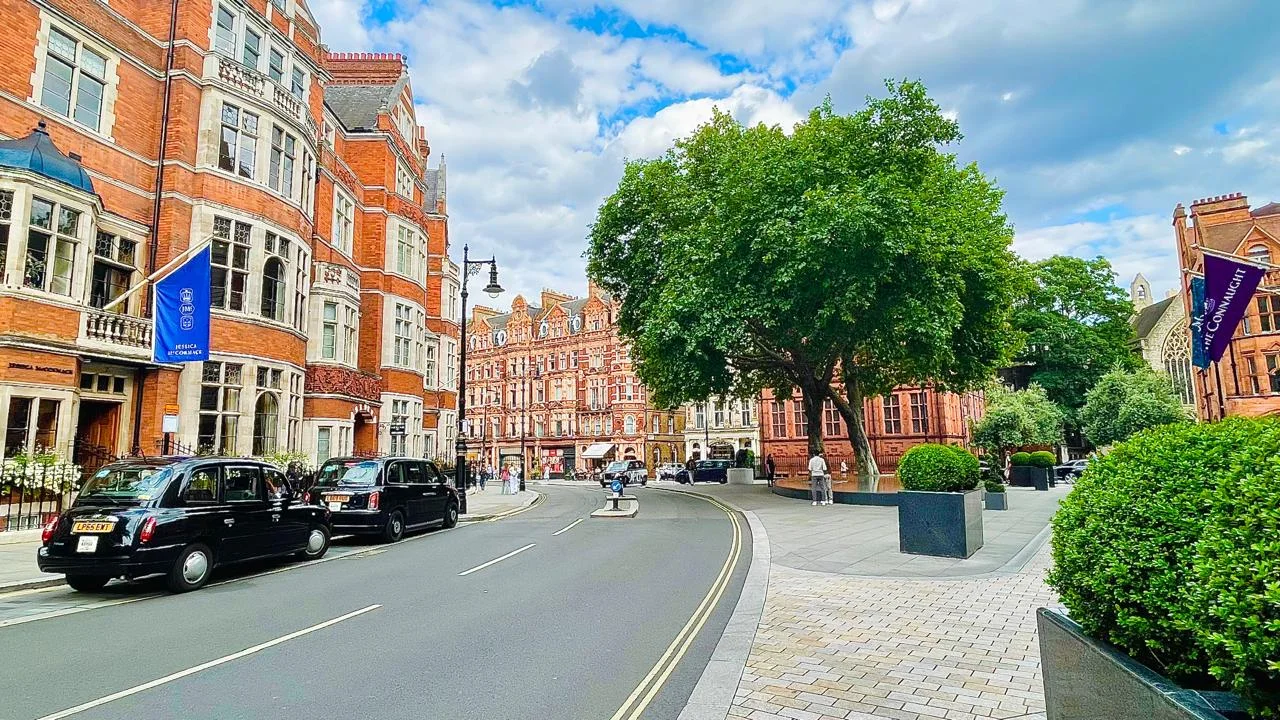

Mayfair
The neighbourhood is named after a fair that the neighbourhood eventually got tired of. From 1686 to 1764 the May Fair ran every spring on the ground that is now Shepherd Market, a riot of jugglers, ballad sellers, gingerbread stalls, semolina-eating contests, women's foot racing and bare-knuckle fights. By the reign of George I, the entertainment had soured into something closer to a slum carnival; the 6th Earl of Coventry, who lived on Piccadilly, organised the locals to have it shut down. It was abolished in 1764. By then the wider area was already being redeveloped by the Grosvenor family into the most ambitious aristocratic estate in London, and within a generation the spring fair's old fields had been replaced by Hanover Square, Berkeley Square, Grosvenor Square, and the most expensive housing in Britain. The fair is gone; the name stuck.
The Grosvenor Grid
The Grosvenor family - who became Dukes of Westminster in 1874 - acquired the land through marriage in 1677, when twelve-year-old heiress Mary Davies wed twenty-one-year-old Sir Thomas Grosvenor. In 1721, the London Journal reported that the ground 'upon which the May Fair formerly was held' would be marked out for a large square with fine streets running off it. Thomas Barlow drew up the grid: wide, straight streets centred on Grosvenor Square. By the mid-eighteenth century the area was covered in brick and stucco terraces, with seven estates - Burlington, Millfield, Conduit Mead, Albemarle, Berkeley, Curzon, and the dominant Grosvenor - holding most of the land. Only the Grosvenor estate has remained intact and in the same family for the entire three centuries that followed. The current Duke of Westminster, born in 1991, is still the largest landowner in Mayfair.
Embassies in Old Houses
The First World War broke the British upper class's hold on the area. With servants harder to find and labour costs rising, the great houses became expensive to run, and many were converted into foreign embassies that needed prestigious addresses and could pay. The American embassy moved into Grosvenor Square between the wars; the 1960 building on the western side, designed by Eero Saarinen, served as the US embassy until 2018 and is now a hotel. The Italian embassy occupies No. 4 Grosvenor Square. Macdonald House, named for Canada's first prime minister, has been the Canadian High Commission since 1961. The wealthy families that built Mayfair sent their lawyers to convert the family seat into chanceries and diplomatic offices, and by the Second World War the square had become an exterritorial archipelago of nations within the city.
Brown's, Claridge's and Bertram's
Brown's Hotel opened in 1837 on Albemarle Street, and is considered one of London's oldest. Queen Victoria is thought to have taken tea there. In 1876 Alexander Graham Bell made the first successful telephone call in Britain from inside Brown's. Rudyard Kipling wrote part of The Jungle Book in his room there; Agatha Christie wrote part of At Bertram's Hotel during a stay - that novel's hotel is widely understood to be Brown's in light disguise. Theodore Roosevelt held his wedding reception there in 1886. Claridge's, on Brook Street, was founded as Mivart's Hotel in 1812 and acquired by William Claridge in 1855. During the Second World War several exiled European royal families lived there; on 17 July 1945 Alexander, Crown Prince of Yugoslavia, was born in the hotel, and Winston Churchill is said to have declared the suite Yugoslav territory for the occasion so that the future king would be born on Yugoslav soil. The Maybourne Hotel Group, which owns Claridge's and The Connaught, is Qatari-controlled, and the north-western corner of Mayfair has been nicknamed 'Little Doha' in consequence.
Savile Row
Tailors began moving into Savile Row, on the south-eastern edge of the estate, in 1803. Henry Poole and Co arrived in 1846 and is the earliest extant tailor on the street. By the late nineteenth century Savile Row was the global capital of bespoke menswear, dressing emperors, sultans, presidents and matinee idols; the term 'bespoke' itself comes from the cloth being 'spoken for' on the tailor's shelf. Just a few hundred yards away, the Burlington Arcade - designed by Samuel Ware in 1819 for the 1st Earl of Burlington - housed luxury shops behind a long Regency colonnade. The walls were built tall to stop passers-by throwing rubbish into the Earl's garden next door. The arcade survived being bombed in the Second World War and a 1926 sale to Prudential for £333,000; it still has its Burlington Beadles, top-hatted security guards charged with enforcing the rules against running, whistling and singing.
The Most Expensive Square
When Victor Watson and Marjory Phillips designed the British edition of Monopoly in 1936, they made Mayfair the most expensive property on the board. The choice was already a cliche by then: Mayfair had become shorthand for unaffordable London. The neighbourhood has never lost that status. Park Lane along the western edge, Piccadilly along the south, Oxford Street to the north and Regent Street to the east enclose roughly a square mile of Georgian and Edwardian buildings; the streets within still mostly belong to the same handful of estates. Residential property here remains among the most expensive in the world, with rents that price out anyone not associated with a hedge fund, an embassy, or an inherited estate. Shepherd Market, the old fairground, was rebuilt around 1860 and is now a small village of restaurants, pubs and antique shops. The fair has not run for 262 years, but the May in Mayfair endures.
From the Air
Mayfair occupies the rectangle bounded by Oxford Street (north), Regent Street (east), Piccadilly (south) and Park Lane (west), centred at 51.5103° N, 0.1472° W. From above, the green strips of Hyde Park and Green Park frame the western and southern edges; Grosvenor Square is roughly central, with Berkeley Square to its east. The Shard, Big Ben and the London Eye are all easily visible to the south and south-east. London Heliport (EGLW) is the closest helipad, with London City (EGLC) east and Heathrow (EGLL) west. Central London is Class A airspace, restricted. From the ground, Park Lane provides the easiest orientation: the long line of luxury hotels facing Hyde Park - the Dorchester, the Grosvenor House and the InterContinental - marks Mayfair's western boundary.
Nearby Stories
- Stevenage 5.7 km away
- Malling Abbey 5.7 km away
- 1952 Farnborough Airshow Crash 7.7 km away
- Ingatestone Hall 8.2 km away
- Hellfire Caves 9.1 km away
- The Carrington Event: The Solar Storm That Could Happen Again 9.8 km away
- Bletchley Park 16 km away
- Castle Hedingham 23 km away