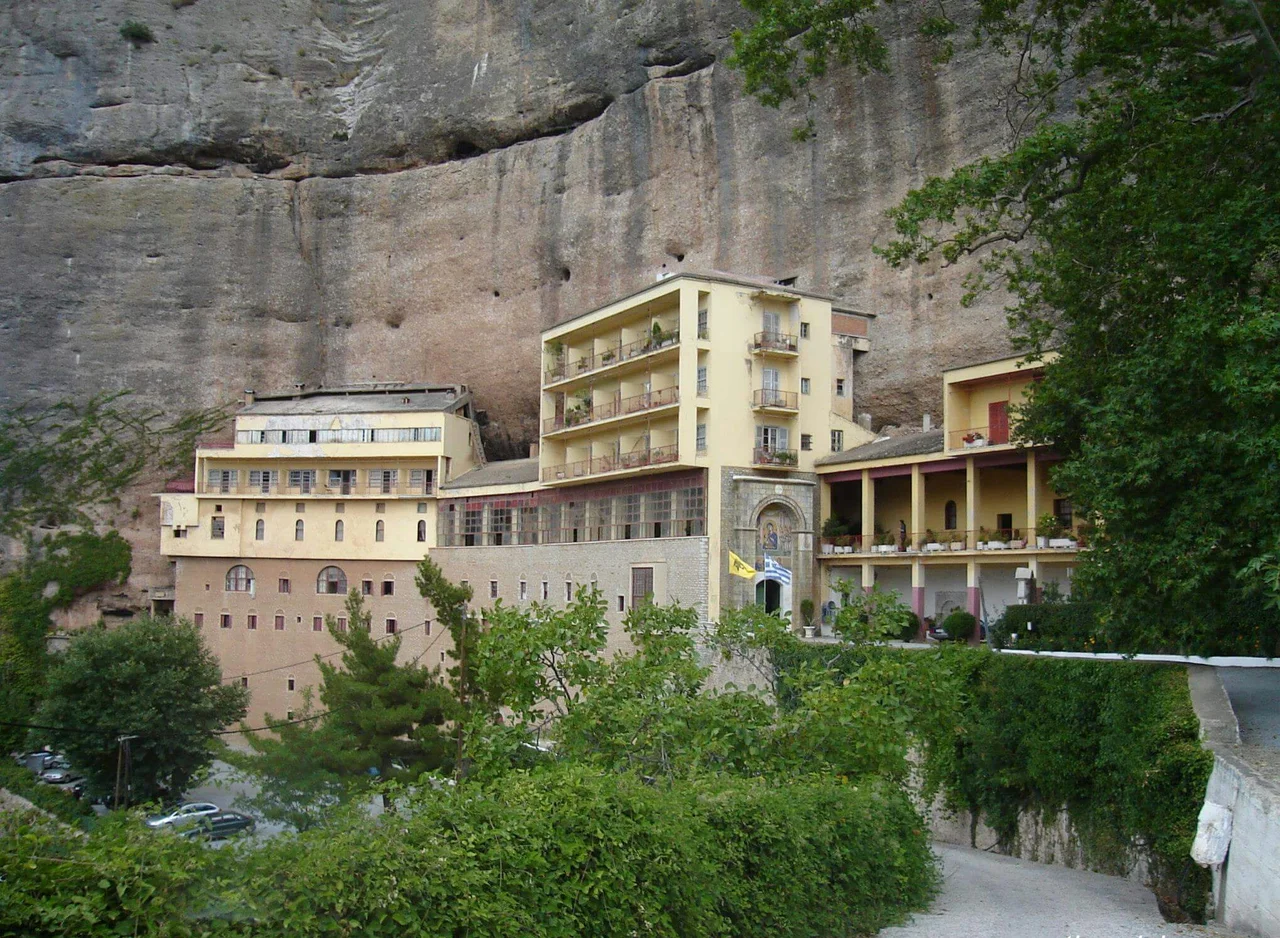

Mega Spilaio
The cliff was already there, and the cave within it, long before anyone thought to build a monastery. Early Christian hermits found it sometime in the first centuries CE — a vast hollow in the sheer limestone face where the slopes of Mount Chelmos plunge into the gorge of the Vouraikos river. They stayed. Communities formed. Over the centuries, what began as a hermit's refuge became Mega Spilaio: the Great Cave, formally the Monastery of the Dormition of the Theotokos, its eight stories of masonry locked into the rock face 120 metres above the gorge floor, one of the most dramatically sited monasteries in all of Greece.
Built into the Mountain
The monastery does not merely sit beside the cliff — it is embedded within it. The cave forms the rear wall and ceiling of the complex, and the monks have built outward from the rock in successive tiers, adding floors as communities grew and rebuilding when disaster struck. The result is an eight-storey structure that merges seamlessly with the limestone face, its whitewashed facades emerging from the overhang in a way that appears, from a distance, almost geological. The gorge of the Vouraikos below carries a narrow-gauge rack railway — the Odontotos, or 'toothed train' — and from its windows, passengers look straight up at the monastery stacked above the void. The monastery lies about 11 kilometres northwest of the town of Kalavryta.
Seventeen Centuries of Survival
The monastery's history is a chronicle of destruction and return. Large-scale disasters struck in 840, in 1400, and again in 1640 — each time, the community rebuilt. Through Byzantine rule, through the Frankish Principality of Achaea, through Ottoman centuries, Mega Spilaio persisted. From around 1354, it served as the residence of the Orthodox Metropolitan of Patras, whose city was then under Latin occupation; the cave monastery became a refuge for the authority of Greek Orthodoxy itself. The community that lived here held together an institutional continuity that outlasted every power that tried to eclipse it.
December 8, 1943
The worst moment came not in the medieval centuries but in the twentieth. On 8 December 1943, soldiers of the German 117th Jäger Division crossed the Vouraikos gorge and reached Mega Spilaio. They accused the monks of sheltering British agents and supporting the Greek Resistance. Twenty-two monks and monastery staff were killed. The complex was burned and destroyed. The massacre at the monastery was part of a larger operation in the region — within days, the Wehrmacht carried out the Kalavryta massacre, killing the male population of the town and burning it to the ground. It remains the worst atrocity committed in Greece during the German occupation.
Rebuilt, Again
After 1945, the monastery was rebuilt from the ground up — the most recent in its long sequence of reconstructions. The eight-storey complex that stands today is largely postwar construction, though it incorporates what could be salvaged from what came before. The monastery celebrates its feast days on 15 August, the Dormition of the Theotokos; on 14 September; and on 18 October, the feast of Luke the Evangelist, along with the community's founders. It remains an active male monastery, and its treasury holds icons, manuscripts, and relics accumulated across centuries. Visitors arrive from the road below or by the rack railway, climbing to a place that has been, through every disruption, continuously inhabited.
From the Air
Mega Spilaio is located at approximately 38.089°N, 22.175°E, on the western slopes of Mount Chelmos in the Peloponnese, above the Vouraikos gorge. From the air at 4,000–5,000 feet, the cliff face is visible as a dramatic vertical wall cutting through the forested slopes west of Kalavryta. The monastery's white facades are visible against the grey limestone on the northern exposure of the cliff. The nearest major airport is LGRX (Araxos), approximately 55 km to the northwest along the Gulf of Corinth coast. Flying east along the Gulf from Araxos, the mountains of the northern Peloponnese rise sharply inland, and the Vouraikos gorge cuts southward through those ranges — the monastery sits in the upper gorge, out of sight from the coast.
Nearby Stories
- Rio–Antirrio Bridge 2.1 km away
- Heraion of Perachora 3.2 km away
- Battle of Chalandritsa 6.2 km away
- Orchomenus (Arcadia) 7.6 km away
- Galaxidi 8.1 km away
- Battle of Coronea (447 BC) 11 km away
- Battle of Lalas 11 km away
- Arkadiko Bridge 23 km away