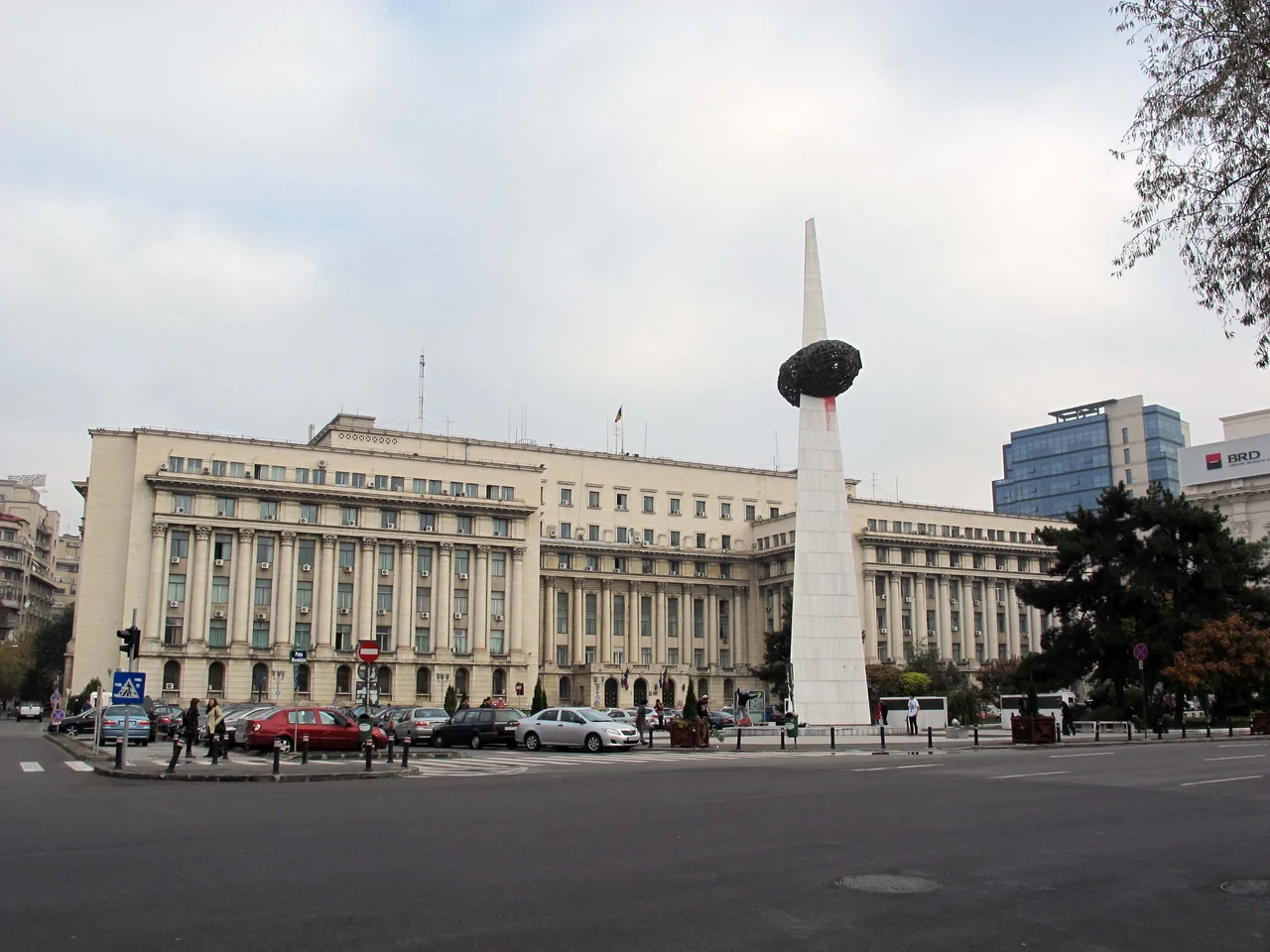

Memorial of Rebirth
Bucharest residents have nicknames for the monument that supposedly honors their dead. The impaled potato. The olive on a toothpick. The vector with the crown. The 25-meter marble pillar rising from Revolution Square was meant to honor the people who died bringing down Nicolae Ceausescu in December 1989, but from the moment it was inaugurated in August 2005, the city has refused to embrace it. The complaint is not that Romania built a memorial to the revolution. The complaint is that Romania built this one.
Square of the Last December
Revolution Square is the right place for the monument, even if the monument itself is wrong. This is where Ceausescu gave his last speech on 21 December 1989, attempting to rally a crowd against the protests that had begun in Timisoara days earlier. Television viewers across Romania watched the moment his control slipped: the boos, the dictator's confused pause, the recognition crossing his face that something had broken. Within four days he and his wife Elena were dead, executed after a brief military trial on Christmas Day. The square sits at the heart of old Bucharest, flanked by the former Royal Palace, now the National Museum of Art, and the Athenaeum concert hall. Around 1,104 people died in the violence that brought down the regime, most of them shot in the chaotic days after Ceausescu fled by helicopter from the Central Committee building just steps from where the pillar now stands.
The Designer's Spike
Alexandru Ghildus designed the memorial: a tall white pillar topped with a metal openwork crown, surrounded by a marble and granite plaza. The whole project cost about 1.2 million euros. From the start, critics asked why a designer best known for chairs and lamps had been chosen to memorialize a national tragedy when the country had no shortage of sculptors. The art critic Mihai Oroveanu said bluntly that Ghildus did not have the qualifications to attempt the work. Both the Bucharest urbanism committee and the local Sector 3 committee rejected the design, but their role was advisory only, and the pillar went up anyway. The Mayor of Bucharest at the time, Adriean Videanu, admitted at the inauguration that he himself did not understand its symbolism. He used the most diplomatic language available to a politician. Other Romanians were less restrained.
Heroes or Errors
In 2005, the contemporary artist Vlad Nanca began stenciling the word erori, errors, on walls around the city, a single letter changed from eroi, heroes. He called the obelisk a horrid grotesque thing that disparaged the sacrifice of the people the monument was supposed to honor. On the night of 12 May 2006, someone scaled the pillar and painted a stencil of V from the V for Vendetta film on the side facing the National Museum of Art. Other paint, applied so high up that no one has been able to reach it for removal, runs down the marble in long red streaks. From certain angles, in certain light, the column appears to be bleeding. The monument is now guarded around the clock. The vandalism keeps happening anyway, because for a significant number of Bucharest residents, the act of marking the pillar feels truer to what 1989 meant than the pillar itself.
Memory Without Closure
The argument over the Memorial of Rebirth is really an argument about how a country grieves a revolution that never quite finished its sentence. Romania's transition from communism was bloodier than any of its neighbors' and less complete: many of the people who staffed the Ceausescu state quietly returned to power under different labels in the 1990s. Families of the dead spent years pushing for a proper memorial, and what they got was an abstract pillar that, to many of them, looked like nothing in particular. Defenders of the design argue that abstraction is appropriate, that any literal sculpture of fallen revolutionaries would have felt sentimental and small. Critics counter that abstraction can also be a way of saying nothing in particular about something specific. Both arguments have merit. The pillar stands, the paint remains, and the conversation continues. That may be the most Romanian outcome possible.
From the Air
Memorial of Rebirth: 44.4387 N, 26.0973 E, in Revolution Square in central Bucharest. Best viewed below 3000 feet. Identifiable as a tall slender white pillar with a darker crown, set in a stone plaza next to the National Museum of Art (the former Royal Palace) and the Athenaeum. Nearest airport is Henri Coanda International (LROP) about 10 nm north. The Memorial of Rebirth sits within the historic core, near the Calea Victoriei and University Square. Class C airspace surrounds Bucharest; coordinate with Bucharest approach for low-level flight.
Nearby Stories
- National Transport Museum, Bulgaria 34 km away
- Slanic Mine 68 km away
- Sinaia 79 km away
- Great Basilica, Pliska 87 km away
- Sinaia Monastery 108 km away
- Holy Forty Martyrs Church, Veliko Tarnovo 115 km away
- Shumen Fortress 126 km away
- Danube Delta 227 km away