.jpg)
Memorial Tunnel
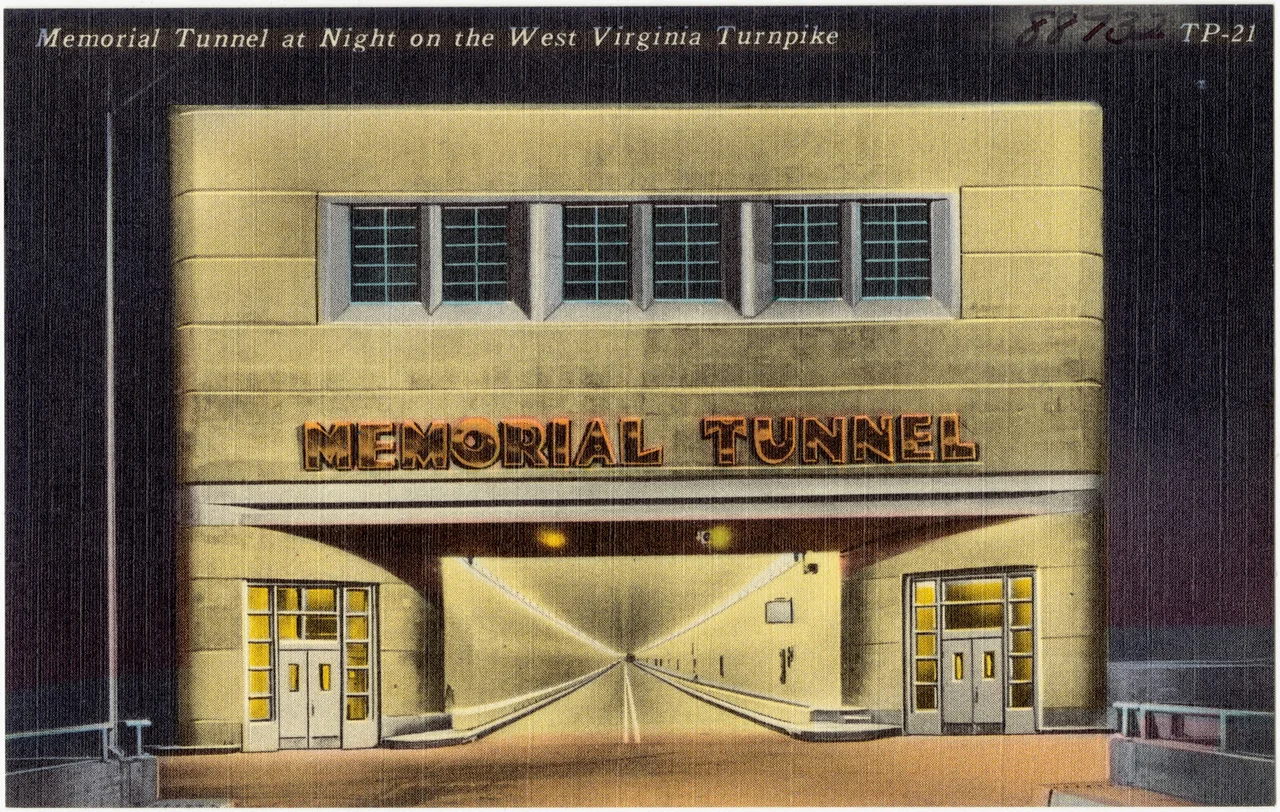
By 1987, the Memorial Tunnel was a bottleneck. The West Virginia Turnpike had been widened from two lanes to four over its entire 88-mile length - everywhere except inside this 2,802-foot tunnel through Paint Creek Mountain, where four-lane expansion was impossible without boring a new tunnel. The state built a parallel route around the mountain instead and closed the tunnel to interstate traffic. What happened next made the abandoned tunnel improbably famous in the engineering world. Between 1993 and 1995, the Federal Highway Administration deliberately set 98 fires inside the closed tunnel - some of them simulating massive truck fires consuming hundreds of gallons of diesel fuel - to test ventilation systems that would later inform the design of Boston's Big Dig, the Channel Tunnel, and most major American highway tunnel construction since. Then it became an anti-terrorism training facility. Now it grows mushrooms.
Eighty-Eight Miles of Miracle
Construction of the Memorial Tunnel began in 1952 and finished in November 1954, the same year the West Virginia Turnpike opened as one of the new postwar limited-access toll roads connecting the eastern interstate system to the central Appalachians. The turnpike, with its tunnels and bridges threading through some of the most difficult terrain in the country, was advertised as 'eighty-eight miles of miracle.' Excavating Memorial Tunnel required moving about 91,000 cubic yards of earth and rock through Paint Creek Mountain. The tunnel was the first in the nation equipped with closed-circuit television monitoring - a small but consequential innovation. Drivers in the mid-1950s, accustomed to two-lane mountain highways, found the long lit bore beneath the ridge a small marvel.
Bypassed and Closed
By the late 1970s, traffic on the turnpike had outgrown the two-lane tunnel. The rest of the route was widened to four lanes between 1976 and 1983. Memorial Tunnel could not be widened in place - the geometry of an existing two-lane bore through a mountain made any expansion enormously expensive - so the state built a parallel surface routing that climbed over the ridge instead of through it. The old tunnel was closed to interstate traffic in 1987. The facility, in good structural condition, sat empty for several years while officials looked for a use.
The Fire Tests
Between 1993 and 1995, the Federal Highway Administration in partnership with the Massachusetts Highway Department conducted what became known as the Memorial Tunnel Fire Ventilation Test Program. The project deliberately set 98 fires inside the closed tunnel, ranging from small pool fires to massive simulated truck fires consuming hundreds of gallons of diesel and producing flames that reached the ceiling. Researchers tested different ventilation strategies - jet fans, transverse ventilation, semi-transverse - measuring how each handled smoke, heat, and visibility for emergency egress. The results reshaped tunnel ventilation engineering globally. The Big Dig's tunnels in Boston used the Memorial Tunnel data directly. The Channel Tunnel design incorporated lessons learned. The Federal Highway Administration changed its rules to allow jet fans as primary ventilation, reportedly saving about $20 million in Big Dig construction costs alone.
Anti-Terrorism Training and Mushrooms
After the fire tests concluded, the tunnel found its next role. By 2000, the Center for National Response - a Department of Defense partnership program - had set up shop in the abandoned tunnel as a training facility for military and civilian first responders. The site allowed exercises simulating tunnel-based terrorism scenarios - hostage situations, hazardous material releases, mass-casualty events - in a realistic environment without alarming the general public. Trainees from federal agencies, state emergency management offices, and military units rotated through. The training program continued for two decades. Then in 2022, a new business announced plans to convert the tunnel into a mushroom-growing facility - the consistent cool temperature and humidity inside the bore being ideal for fungiculture. Tunnel vision, the headline writers wrote. The mushroom operation was up and running by 2023.
Flying Over Paint Creek Mountain
From the air, the Memorial Tunnel itself is invisible - it is, after all, a tunnel - but the surface routing around Paint Creek Mountain that replaced it is clearly visible as the current path of the West Virginia Turnpike (Interstate 64 / Interstate 77). The original tunnel portals can be picked out on either side of the mountain as small openings flanked by abandoned roadway. Paint Creek itself winds through the valley below. The terrain around the site - the New River Gorge country, the Kanawha Valley to the north - is some of the most dramatic in the eastern United States, with the Allegheny Plateau dissected by deep creeks into a confused mosaic of ridges and hollows.
From the Air
Located at 38.13°N, 81.42°W on Paint Creek Mountain in Kanawha County, West Virginia, just east of the West Virginia Turnpike's current routing. The tunnel itself is underground; look for the portals on the north and south sides of the mountain. Nearest airports: Yeager Airport (KCRW) at Charleston about 16 nm north, Raleigh County Memorial (KBKW) at Beckley about 25 nm south. Best context is gained from 4,000-6,000 feet AGL, where Paint Creek's valley and the turnpike's bypass routing are visible.
Nearby Stories
- Hobet Coal Mine 6.8 km away
- Beckley, West Virginia 18 km away
- Southwest Airlines Flight 2294 19 km away
- Morris Memorial Hospital for Crippled Children 20 km away
- Mingo County, West Virginia 21 km away
- Summersville, West Virginia 25 km away
- Westsylvania 32 km away
- Monroe County, West Virginia 38 km away