_-_img_06.jpg)
Mendut: The Temple That Was a Bamboo Forest
The inscription is dated 824 AD, carved during the reign of King Indra of the Shailendra dynasty, and it records the completion of a sacred building called Venuvana. The word is Sanskrit for "bamboo forest." Dutch archaeologist JG de Casparis spent years connecting that name to the stone structure standing in a village near Magelang, Central Java, and when the connection clicked, it reframed everything about the temple now called Mendut. This was not simply a shrine. It was meant to evoke a grove - a place of enclosure, shade, and transformation.
Oldest of the Sacred Three
Mendut is the oldest of three Buddhist temples that form a straight line across the Kedu Plain: Mendut to the southwest, the small Pawon in the middle, and the colossal Borobudur to the northeast, each separated by roughly one to two kilometers. The alignment is deliberate. Scholars believe pilgrims walked from Mendut through Pawon to Borobudur in a ritual sequence - though what exactly that sequence involved has been lost to the centuries. The religious relationship among the three temples is acknowledged but not fully understood. What is clear is that Mendut came first. The style and detail of its carvings predate those of Borobudur, and the Karangtengah inscription placing its construction during King Indra's reign gives it a firm anchor in the early ninth century. When it was rediscovered in 1836, it was a ruin covered in bushes. Restoration began in 1897 and took nearly three decades, finishing in 1925.
Three Giants in the Dark
Step inside Mendut's main chamber and your eyes adjust slowly. Three massive stone statues fill the space: a seated Dhyani Buddha Vairocana in the center, flanked by Bodhisattva Avalokitesvara on the left and Bodhisattva Vajrapani on the right. The central figure stands three meters tall. Each statue serves a specific spiritual function. Vairocana liberates devotees from the karma of the body - the accumulated weight of physical actions. Avalokitesvara addresses the karma of speech. Vajrapani handles the karma of thought. Together, they offer a complete purification, and to sit in that chamber with all three presences is to understand why the builders chose the scale they did. These are not decorative. They are meant to overwhelm.
Walls That Teach
The temple's exterior is a curriculum in stone. The base is square, measuring 13.7 meters on each side, raised 3.7 meters above the ground on an elevated platform. The full structure reaches 26.4 meters, oriented to face the northwest. Makara statues guard each side of the stairwell, and the walls between them are carved with bas-reliefs of Jataka fables - animal stories that carry Buddhist moral teachings. Walk clockwise around the terrace, performing the pradakshina circumambulation, and you pass an encyclopedia of Bodhisattvas carved into the outer walls: Avalokitesvara, Maitreya, Kshitigarbha, Samantabhadra, Manjushri, Vajrapani, and the female deity Prajnaparamita, among others. Inside the front chamber, a bas-relief of Hariti surrounded by children faces Atavaka on the opposite wall, with Kalpataru trees and flying devata divinities filling the remaining space. Originally the temple had two chambers, but the roof and much of the front chamber's walls are now missing. The uppermost section of the roof, which likely held a stupa pinnacle, has not survived.
A Living Pilgrimage
Mendut is not a museum. Every year during the full moon in May or June, Indonesian Buddhists observe Vesak by reenacting the ancient pilgrimage route. They gather at Mendut, offer prayers and walk the pradakshina around the temple, then continue on foot through Pawon and onward to Borobudur. The procession is a mass prayer in motion, and it draws practitioners from across the Indonesian archipelago. But Mendut serves other spiritual communities as well. Followers of Kejawen, the syncretic tradition of Javanese mysticism that blends Hindu, Buddhist, Islamic, and indigenous spiritual elements, also worship here. The temple is believed to have the power to fulfill wishes, particularly healing from illness. This dual use - orthodox Buddhist practice alongside local folk belief - mirrors a pattern found across Java, where religious boundaries have always been more porous than doctrinal categories suggest.
The Buddhist Monastery Next Door
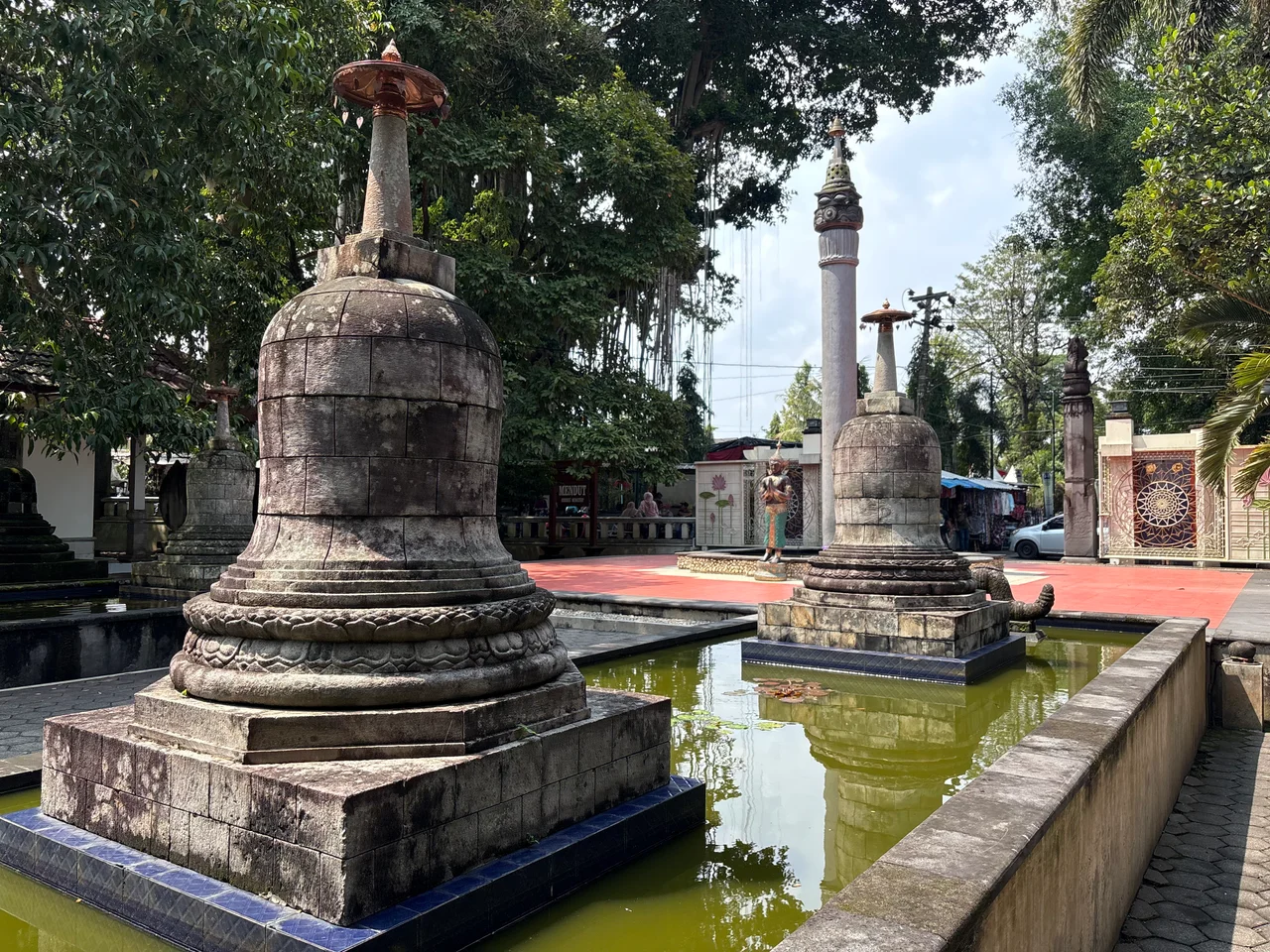
Adjacent to the ancient temple sits the Mendut Buddhist Monastery, a working religious community that maintains a living connection to the site's original purpose. The monastery grounds include Candi Sangharaja, a modern structure built to honor the 100th birthday of Vajirananavarorasa, the revered Thai patriarch. The contrast between the weathered ninth-century stonework and the monastery's contemporary buildings captures something essential about Mendut. This is a place where twelve hundred years of Buddhist practice have not been interrupted so much as layered. The ancient carvings and the modern prayers share the same air, the same volcanic soil, the same straight-line connection to Borobudur rising above the rice paddies to the northeast.
From the Air
Mendut temple (7.60S, 110.23E) is located in Mendut village, Mungkid sub-district, Magelang Regency, Central Java, Indonesia. It sits approximately 3km east of Borobudur and 40km northwest of Yogyakarta. Adisucipto International Airport (WARJ) is about 40km southeast. The temple is a modest structure surrounded by trees and the adjacent Mendut Buddhist Monastery, harder to spot from altitude than Borobudur. Look for the straight-line alignment: Mendut to the southwest, Pawon in the middle, Borobudur to the northeast. Best viewed at 2,000-4,000 feet AGL. The Progo River runs nearby to the west. Tropical climate with frequent cloud cover; dry season (May-September) offers clearer conditions.
Nearby Stories
- The River Runway 4.8 km away
- Ganjuran Church 12 km away
- Forty Thousand Hills 15 km away
- Kedung Ombo Dam 18 km away
- A King's Canal, Carved in Stone 20 km away
- Gedong Songo: Nine Temples on a Volcanic Hillside 24 km away
- Through the Limestone Dark 26 km away
- The Ghost Boat That Built an Empire 99 km away