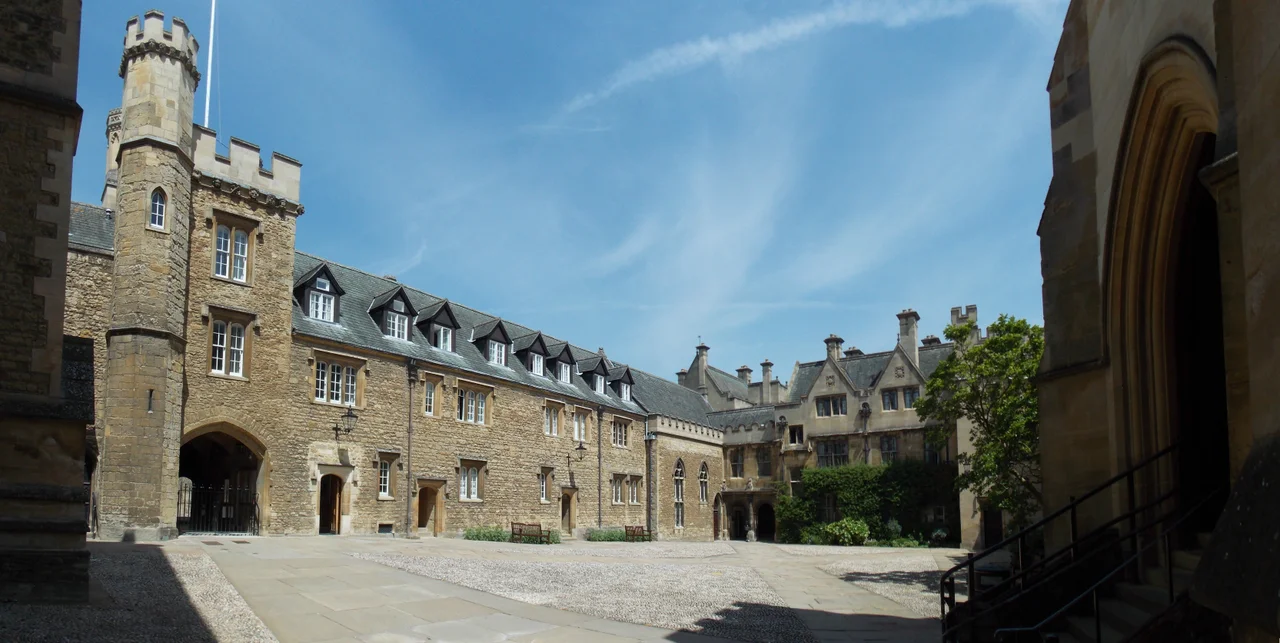

Merton College, Oxford
Walter de Merton wrote a constitution for his college in 1264, eleven years before the Norman royal house lost the throne to a Frenchman, and that constitution made one thing unmistakable: this was to be a self-governing community, with endowments vested directly in the Warden and Fellows. The king could not seize the property. No bishop could appoint the master. Walter built in a degree of institutional independence that no English college had ever enjoyed before. Eight centuries later, Merton still operates by an unbroken line of statutes and an unbroken line of wardens descending from that founding moment. The library Walter's successors built has been continuously in use since 1373. There is no older one anywhere in the world for university students and academics.
The First Statutes
Walter de Merton served as Lord Chancellor to Henry III and later to Edward I, and as Bishop of Rochester. He drew up the first statutes for his foundation in 1264 - making Merton, in the most defensible reading, the oldest Oxford college. Balliol and University College both dispute the claim, but neither had statutes until the 1280s. By 1274, when Walter retired from royal service and made his final revisions, the college was consolidated on its present site in the southeast corner of Oxford. The hall went up before 1277, and the chapel followed in the 1290s. The east window of the chapel was finished in 1294 and is so precisely dated that architectural historians use it to mark the point at which the geometric strictness of Early English style was beginning to relax. The great tower was complete by 1450. Mob Quad - the cluster of buildings around what is sometimes called the oldest quadrangle in Oxford - went up in three phases between 1288 and 1378. The college library on its upper floor was completed in 1373 and has been functioning ever since.
The Library Where Books Were Chained
Merton College Library opened in 1373 - twelve years before Geoffrey Chaucer started writing The Canterbury Tales. For centuries the books were chained to the shelves, because books were valuable and students were students. Some of the chains are still there. The medieval lectern bookcases survive, with sloping wooden surfaces where readers stood to consult manuscripts. The library still holds incunabula - books printed before 1501, including the early years of the printing press itself. The room is small and dark by modern standards, lit through narrow medieval windows, and is one of those rare spaces where the architecture of study has not changed in essentials for six hundred and fifty years. Students still work in here. Then they leave for tutorials and come back to the same desks the next day. Walter de Merton, dying in 1277 - thrown from his horse while fording a river - would understand exactly what they were doing.
Tolkien's Last Office
J. R. R. Tolkien was Merton Professor of English Language and Literature from 1945 until his retirement in 1959. His college rooms at Merton were where he finished The Lord of the Rings, completed in 1949 and published in three volumes from 1954 to 1955. The book is dedicated 'to my sons and my daughter, and to my friends the Inklings' - the literary group that included C. S. Lewis, who was at Magdalen until he moved to Cambridge in 1954. The two men walked together in the Merton and Magdalen meadows and along Addison's Walk, debating myth and meaning. Tolkien published The Lord of the Rings only after years of pestering by his Merton colleagues and his friend Lewis. Five Nobel laureates have studied or taught at Merton. Liz Truss, who served as Prime Minister for 49 days in September and October 2022, studied PPE here in the mid-1990s. Merton's traditionally tiny intake produces an unusually high proportion of academic firsts; the college has topped the Oxford Norrington Table more often than any other college since the table was officially published in 2004.
The Civil War Outlier
Most Oxford colleges sided with Charles I when the Civil War broke out. Merton sided with Parliament. The reason was personal and bureaucratic: the warden, Nathaniel Brent, had served as Vicar-General to William Laud, the Archbishop of Canterbury and Visitor of Merton, and Laud had bullied Brent with letters demanding radical reforms during his 1638 visitation. When the war came, Brent's choice was clear. He left Oxford for Parliament-held London, served on the parliamentary committee that prosecuted Laud, and returned in triumph after Laud was beheaded in 1645. Merton's plate and funds were sequestered by another fellow, John Greaves, who was supporting the King. By 9 November 1648, Greaves had lost both his Merton fellowship and his Savilian chair of astronomy. The Queen, Henrietta Maria, had been quartered at Merton during the King's occupation of Oxford. After the war, the college returned to its books.
The Time Ceremony
Every October, on the night the clocks go back from British Summer Time to Greenwich Mean Time, Merton students gather in Fellows' Quad in formal academic dress and walk backwards around the quad, drinking port. They invented this ceremony in 1971, mostly as a parody of older Oxford rituals. They claimed it preserved the integrity of the space-time continuum during the transition between time systems. The toasts are: 'to a good old time!' - then a joint toast to the quadrangle's sundial and the famous mulberry tree planted in the early 17th century: 'o tempora, o more!' - a pun on Cicero - and finally 'long live the counter-revolution!' The mulberry tree was planted by Henry Savile, warden from 1585 to 1621, who also built the Fellows' Quadrangle in 1608-1610, supervised the new authorized translation of the King James Bible, and founded the Savilian chairs of astronomy and geometry. Fellows' Quad is the grandest of Merton's quadrangles. The southern gateway is surmounted by a tower decorated with columns of all four classical orders, possibly inspired by buildings Savile had seen on his European travels.
From the Air
Located at 51.7511N, 1.2521W in central Oxford, on the south side of Merton Street and at the southeastern corner of the old walled city. The college backs onto Christ Church Meadow. Merton's chapel tower (complete by 1450) is a moderate visual landmark alongside the great spires of Christ Church Cathedral, the University Church of St Mary the Virgin, and Magdalen Tower. Best viewed from low altitude (1,500-3,000 feet AGL). Nearest airports: London Oxford Airport (EGTK, 6 nm north-northwest) and RAF Benson (EGUB, 11 nm south). London Heathrow (EGLL) lies 38 nm southeast. From the air, look for Merton's stone roofs immediately east of Christ Church and north of the broad expanse of Christ Church Meadow.
Nearby Stories
- St George's Chapel, Windsor Castle 7 km away
- RAF Honeybourne 7.8 km away
- Sulgrave Manor 8.9 km away
- Cotswolds 9 km away
- Chesham 9.4 km away
- Avebury 11 km away
- Donnington Castle 12 km away
- Ampthill Park 14 km away