
Ancient Messene
It took 85 days. That is how long the combined forces of the Theban army, Argive allies, returning Messenian exiles, and construction workers from across the Greek world needed to raise the walled city of Messene on the slopes of Mount Ithome. The year was 369 BC. The Theban general Epaminondas had defeated Sparta at the Battle of Leuctra two years earlier, and now he was doing something no Greek commander had done before: building a city as a political act, to make freedom permanent for a people who had been enslaved for generations. The walls went up in 85 days. They still stand.
A People Returning from Exile
The people for whom Messene was built were the Messenians — a Greek people who had been subjugated by Sparta in the Archaic period and reduced, in large numbers, to the condition of helots: enslaved laborers tied to the land, required to hand over half of everything they produced, and subject to state-sanctioned killing. Those who could flee did. By the time Epaminondas entered Messenia, the Messenian diaspora had been scattered for generations across Sicily, North Africa, and the Greek colonial world — a community in exile, as Pausanias wrote, that had preserved its Doric dialect in unusual purity.
Epaminondas sent word to them all. Come home, he said. The exiles who returned became the citizens of the new city. They had maintained something cohesive during their centuries of dispersal — an identity, a language, a shared memory of the mountain. When they arrived at the slopes of Ithome, they did not find their old home. They found a new one, built for them in less than three months.
Walls That Defined a Freedom
The circuit wall of ancient Messene extended nine kilometers, built of finely fitted ashlar limestone blocks ranging from seven to nine meters in height. It was not merely defensive architecture. It was a declaration. The city enclosed within it Mount Ithome itself, enough agricultural land to sustain the population through a siege, and captured springs that ensured the water supply would never be cut off. The Arcadian Gate, with its double-court design, stands today as one of the best-preserved examples of ancient Greek military architecture anywhere in the world.
The policy behind the walls proved sound almost immediately: after the Theban army departed, the Spartans attempted to retake Messenia and failed. The city held. The Messenians found protection with the Macedonians, and the long struggle with Sparta ended definitively when Macedon conquered Greece. The walls that were built in 85 days endured for centuries — and much of that masonry is still standing after more than 2,300 years, a testament to the engineering discipline of the artisans Epaminondas recruited.
A City Worth Excavating
Modern excavation at ancient Messene began on April 10, 1829, when the French scientific commission of the Morea Expedition, led by Guillaume-Abel Blouet, arrived at the site at the close of the Greek War of Independence. Systematic work followed: the Athens Archaeological Society under Themistoklis Sofoulis in 1895, then George Oikonomos in 1909 and 1925, Anastasios Orlandos in 1957, and Petros Themelis beginning in 1986. Themelis's sustained excavation, in collaboration with international institutions including the Open University of Cyprus, has transformed understanding of the site. The work continues today.
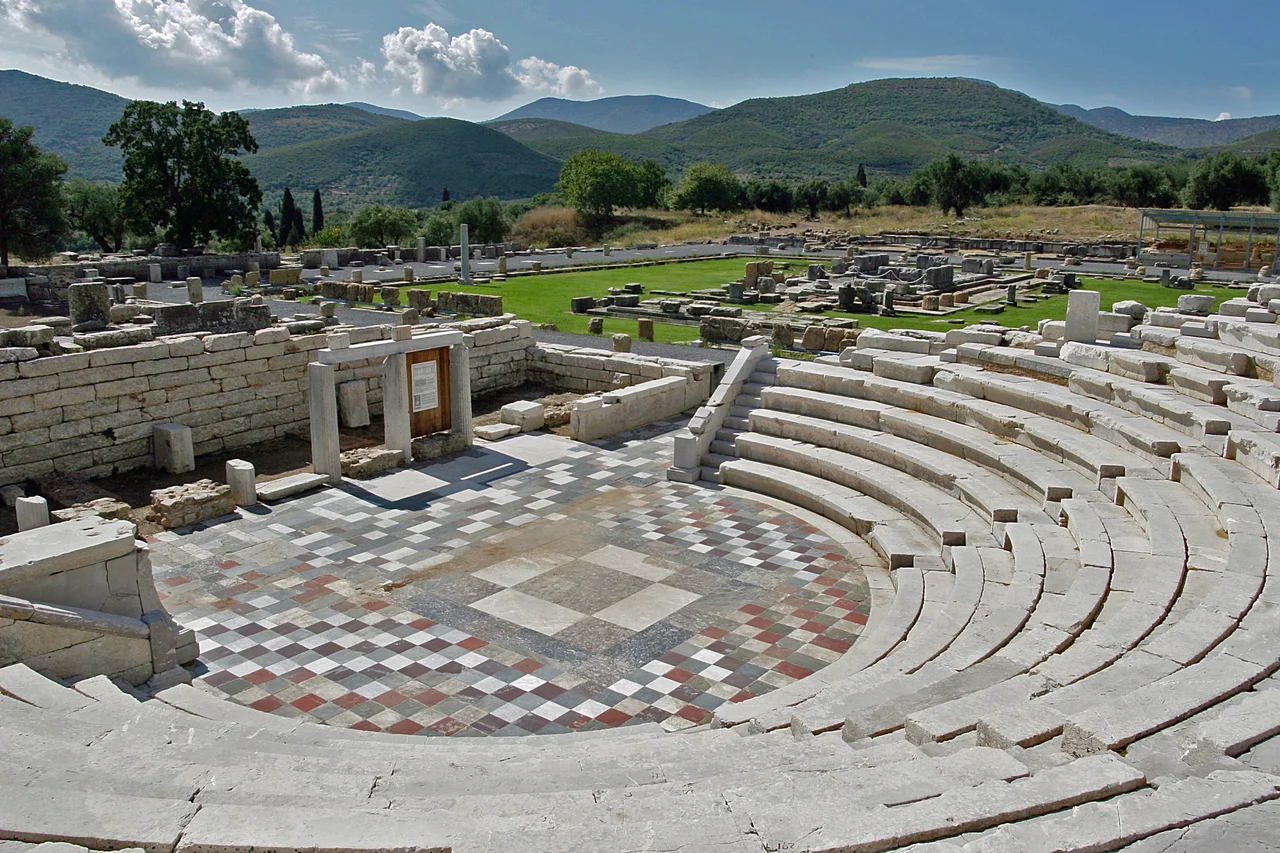
What the excavations revealed is not a single frozen moment but a palimpsest. The Hellenistic Asklepieion — the sanctuary and healing complex dedicated to the god of medicine — is one of the most impressive in Greece. The stadium, which still hosts athletic events, is astonishingly well preserved. The Bouleuterion (council chamber), the theatre, the gymnasium, the temple of Zeus Ithomatas on the acropolis summit — each layer of excavation uncovers more. A museum built within the ancient walls displays the finds. In 2011, the site received a European Union Prize for Cultural Heritage / Europa Nostra Award.
From Bronze Age Memory to Byzantine Survival
The site's history runs far deeper than 369 BC. A Linear B tablet from Mycenaean Pylos — catalogue number PY Cn 3 — mentions a region called me-za-na, which scholars believe is an early form of Messana, the Mycenaean name for the region around Ithome. Excavations have found evidence of Bronze Age settlement, and the name itself was already ancient when Epaminondas chose to revive it.
Messene survived as an urban center through Late Antiquity, though not without damage. The great earthquake of 365 CE, which devastated much of the eastern Mediterranean, struck hard in the southwestern Peloponnese. An early Christian house church — one of the very few known examples of a domus ecclesiae building in Greece, dating to the third and fourth centuries CE — was destroyed in that earthquake. A three-aisled basilica from the sixth century rose near the old theater. The city transitioned from pagan to Christian, Hellenistic to Roman to Byzantine, and continued. A settlement at the site persisted under the name Voulcano through the medieval, Frankish, and Ottoman periods before the village was renamed Mavromati, the name it carries today.
What Stands Now
Ancient Messene today is one of those archaeological sites that rewards time. Located 25 kilometers north of Kalamata and 60 kilometers east of Pylos, it is not difficult to reach but far enough from the main tourist routes that it seldom feels crowded. The ruins spread across a wide bowl in the mountain's western flank: the theatre, the Asklepieion, the stadium, the sanctuaries, the agora, the long stretches of preserved wall with their towers intact.
The notable people produced by ancient Messene include Aristomenes, the legendary hero-king of the resistance wars against Sparta; Euhemerus, the fourth-century BC mythographer whose rationalist treatment of the gods influenced later philosophy; and the sculptor Damophon of the second century BC, whose works were seen and described by Pausanias. These figures emerged from a city that was built as a political statement and endured as a living community for centuries. The statement, and the community, remain readable in the stone.
From the Air
Ancient Messene sits at approximately 37.175°N, 21.92°E, on the western slopes of Mount Ithome in the southwestern Peloponnese. From the air, the site is identifiable by the long, well-preserved circuit walls running across the mountain flank and valley, with the flat-topped summit of Ithome (about 800 m) rising above. The village of Mavromati is visible within the ancient walls. Nearest airport: Kalamata International (LGKL), approximately 25 km to the southeast. Recommended viewing altitude: 4,000–6,000 feet for the full sweep of walls and topography. The Messenian Gulf is visible to the south in clear weather.
Nearby Stories
- Agios Sostis 1.5 km away
- Karyes 13 km away
- Koroni 13 km away
- Dimitrios (Shipwreck) 16 km away
- Pyramid of Hellinikon 22 km away
- Agios Andreas, Katakolo 28 km away
- 2023 Messenia Migrant Boat Disaster 34 km away
- El-Kouf National Park 464 km away