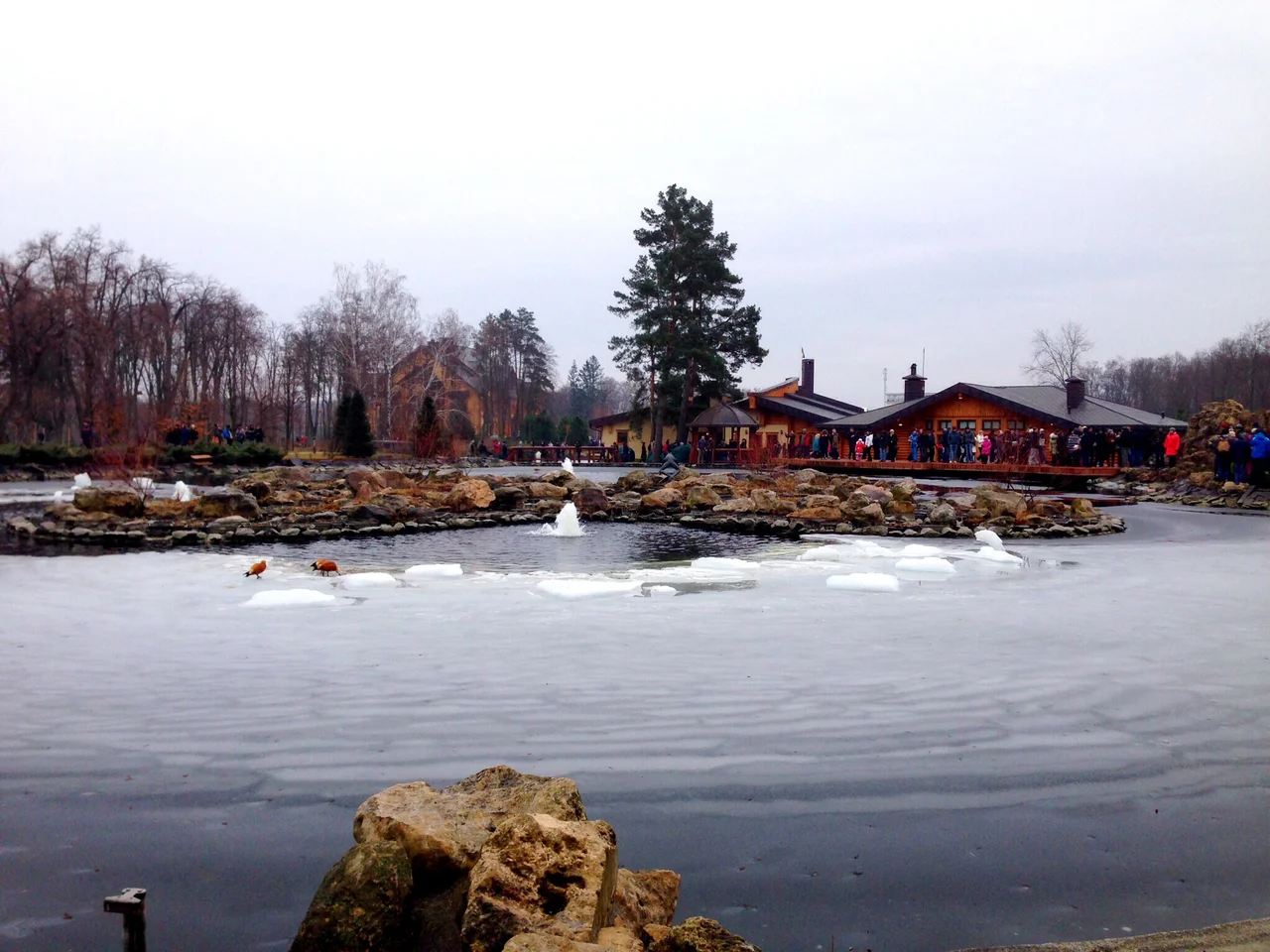

Mezhyhirya Residence
For years the fence kept everyone out. Five meters tall, it ran the entire perimeter of a vast estate on the banks of the Dnipro north of Kyiv, hiding whatever lay inside from a curious and skeptical public. Then, on 21 February 2014, President Viktor Yanukovych fled the country during the Revolution of Dignity, and the gates were suddenly open. Ordinary Ukrainians walked in and found a private world: a golf course, an ostrich farm, an automobile museum of exotic cars, man-made lakes, a helicopter pad, and a floating banquet hall shaped like a galleon. What had been rumor became, overnight, a place anyone could stand in and see. For the crowds who wandered its lawns that first weekend, the shock was less any single object than the sheer scale of it all, hidden for so long behind a wall.
A Monastery, a Dacha, a Palace
The land had held very different dreams before. Until 1786 a monastery stood here, the Savior-Transfiguration, its founding traced back to the princely age of Kyiv, until Catherine the Great's edict dissolved it and, the story goes, had it burned. The poet Taras Shevchenko later wrote bitterly of the empress setting the Mezhyhirya Savior alight in the night. The monastery flickered back to life as a convent and was closed again by the Bolsheviks in the 1920s, its buildings turned briefly into a college for ceramics and a commune of artists. From 1935 the grounds served as a leafy summer retreat for the leaders of the Communist Party, a state recreation complex screened from the public it supposedly belonged to. Layer by layer, this quiet bend of the river had always been a place set apart for the powerful, and it would remain so under a new kind of ruler.
The House Called Honka
The centerpiece was a grand log building known as the club house, or simply object Honka, named for the Finnish company that manufactures such homes. Around it spread the trappings of extravagance: an equestrian club and shooting range, a yacht pier, a dog kennel, fountains, a small church, and hunting grounds, all behind that towering fence. Moored in an inner harbor sat a reception house built atop a barge, a palace on the water with windows dressed as portholes. The public paid for none of it knowingly, and that was the sting. Yanukovych had long insisted the arrangement cost him almost nothing, claiming a rent of just over three hryvnias a month, a few dollars, for a lease running forty-nine years. The gulf between that figure and the grandeur behind the gate was the whole scandal in miniature.
The Museum of a Fugitive's Taste
When the estate returned to state ownership in 2014, Ukrainians did something pointed with it: they turned it into a museum, and left much of it as they found it. Activists occupied the log clubhouse in the days after the president fled, and journalists pulled bundles of waterlogged financial documents from the estate's lake, where they had apparently been dumped in a hurry. Visitors now wander the grounds that were hidden for over a decade, tour the collection of exotic cars, and read the estate as a document of how power lived while ordinary citizens did not. A film crew even shot 360-degree panoramas of the interiors that spring, publishing them so the world could look inside room by room. Yanukovych fled toward Russia, and the second palace he had been building on the Crimean coast, nicknamed Mezhyhirya Two, was left unfinished. Here on the Dnipro, the guardhouse gate that once shut the public out now waves them in, an estate transformed from a symbol of secrecy into a lesson anyone can walk through.
From the Air
The Mezhyhirya estate sits on the Kyiv Reservoir near Novi Petrivtsi in Vyshhorod district, north of the capital, at 50.6148 N, 30.474 E. From 2,500 to 4,500 feet the broad reservoir, the wooded shoreline, and the estate's lakes and open grounds stand out. Kyiv Zhuliany (UKKK) lies to the south in the city; Boryspil International (UKBB) is farther southeast across the river.
Nearby Stories
- Boryspil 21 km away
- Oster 37 km away
- Pereiaslav 43 km away
- Radomysl Castle 48 km away
- Arboretum Oleksandriya 57 km away
- Nizhyn 72 km away
- Serhiy Pavlovych Korolyov Museum of Cosmonautics 86 km away
- Korosten 88 km away