
Michael Healy (artist)
The child sat apart in a Dublin tenement, spending every penny he had on pencils and drawing without stop. His friend C. P. Curran would later write that "there was nothing in his parentage to turn him towards the arts." The boy taught himself anyway. By fourteen Michael Healy was out in the world earning his living, and by thirty he had walked into the new stained-glass cooperative An Tur Gloine on a January morning in 1903, picked up a brush, and discovered the medium that would absorb the next thirty-eight years of his life. The glass he made in those years - at Loughrea, at Letterkenny, at Clongowes Wood, at Mayfield in Cork - is among the finest stained glass produced anywhere in the twentieth century.
From Tenement to Florence
Healy was born on 14 November 1873 in a Dublin tenement, and the first record of him at art school is from 1892, when he was eighteen. He thought briefly about becoming a Dominican lay brother and entered the noviciate at Tallaght for about two years before leaving. In 1895 he returned to what was then the Dublin Metropolitan School of Art (today the National College of Art and Design) for three years of part-time study, supporting himself by illustration. In 1897 he was hired by a new Dominican periodical, The Irish Rosary, and through the good offices of the editor, Father Stephen Glendon, the young artist was sent to Florence for eighteen months at the Life School of the Accademia di Belle Arti. The Italian months changed him - they gave him an Italianate confidence with the human figure that would haunt every saint he ever drew in glass. He came home in 1901, took up an art teaching job at Newbridge College in County Kildare, hated it, resigned by the end of 1902, and (Curran writes) "lived through some difficult days at this period" before Sarah Purser invited him to join her new stained-glass cooperative.
An Tur Gloine
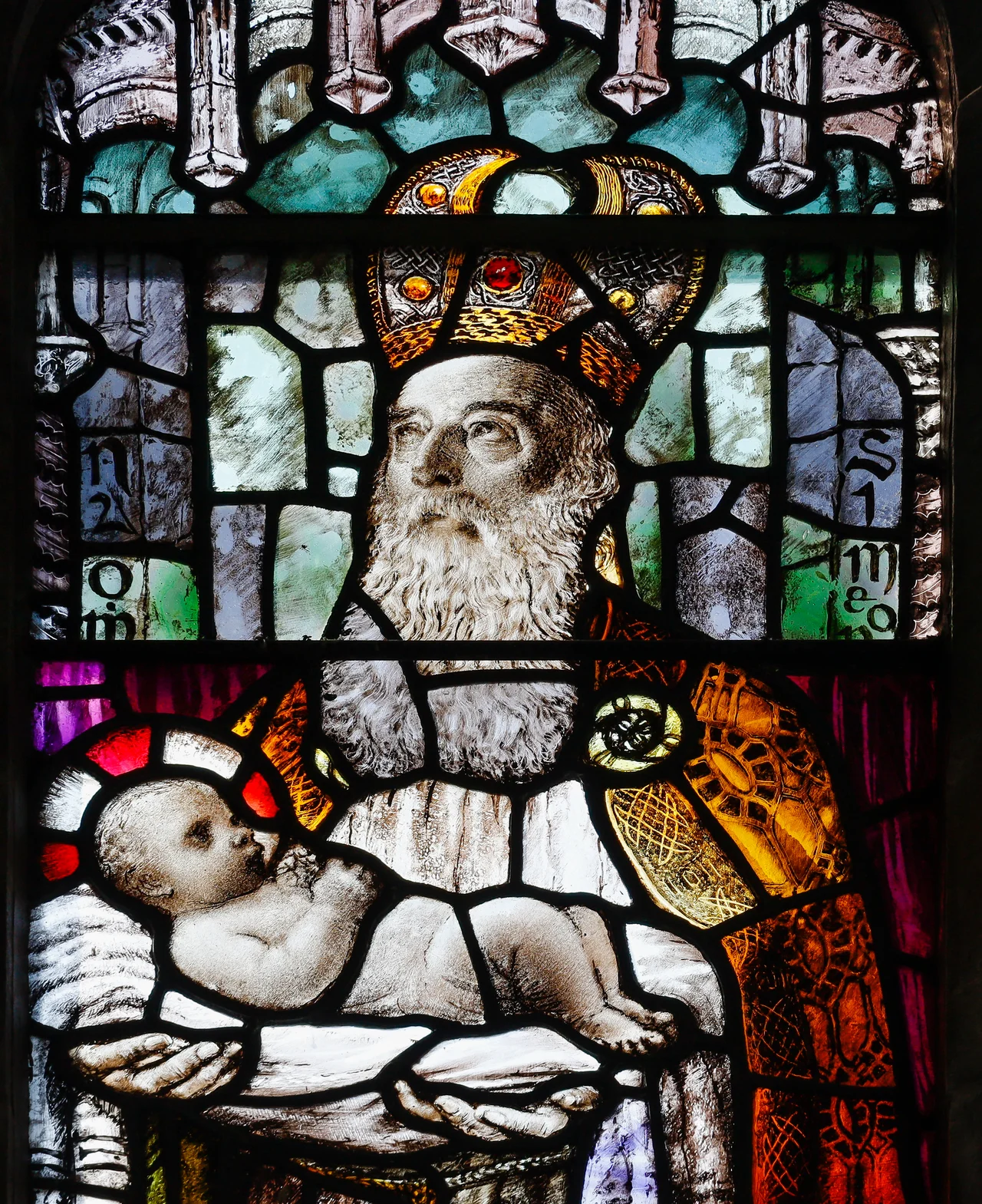
An Tur Gloine - "the Tower of Glass" - opened in Dublin in January 1903, founded by the painter and philanthropist Sarah Purser to give Ireland its own stained-glass industry rather than buy from Munich or London. The other founding artists were London-born Alfred E. Child (also the manager) and Catherine O'Brien. The studio would later be joined by Beatrice Elvery, Ethel Rhind, Hubert McGoldrick, Wilhelmina Geddes, and Evie Hone. Michael Healy worked at An Tur Gloine full time, without interruption, from its first morning in 1903 until his death in 1941 - thirty-eight uninterrupted years at a single bench. For the first two years he painted other artists' designs. Then in 1904 came his Simeon and his St John, the first windows he both designed and painted himself, and the studio realised what it had. By 1906 he had stopped painting other people's designs almost entirely. By 1909, given a four-light window for the Church of Ireland at Rathmines, he was the rising star of his trade.
Loughrea Cathedral
If Healy's work has a centre, it is St Brendan's Cathedral in Loughrea, County Galway, where his windows accumulated across his entire career - from the Simeon installed in 1904 through to the great Last Judgement completed in 1940, the year before his death. The cathedral's interior, with its Healy and Geddes glass, its Sarah Purser, its Patrick Pye carvings of later date, is one of the great unsung treasures of Irish ecclesiastical art - an entire visual programme by the country's finest craftsmen, hidden in a small western town. Healy's mature technique used acid-etching of "flashed" coloured glass to draw light directly out of the medium; his Our Lady Queen of Heaven (1933) at Loughrea pushed the aciding technique, according to specialists, to new frontiers. His massive four-light St Augustine and St Monica (1934-35) for John's Lane Church in Dublin, his three-light dolours sequence for Clongowes Wood College chapel (begun in 1935 and not finished at his death), and the Loughrea Ascension and Last Judgement are the high summit of his work.
The Daily Recorder
Healy's reputation rests on his glass, but his daily eye was on something else. Between commissions he was constantly drawing the street people of Dublin - the barmen, the customers, the queues, the figures on benches, the labourers at corners - in rapid pencil and watercolour impressions. He occasionally painted in oils as well, including portraits and landscapes, exhibiting only a handful of the latter in his lifetime. His diary for 1916, with first-hand observations of the Easter Rising woven through notes on the windows he was working on at the time, sits today in the National Irish Visual Arts Library at the National College of Art and Design - a quiet primary source from a man who lived and worked four streets from where the Rising began. He also produced cartoons and illustrations earlier in his career, particularly for Dominican publications, and his small panel for Ragnar Ostberg in Stockholm in 1926 suggests how widely his reputation had travelled by mid-career.
Glass That Goes On Living
Healy died on 22 September 1941. His final window for Clongowes Wood, The Fourth Dolour: Christ meets His Mother, was completed by Evie Hone. The vast majority of his windows - and there are well over a hundred - still sit in the churches for which they were commissioned, scattered across Ireland and as far afield as Phoenix, Arizona; Bloomfield Hills, Michigan; Mercersburg, Pennsylvania; Newton, Massachusetts; Karori, New Zealand; and Conception Harbour, Newfoundland. The five windows he made between 1924 and 1925 for the chapel of the Convent of Mercy at Ballyhaunis in County Mayo were rescued when the convent closed and now stand in a dedicated room at the National Gallery of Ireland in Dublin, lit from behind, the way Healy intended. Stained glass needs light passing through it to live, and a hundred years after he made them, the windows in Loughrea Cathedral and at Donnybrook, at Letterkenny and Clongowes, still turn morning sun into deep red, gold, ultramarine, and the particular acid-bitten azure that was Healy's own.
From the Air
Michael Healy was born and worked in central Dublin, with An Tur Gloine studio located near Pembroke Street at approximately 53.336 degrees N, 6.253 degrees W, in the Georgian core of the city south of the Liffey. His windows are scattered across Ireland, with major concentrations at St Brendan's Cathedral, Loughrea (County Galway, 53.20 N, 8.57 W) and at the National Gallery of Ireland on Merrion Square. Dublin Airport (EIDW) lies about 10 km north of the city studio. For Loughrea, the nearest airport is Galway (EICM) about 30 km west.
Nearby Stories
- Wicklow Mountains 12 km away
- Mornington 14 km away
- German submarine U-1051 16 km away
- Abbey of Kells 18 km away
- Irish Military Intelligence Service 20 km away
- HMS Manners (K568) 37 km away
- Templemore 42 km away
- Irish Sea Bridge 43 km away