
Middle Temple
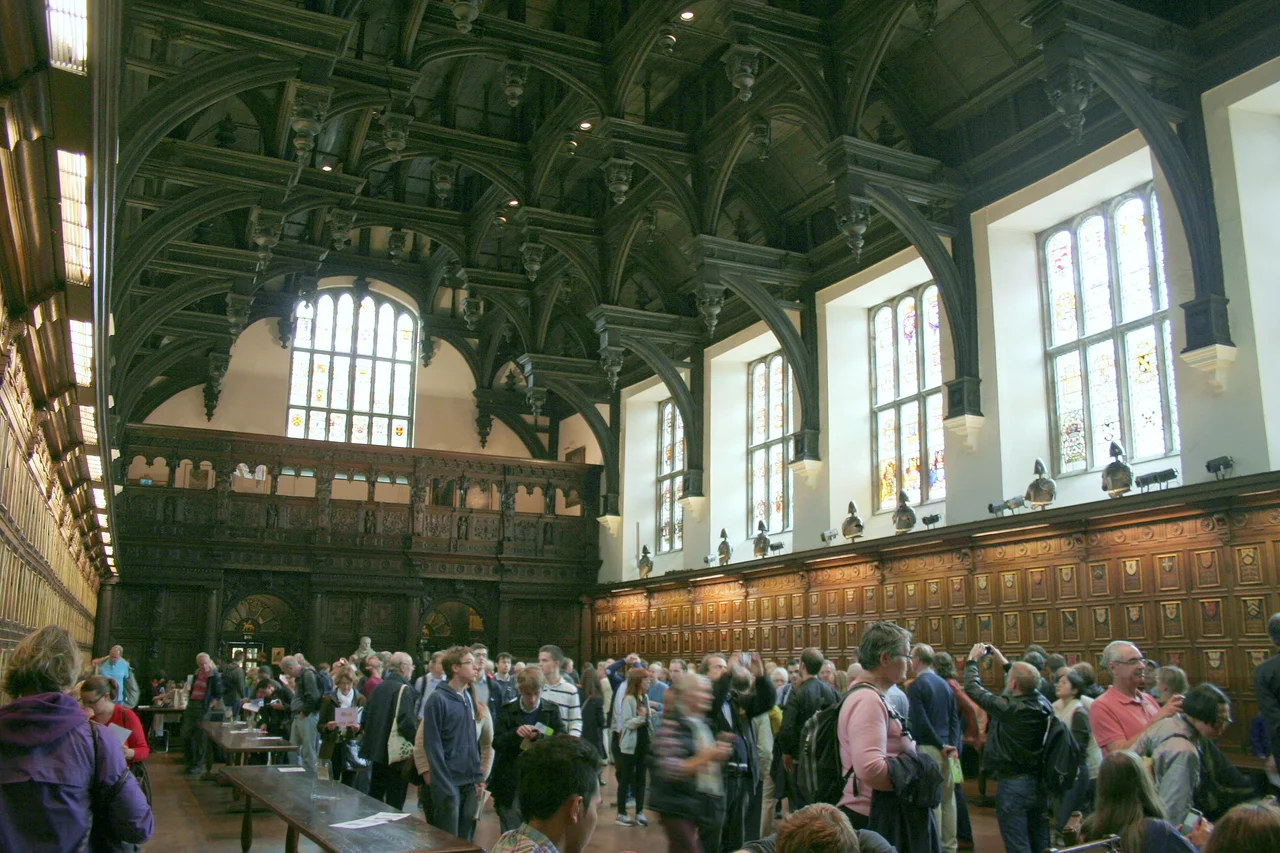
On the night of 2 February 1602, a young company of players performed a new comedy in a candlelit hall off Fleet Street. The play was Twelfth Night, the venue was Middle Temple Hall, and a law student named John Manningham scribbled the date and the play's plot into his diary. That diary entry survives. It is the earliest recorded performance of any Shakespeare play, and the playwright himself was probably in the room. Four centuries later, the same hall stands - with the same double-hammerbeam roof, the same long tables, and one of the same tables said to have been hewn from the timbers of Sir Francis Drake's Golden Hinde. The Middle Temple's job is to train barristers and admit them to the English Bar. Its parallel job, less official, is to act as a kind of seven-hundred-year-old time capsule.
Why the Lawyers Came
The Inns of Court exist because the Church lost a turf war. In the twelfth and early thirteenth centuries, English law was taught in the City of London mostly by clergy. A papal bull in 1218 forbade clergy from practising in the secular courts, so common law - which the English king's courts preferred - had to be picked up by laymen. Henry II and later Henry III then banned the teaching of Roman civil law inside the City walls to keep church jurists at bay. The common lawyers, needing somewhere close to Westminster Hall but outside the City, migrated to Holborn and formed guilds that gradually hardened into the four Inns. The western half of the Knights Templar's old precinct, on the strip of riverside ground between Fleet Street and the Thames, was leased to lawyers from St George's Inn in 1346. They have been there ever since. The St George's Cross still appears on the arms of Middle Temple.
Fire and Beer
In January 1679, a fire broke out in the Temple that did more damage to the Middle Temple than the Great Fire of 1666 had managed thirteen years earlier. The Thames was frozen so solid that no water could be drawn for the engines; instead, beer was rolled out of the Temple cellars and used to dampen the flames. The Lord Mayor of London - who had no jurisdiction over the Temple, which is independent of the City - tried to assert his authority during the chaos, and when rebuffed turned back a fire engine he had himself dispatched. The fire was eventually contained only by blowing up surrounding buildings with gunpowder. Some of the Inn's most important records had been lost; an Act of Parliament had to be passed to resolve the chaos in the records of the Court of Common Pleas. The Inn has never quite trusted civic authority since.
First Through the Door
On 24 December 1919, Helena Florence Normanton became the first woman to be admitted to any Inn of Court when she joined Middle Temple as a student member. Three weeks later, on 17 January 1920, Olive Clapham became the second woman in any Inn, also at Middle Temple. Clapham passed the bar finals examinations in May 1921, becoming the first woman to do so. The Inn's other claim on legal firsts is older: Queen Elizabeth I visited the Hall in 1578, unannounced, to inspect the new building and listen to a barristers' debate. It is the earliest recorded visit of a reigning monarch to an Inn of Court. The list of those called to the Bar by Middle Temple reads like a register of statesmen and writers: Sir Walter Raleigh, William Blackstone (who wrote the Commentaries on the Laws of England), Charles Dickens, the American jurist John Rutledge, the Indian statesman Vallabhbhai Patel, the Fijian leader Ratu Sir Lala Sukuna, Sadiq Khan.
Goldsmith and Blackstone
In Brick Court, the poet and playwright Oliver Goldsmith - author of The Vicar of Wakefield and She Stoops to Conquer - kept rooms from 1765, and threw raucous parties attended by Samuel Johnson and most of the literary establishment. The floor below was occupied by Sir William Blackstone, who would soon become the first professor of law at Oxford. Blackstone complained about the noise. He eventually moved to Pump Court, though no one now records whether he left because of the parties or for some unrelated reason. Goldsmith is buried in Temple Church, the round Norman church the two Inns share. Fountain Court, just south of Brick Court, was described by Dickens in Martin Chuzzlewit, and was the subject of a poem by Letitia Elizabeth Landon, who called the fountain 'the poetry of the place, or, rather, the voice of the poetry with which it is filled.'
Liberty in the Middle of London
Middle Temple is a liberty - a peculiar geographic and legal term meaning an area historically outside the jurisdiction of the City of London Corporation. The liberty is governed by its own Parliament, made up of Benchers (senior barristers and judges) elected for life, headed by a Treasurer elected annually. Its functions as a local council are set out in the Temples Order 1971. Practically, this means that while the Middle Temple sits within the geographic boundaries of the City of London, it administers its own affairs - from street cleaning to building maintenance to charitable scholarships. Honorary members of the British royal family have served as 'Royal Benchers' since Edward VII became the first in 1861. The Library, demolished after the Blitz badly damaged it, was rebuilt in the 1950s by Edward Maufe and opened by the Queen Mother in 1958. Among its treasures are the only surviving pair of globes - one terrestrial, one celestial - made by Emery Molyneux in 1592, the first English-made globes of consequence. They are extraordinarily fragile, extraordinarily important, and look out on a courtyard where lawyers have been arguing for seven hundred years.
From the Air
Middle Temple sits at 51.5125° N, 0.1120° W, between Fleet Street and the Victoria Embankment, immediately west of the Royal Courts of Justice. From above, look for the leafy enclave between the Thames and the Strand/Fleet Street axis; the round Temple Church, with its conical roof, is visible just east of Middle Temple Hall. The Inn's lane runs north-south through the precinct. London City (EGLC) is the nearest major airport; London Heliport (EGLW) handles helicopter traffic. Central London is Class A airspace. From the ground, the easiest entrance is Wren's 1684 gatehouse on Fleet Street, leading directly into Middle Temple Lane - one of the few cobbled streets left in central London, still lit by gas lamps in places.
Nearby Stories
- Stevenage 5.7 km away
- Malling Abbey 5.7 km away
- 1952 Farnborough Airshow Crash 7.7 km away
- Ingatestone Hall 8.2 km away
- Hellfire Caves 9.1 km away
- The Carrington Event: The Solar Storm That Could Happen Again 9.8 km away
- Bletchley Park 16 km away
- Castle Hedingham 23 km away