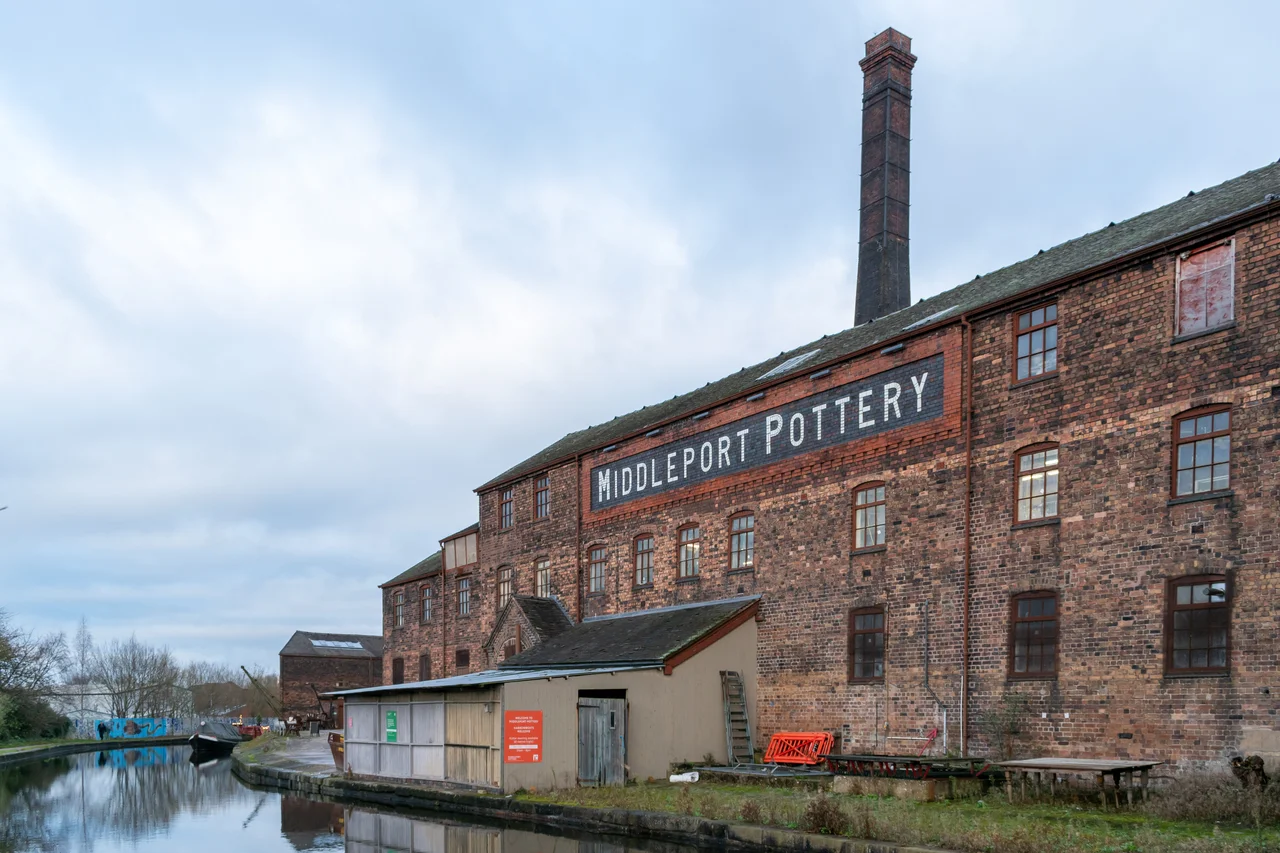

Middleport Pottery
In 2010, Middleport Pottery was three weeks from being shut for good. The bottle ovens were derelict, the buildings were structurally unsafe, and the company that had been making Burleigh ware in this factory since 1889 was running out of money. Two of the three buyers interested in the site wanted to demolish it for the land. Then the Prince's Regeneration Trust stepped in, brokered a complicated three-way deal with the ceramics holding company Denby, and committed nine million pounds to restoring the factory and keeping it open. Today the bottle oven is still standing. The presses still run. Burleigh Pottery is the only pottery in England still producing transferware using nineteenth-century copperplate engraving, and they still produce it here, in the same building, using some of the same techniques, in a town that nearly lost both.
What a Model Pottery Looked Like
William Leigh and Frederick Rathbone Burgess opened Middleport in 1888 as a deliberate break with what they saw as the chaos of older Staffordshire potteries. The Gladstone Pottery Museum, preserved elsewhere in Stoke, shows the older pattern: a constricted site with kilns and workshops jumbled together as space and circumstance allowed. Middleport was different. Its long parallel ranges were laid out in a strict logical sequence from raw materials to finished goods, with passageways just wide enough for a horse-cart between them. Finished pottery left the packing house on a crane that swung it directly down onto narrowboats waiting in the cut. The Trent and Mersey Canal carried Burleigh ware to Liverpool and from there to ports across the British Empire. The factory was designed to work as a continuous process. It was also designed, in its way, for the people working it, with better ventilation and natural light than older potteries allowed.
The Boulton Engine and Charlotte Rhead
Power for the clay-mixing machinery came from a William Boulton steam engine installed when the factory opened and run continuously until the coal strike of the 1970s. The same boiler that powered the engine heated the building and dried the slip. The engine has now been restored to working order. The factory's designers worked through the great names of Staffordshire ceramic art. Charlotte Rhead, daughter of the designer Frederick Rhead, worked here from 1926 to 1931 and produced the tube-lined designs (with raised piped slip outlining the floral patterns) that collectors still seek out today. David Copeland brought modern designs to Middleport in the 1960s while continuing to use the traditional copperplate engraving technique that Burleigh has used since the start: each pattern engraved by hand into a sheet of copper, then transferred to tissue paper, then applied wet to the pot.
The Years of Risk
The pottery went into bankruptcy in 1999. The Dorlings, William and Rosemary, bought it with the intention of keeping it open, revitalised the inventory with new colours, and were close to making it work when they discovered that their bookkeeper had been embezzling funds and failing to pay taxes. They sold to Denby Holdings in 2010 and stayed on as consultants for three months. By that point the buildings had been on Historic England's at-risk register for years, and six of the seven original bottle ovens were already gone. The surviving bottle oven was separately listed. When the Prince's Regeneration Trust took over in the same year, the timing was almost the last possible moment to save the building rather than rebuild it. The architects Feilden Clegg Bradley Studios led a three-year restoration, partly funded by the National Lottery Heritage Fund and Historic England, and the pottery reopened as a public visitor destination in July 2014.
Burleigh Still
What makes Middleport unusual among heritage projects is that the heritage is still working. Burleigh Pottery, owned now by Denby, continues to produce in the factory as a tenant of Re-Form Heritage (which inherited the building when the Prince's Regeneration Trust restructured). The restoration is reckoned to have saved 50 jobs and created 70 more. The unused buildings now hold workshops, a café, a heritage visitor centre, and the Prince of Wales Studios in the converted Old Packing House, opened in January 2016 by Prince Charles (now King Charles III). The pottery has won eight awards since 2014: a RIBA National Award, three RIBA West Midlands awards, a Europa Nostra Award, a Civic Trust AABC Conservation Award, a Placemaking Award, and a Heritage Open Days Community Champions Award. It has filmed three series of The Great Pottery Throw Down. An episode of Peaky Blinders was shot here. A nineteenth-century model factory has become a working twenty-first-century one, with the same chimney and the same crane and (in many cases) the same patterns.
From the Air
53.04 N, 2.21 W, on the Trent and Mersey Canal in the Middleport area of Stoke-on-Trent, immediately north of the main Stoke city centre. From 1,500 to 2,500 feet AGL the pottery reads as a long linear red-brick complex along the canal, with one surviving bottle oven distinctive from above. Nearby airports: EGNX East Midlands to the south-east, EGCC Manchester to the north, EGNR Hawarden to the west.
Nearby Stories
- National Memorial Arboretum 2.2 km away
- Stanlow Abbey 4.5 km away
- Alderley Edge 5.6 km away
- Lilleshall Abbey 7.2 km away
- Hope Cement Works 8.4 km away
- 2025 Wrexham National Eisteddfod 9.1 km away
- Tutbury Castle 16 km away
- Powis Castle 25 km away