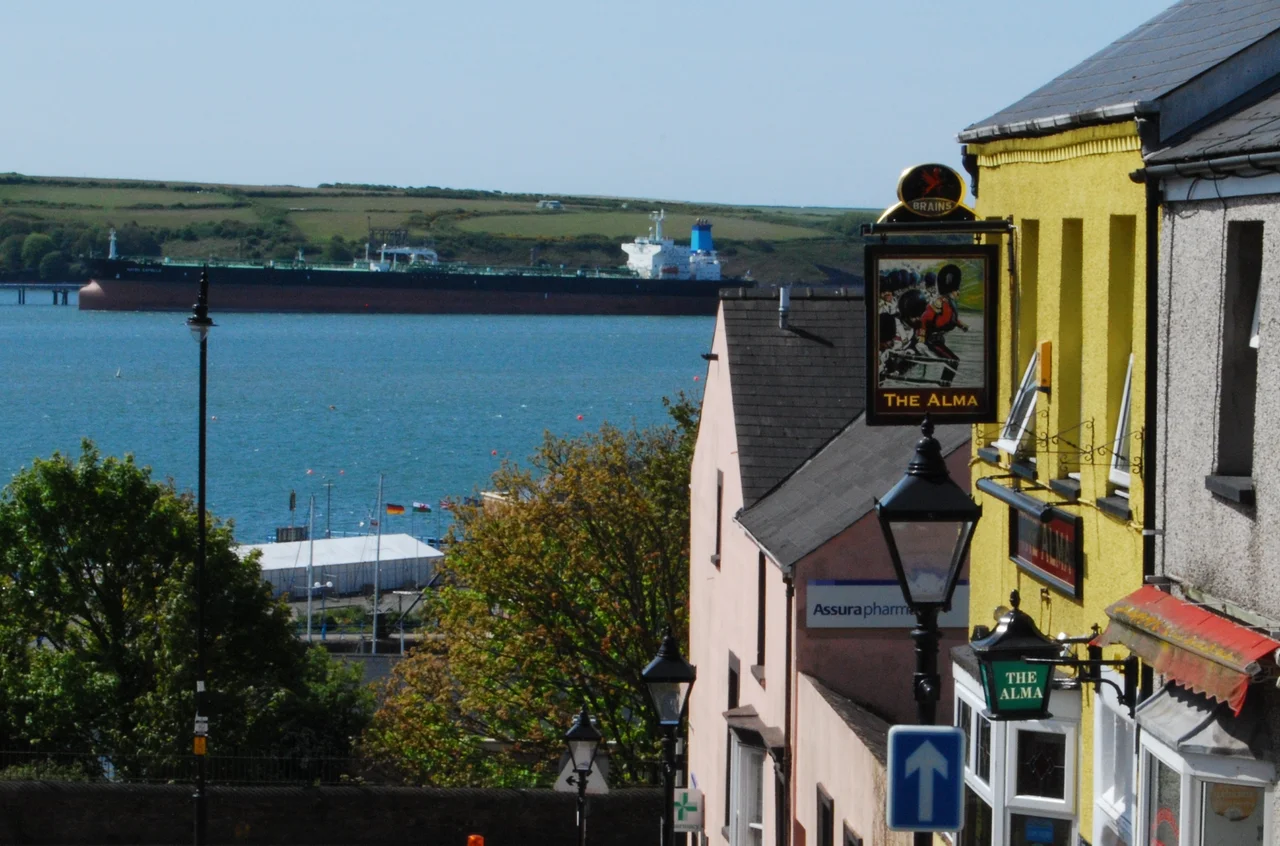

Milford Haven Waterway
Nelson called it the finest port in Christendom. He had been to most of the contenders, so he ought to know. Standing on the Hamiltons' yacht in 1802, the admiral compared Milford Haven only to Trincomalee in Ceylon - high company for a stretch of water in the far southwest of Wales. What he was looking at was a ria, a river valley drowned by rising seas at the end of the last ice age, scoured deep enough that today supertankers carrying a quarter of Britain's natural gas glide past the same green headlands that watched Viking longships winter here in 854.
A Door That Always Opened
Geography made Milford Haven inevitable. The Daugleddau estuary winds inland for miles, sheltered from Atlantic gales by the curve of Pembrokeshire's coast, with water deep enough that ships of any era could anchor close to shore. The Vikings noticed first. From the 790s onward, Norse crews used the haven as a stormhole, and in 854 the chieftain Hubba wintered here with twenty-three ships. The settlement of Hubberston still carries his name - a quiet bit of inheritance from a man who would otherwise be remembered only for raiding the rest of Britain. In 1171, Henry II gathered four hundred warships, five hundred knights, and four thousand men-at-arms in these waters before sailing for Waterford, the first English king to set foot on Irish soil. Three centuries later, in August 1485, a 28-year-old exile named Henry Tudor came ashore at Mill Bay near the haven's mouth with roughly two thousand French mercenaries. Two weeks later he was Henry VII, and the Tudor century had begun.
Forts for Phantom Invasions
The same depth that made Milford useful also made it dangerous. An enemy fleet could anchor here too. By 1590, two forts guarded the entrance against Spanish ambitions that never quite materialized. In 1405, the French had landed in force at the haven to support Owain Glyndwr's rebellion - Marshal Jean II de Rieux arrived from Brest with twenty-eight hundred knights, and for a moment it seemed Wales might break free of England through this very doorway. Charles I built another fort at Pill in 1643, hoping to deny it to Parliament. The fort fell within a year, and in 1649 Oliver Cromwell himself sailed from Milford for the brutal conquest of Ireland that still casts a long shadow. The strategic anxiety persisted into the Victorian age: Stack Rock Fort, built on an island in mid-haven between 1850 and 1871, was part of a chain of Palmerston defenses against another French invasion that, again, never came. The forts kept being built because the haven was too tempting not to defend.
Whale Oil, Crude Oil, Cold Gas
The modern haven runs on hydrocarbons, but it began with whale oil. The town of Milford Haven was founded in 1790 by Sir William Hamilton and his nephew Charles Greville, who invited seven Nantucket Quaker families to relocate the American whaling industry to Welsh shores. The Custom House on the docks, built in 1797, was designed specifically to store whale oil bound for the lamps of London. The whaling faded; coal and corn took its place; trawlers crowded the docks. Then in 1960 the first oil refinery opened, and within a year a tanker called Esso Portsmouth had spilled crude into the same water that Nelson once praised. The harbourmaster's pragmatic response - clean up first, allocate blame later - became standard practice. The Sea Empress disaster of 1996, briefly thought to be the worst tanker spill in British history, recovered better than anyone expected, partly thanks to the haven's strong tides. Today South Hook and Dragon LNG terminals receive Q-Flex tankers from Qatar; the first, the Tembek, docked in March 2009. Roughly a quarter of Britain's gas now arrives through this single inlet.
What Shakespeare Saw
Shakespeare set part of Cymbeline at Milford Haven in 1611, calling it 'blessed Milford,' though he almost certainly never visited. The Welsh chronicler George Owen of Henllys had declared it the most famous port in Christendom eight years earlier; word travelled. Long before either of them, the medieval Welsh romance Culhwch and Olwen has King Arthur landing here from Ireland in pursuit of the boar Twrch Trwyth. The haven kept producing writers as well as receiving them - Howell Davis, the pirate born nearby in 1680, captained the ships that trained Bartholomew Roberts before being shot dead in 1719 on the island of Principe. Even St Thomas a Becket chapel, dedicated in 1180 on the north shore as a beacon for sailors in foul weather, refused to disappear: stripped of its consecration after the Reformation, it served as a navigation light, then as a pig sty, then was reconsecrated in the 20th century - a small piece of medieval Wales that simply outlasted every reason for being torn down.
Reading the Water
From the air, the haven still reads as a single landscape: a serpentine channel of dark water flanked by patchwork green, oil-storage tanks gleaming silver on the south shore, the white spheres of South Hook crouched against the cliff. Cruise ships now call too - the Maasdam was the first transatlantic liner to dock here, in July 2008 - and ferries from Pembroke Dock still cross the Irish Sea to Rosslare twice a day. The Site of Special Scientific Interest covers most of the coastline, recognising what the geology already knew: this is a drowned river, and rias are rare. Wave-power testing has begun at West Dale Bay. The same depth that brought Vikings and Tudors and Qataris will likely bring whatever comes next.
From the Air
Milford Haven Waterway lies at 51.70 N, 5.12 W on the southwest coast of Wales. From cruising altitude the ria reads as a long, dark, branching estuary cutting inland from the Atlantic, with the silver tanks and white LNG spheres of South Hook and Dragon terminals on the south shore. Best visibility from 8,000-15,000 feet for the full coastal context. Nearest airports: EGFE (Haverfordwest/Withybush) 12 nm north, EGFH (Swansea) 60 nm east. Frequent Atlantic weather - low cloud and rain are common; clear days reveal the full sweep from St Davids Head to Tenby.
Nearby Stories
- Abercych 1.3 km away
- Pendine Sands 6.4 km away
- HMS H47 20 km away
- HMHS Glenart Castle 43 km away
- Ilfracombe Lifeboat Station 45 km away
- Johnstown Castle 67 km away
- Hook Lighthouse 98 km away
- 1979 Fastnet Race 142 km away