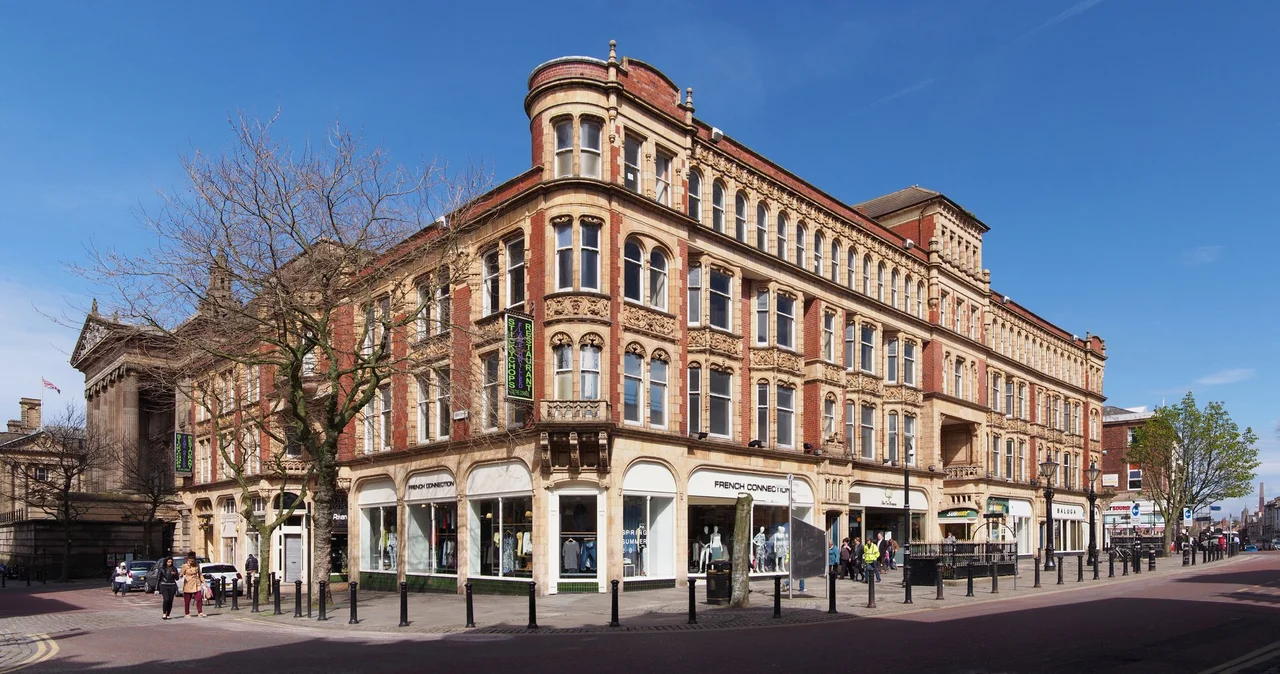

Miller Arcade
In 1895, a Preston dentist named Nathaniel Miller decided his city deserved its own version of Burlington Arcade. He held a competition for the commission, picked a winner, and four years later the public walked through a glazed Victorian palace of shopping where the tooth-pulling had once been done. The turrets came down in the 1920s, the hotel rooms closed in 1947, and the Geisha Ballroom on the upper floors has long since faded from anything but archive photographs. But the bones of Miller's experiment in Edwardian retail still stand at the south side of Market Square, ornate tiles underfoot, glass overhead.
A Dentist's Big Idea
Nathaniel Miller made his money in a Preston dental practice when dentistry was a barely regulated trade and the city centre was thick with cotton-trade money. He wanted something more permanent than tooth extractions, so in 1895 he held a competition for an indoor shopping centre modelled on London's Burlington Arcade. The winning architect, Edwin Bush of the Birmingham firm Essen, Nichol and Goodman, produced a smaller Lancashire cousin of the Mayfair original, with the same idea of refined undercover retail for a clientele who would rather not get rained on. When it opened in 1899, it was the first indoor shopping centre Preston had ever seen, and Miller had transformed himself from a man who fixed teeth into a man who built arcades.
Turrets and a Ballroom
The original building wore four pepper-pot turrets at its corners, the kind of decorative flourish that announced ambition to anyone glancing up. Safety concerns took them off in the 1920s, leaving the silhouette flatter but the interior unchanged. The upper floors were a hotel in the building's first decades. Somewhere within was a room called the Geisha Ballroom, a piece of Edwardian Japonisme that fit with the period's appetite for the exotic and has left almost no trace beyond its name. The hotel kept going under successive proprietors until 1947, when the residential life of the building finally ended. What remained downstairs was the arcade itself, ornate tiling, vintage shop fronts, glass-panelled ceiling, and a row of benches in the middle for anyone who wanted to sit and watch the city go by.
Grade II and Going Concerns
Miller Arcade is now Grade II listed, a designation that recognises the rarity of intact Victorian arcades anywhere in the north of England. The current tenants are a mix you would not have predicted in 1899: a Subway sandwich franchise sits among independent eateries and bars like Baluga, Smashed, IceBurg, and Haute Dolci, with the outdoor clothing chain Rohan tucked in alongside. The building is owned by Callaway Estate Limited, and the Lancashire Evening Post has published periodic appeals to safeguard its future. It has survived 125 years of changing retail fashions, two world wars, and the rise of the out-of-town shopping centre — which feels like the sort of thing a Preston dentist with ambitions would have been quietly proud of.
Where to Find It
The arcade sits on the south side of Preston's Market Square, a few steps from the Harris Museum and a couple of minutes' walk from the Minster. It is one corner of a compact city centre where Victorian wealth from cotton and engineering left behind buildings far grander than a town of Preston's size would otherwise have produced. Walk in off the square, look up at the glass, and the rest of the modern high street disappears for a moment.
From the Air
Preston city centre sits at 53.7587N, 2.6981W in Lancashire, North West England, on the north bank of the River Ribble. Miller Arcade is at the south side of Market Square, two minutes' walk from Preston Minster and the Harris Museum. Nearest airports: Blackpool (EGNH) 14 nm west, Warton (EGNO) 7 nm west, Manchester (EGCC) 28 nm south-southeast. Best viewing altitude 2,000-4,000 ft. M6 motorway runs along the eastern edge of the city; the docks and the bend of the Ribble are clear orienting features to the south.
Nearby Stories
- Winwick rail crash 1.4 km away
- Hoylake Lifeboat Station 4.4 km away
- Murder of Lindsay Rimer 7 km away
- Mellor Mill 7 km away
- Embsay and Bolton Abbey Steam Railway 7.8 km away
- Piel Castle 11 km away
- Ashton Memorial 13 km away
- Hoylake 35 km away