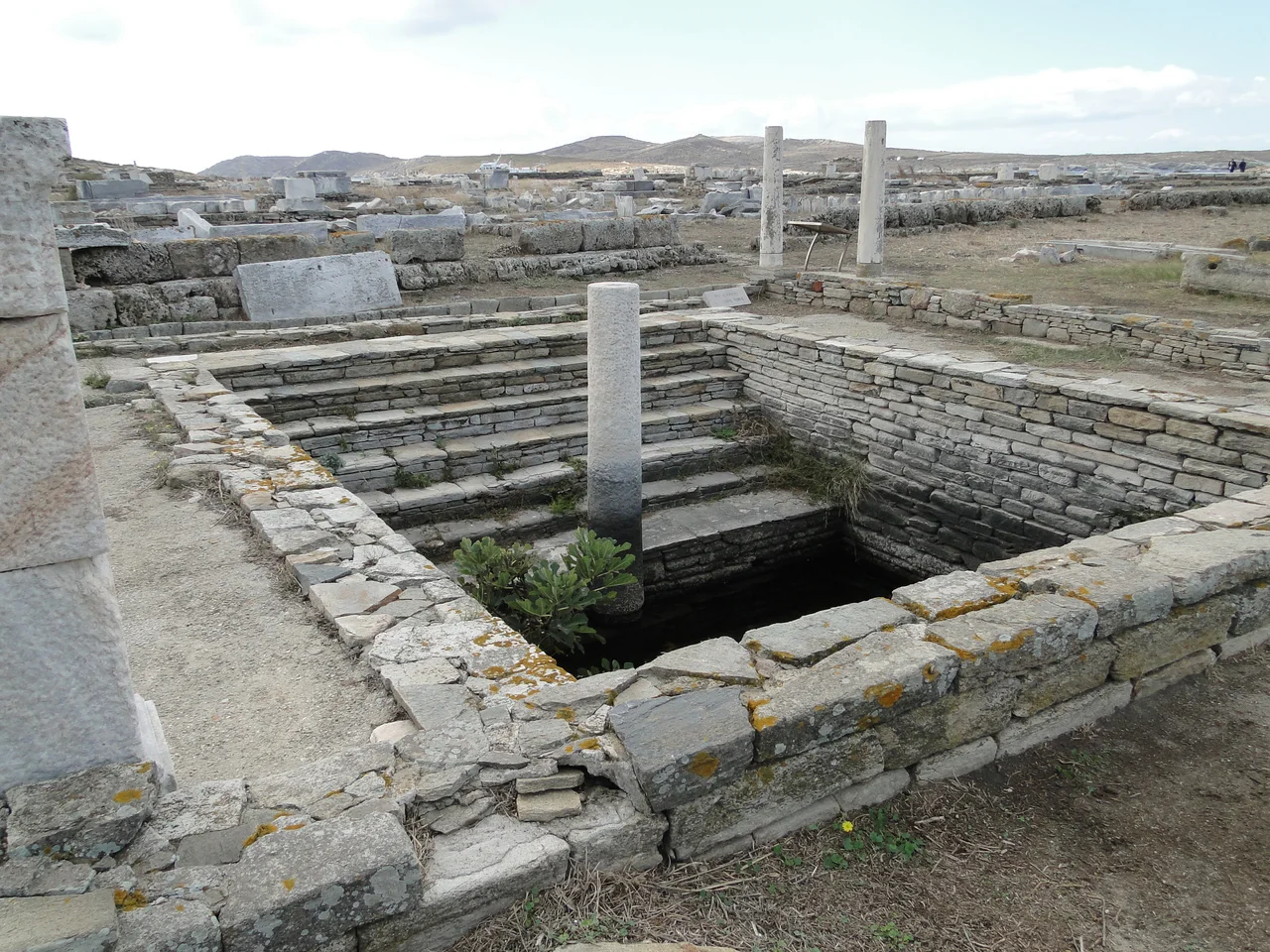

Minoan Fountain
Carved directly into the rock of Delos sometime in the sixth century BC, the Minoan Fountain is not ornamental. Nine granite steps descend toward water. A single thin Doric column, standing on the third step from the bottom, supports the roof. The spring still fills. On an island where no one was permitted to be buried or to give birth — an island maintained in a state of permanent sacred suspension — this was where the living came to drink.
Hewn from the Rock
The fountain-house sits directly behind the Stoa of Antigonos, just outside the temenos — the sacred precinct — of the Sanctuary of Apollo. Its position is deliberate: close enough to the gods to be sanctified, public enough to serve the merchants, pilgrims, and traders who crowded Delos during its centuries of greatness. The structure was built with regular courses of granite and gneiss, materials quarried locally on this granite-rich island. Three walls and a hipped roof enclosed the space; the south façade opened onto a portico lined with small Doric columns, drawing visitors into the cool descent toward the water below.
The spring it formalizes is older than the building itself. Before the sixth-century BC structure gave it its current shape, the sacred spring had already been in use. The fountain-house simply imposed order — architecture as the formalization of devotion.
Dedicated to the Nymphs
When repairs were undertaken in the mid-second century BC, the fountain was redecorated. A fresco appeared on the walls: a river god attended by three nymphs. An inscription made the dedication explicit — this spring belonged to the Minoan Nymphs. Why Minoan? The name suggests a connection to Crete, or to pre-Greek traditions of water worship that predated the Olympian pantheon. On Delos, where the layers of sacred meaning went back to the third millennium BC, such connections were not unusual.
A separate inscribed stele, dating to the fifth century BC, set out the rules for public use. The language is direct: no washing, no swimming, no throwing of dung into the sacred spring. Transgressors faced a monetary fine. The spring was holy, but it was also practical — and whoever administered the sanctuary understood the difference between reverence and sanitation.
Still Filling
The column still stands. The spring still fills. After twenty-five centuries, the water table beneath this small granite island has not given out. Visitors who descend the nine steps today enter the same physical space that Ionian pilgrims, Roman merchants, and Phoenician traders once descended — the proportions unchanged, the rock walls the same, the sound of water the same.
Most of Delos exists only in outline: foundations, tumbled columns, the ghost-shapes of walls. The Minoan Fountain is different. It retains its depth, its column, its steps. The island caretakers who inhabit Delos in small numbers today keep the sacred lake dry to prevent the spread of malaria-carrying mosquitoes. But the fountain's spring, tucked behind its portico, keeps filling — quiet, persistent, indifferent to the centuries stacked above it.
From the Air
The Minoan Fountain is located at approximately 37.40°N, 25.27°E on the island of Delos, in the northern section of the main archaeological site near the Sanctuary of Apollo. The nearest major airport is LGMK (Mykonos National Airport), approximately 6 km to the northeast. Delos is reached by boat from Mykonos harbor. From the air, the Sanctuary of Apollo precinct is visible as a dense concentration of ruins in the northern part of the island. Recommended viewing altitude: 2,000–4,000 feet to distinguish the layout of the sanctuary from surrounding structures.
Nearby Stories
- Panagia Ekatontapiliani 1.5 km away
- Panagia Kanala 15 km away
- Andros 30 km away
- HMHS Britannic 30 km away
- Kimolos 33 km away
- Amorgos 34 km away
- Ikaria 51 km away
- Emporio, Chios 71 km away