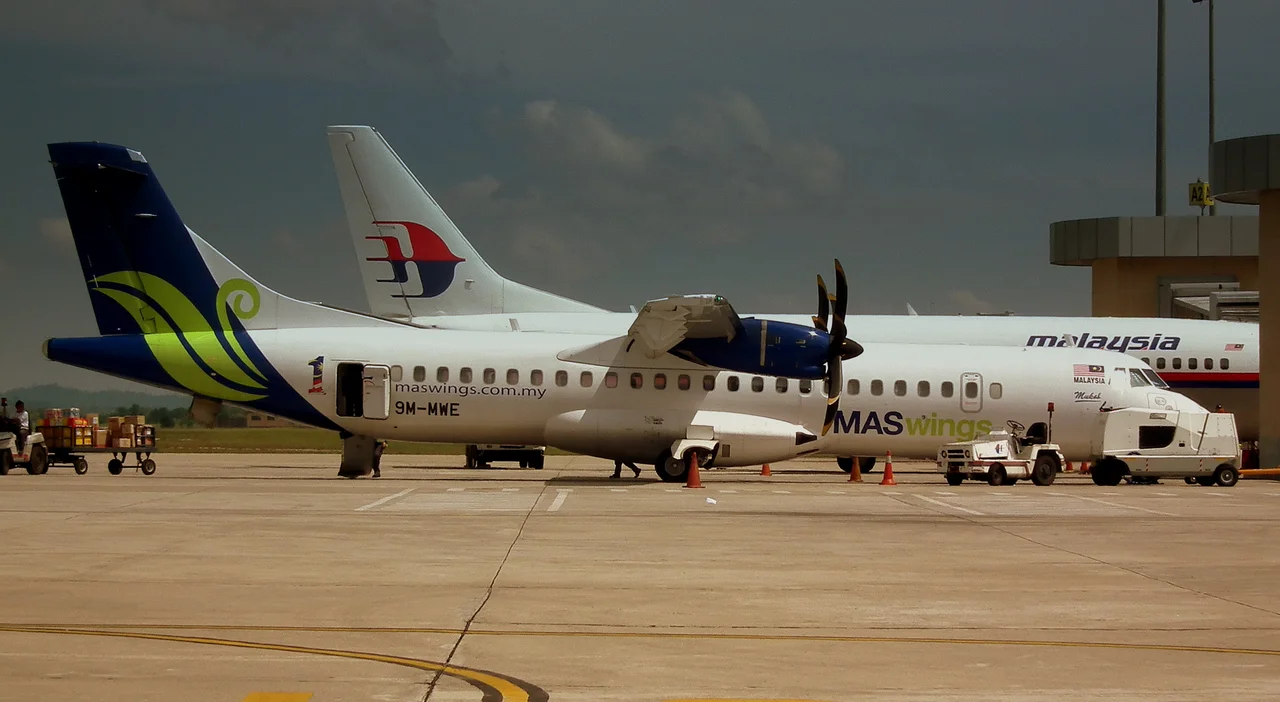

Miri Airport
Every passenger who lands at Miri Airport, whether arriving from Singapore or from Kuala Lumpur, must pass through immigration. Not customs -- immigration, as in border control, passport stamps, the full apparatus of entering a sovereign territory. Sarawak is part of Malaysia, but it negotiated its own immigration autonomy when it joined the federation in 1963, and it has never relinquished it. Flights from Peninsular Malaysia, from Sabah, from the federal territory of Labuan -- all are treated as arrivals from outside. This makes Miri Airport one of the more unusual domestic airports in the world: a facility that the Malaysian government does not officially classify as international, despite its daily scheduled flights to foreign destinations and its insistence on treating every inbound passenger as a foreign arrival.
From Lutong to the Oil Town's Edge
Miri's aviation history begins at Lutong Airport, a small field that served the town during its early decades as an oil-producing center. As Miri grew -- driven first by petroleum extraction and later by its role as the commercial gateway to northern Sarawak -- Lutong could no longer handle the traffic. A new site was selected 9.5 kilometers southeast of the city center, and Miri Airport became fully operational after 1985. The terminal was designed to handle up to two million passengers annually, a capacity that seemed generous at the time. By 2012, the airport was already operating beyond its designed limits. Passenger numbers climbed steadily: 1.23 million in the first nine months of 2010, then 1.35 million in the same period of 2011, a 9.75 percent increase. Cargo traffic surged too, jumping 18.69 percent to 5,756 metric tons. The airport that was built to last decades was overwhelmed in less than three.
Jungle Hoppers and Widebodies
What makes Miri unusual among busy airports is the range of aircraft it handles. On any given day, the apron accommodates everything from Boeing 737s and Airbus A320s at the main gates to Viking Air DHC-6-400 Twin Otters at the rural services piers -- the same stubby turboprops that connect Miri to highland strips at Bario, Long Banga, and Long Seridan, where runways are short and approaches thread between mountain ridges. The airport's 2014-2016 expansion added parking bays and covered walkways to handle this mix: Apron A serves code C aircraft and has a widebody-capable gate that can accommodate an Airbus A330 or Boeing 777, while Apron B is restricted to ATR 72s and smaller aircraft, primarily used by rural carrier AirBorneo. The result is an airport where a passenger boarding a jet to Kuala Lumpur might glance across the tarmac and watch a Twin Otter taxi toward the jungle.
The 125-Landing Day
By 2014, Miri Airport was handling more than 4,000 flights per month -- an average of 125 aircraft landings and takeoffs every day. Of those, 62 were rural service flights, the small-aircraft runs that connect Miri to remote communities across Sarawak's interior. With a single runway designated 02/20, measuring 2,745 meters by 60 meters, the math was punishing. Incoming flights had to wait in holding patterns while departures cleared the runway. Peak-hour congestion became routine. Sarawak's assistant minister for communications held urgent meetings about the bottleneck, and calls for a second runway grew louder. The airport's navigation aids -- ILS, DVOR/DME, NDB, and PAPI -- support precision approaches, but no amount of instrument capability can solve the fundamental problem of too many aircraft for one strip of asphalt.
A Gateway Perpetually Expanding
Miri Airport has been in a near-constant state of upgrade since its terminal reached capacity. In December 2014, RM78 million was allocated for runway extension, additional aerobridges, and apron expansion. In April 2016, Malaysia's Transport Minister proposed upgrading the airport's official status to international -- a recognition that its daily flights to Singapore and Brunei already made it one in practice. Then in October 2024, Prime Minister Anwar Ibrahim announced RM253 million for a comprehensive overhaul under Budget 2025. The plan doubles the terminal's capacity to four million passengers annually, expanding the building from 16,900 to 25,000 square meters and adding six passenger boarding bridges. A new baggage handling system, upgraded rural air services area, and modern wayfinding signage are included. The Pan Borneo Highway project will add a dedicated interchange connecting the airport to Miri city, smoothing the ground-side bottleneck that mirrors the airside one.
Shadows on the Runway
On September 6, 1997, Royal Brunei Airlines Flight 839 crashed short of the runway at Miri Airport, killing all ten people on board. The accident remains the most serious incident in the airport's history and a reminder of the challenges of aviation in northern Borneo, where tropical weather, mountainous terrain, and limited infrastructure combine to make every approach consequential. Miri's runway is well-equipped -- Cat 1 precision approach lights on Runway 02, high-intensity approach lights on Runway 20 -- but the equatorial climate delivers sudden squalls, low cloud bases, and visibility that can shift from clear to marginal in minutes. For the Twin Otter pilots who fly the rural routes, these conditions are routine. They navigate by experience as much as by instruments, threading between limestone karst towers and rainforest ridgelines to reach strips that barely register on aviation charts.
From the Air
Located at 4.32N, 113.99E, 9.5 km southeast of Miri city center, Sarawak, Malaysian Borneo. ICAO: WBGR, IATA: MYY. Runway 02/20, 2,745m x 60m. ILS, DVOR/DME, NDB, PAPI (3-degree slope). Cat 1 precision approach on Runway 02. Handles code C aircraft (737/A320) and widebodies up to A330/777. Rural services apron for ATR 72 and DHC-6 Twin Otter. Expect tropical weather patterns with frequent convective activity. Nearby airports: Marudi (WBGM), Mulu (WBMU).
Nearby Stories
- The Line That Split a Sultanate 2.1 km away
- The Black Lake and the White Crocodile 8.3 km away
- Sarawak Chamber 40 km away
- Niah National Park 42 km away
- Similajau National Park 78 km away
- The Mountain You Must Not Name 88 km away
- Luconia Shoals 185 km away
- Crown Colony of Sarawak 186 km away