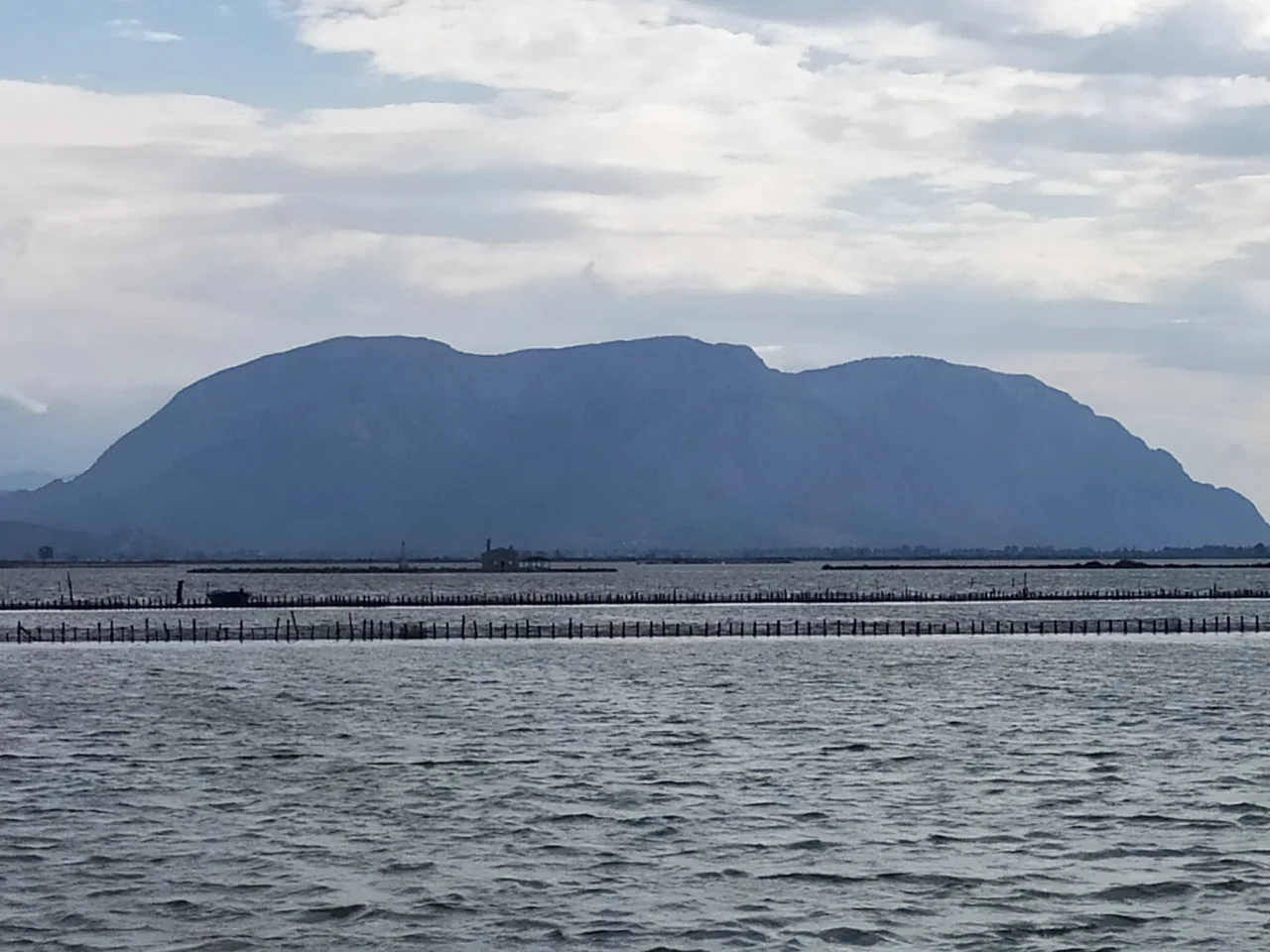

Missolonghi
The name, according to historians, comes from Italian: mezzo laghi, meaning in the middle of lakes. The geography still makes the etymology obvious. Missolonghi sits on a thin tongue of land between a broad, shallow lagoon to the north and the Gulf of Patras to the south, its streets barely above sea level, its marshes once famous for being impassable in winter. This watery isolation, which might have seemed a disadvantage, turned out to be the town's principal defense during three years of siege in the 1820s — and the foundation of a fame that still defines the place two centuries later.
A Town Built on Water
Missolonghi is first mentioned in written records during the naval Battle of Lepanto in 1571, noted by the Venetian historian Paolo Paruta as a settlement on the edge of the lagoon system. The town grew through the 17th and 18th centuries as a fishing and trading hub, passing between the Venetian Republic and the Ottoman Empire — Venetians capturing it in 1684, the Ottomans recovering it after the 1699 Treaty of Karlowitz. The lagoon was productive. Missolonghi's fishermen developed the practice of producing avgotaracho, cured grey mullet roe, which became a local delicacy and remains one today. The marshy land around the town, navigable only to those who knew it, gave it a natural perimeter that shaped every military engagement for centuries.
The First to Rise
When the Greek War of Independence broke out in spring 1821, Missolonghi was the first place in western Greece to join the uprising. The date was 20 May 1821. The town notables — Athanasios Razikotsikas, Panos Papaloukas, A. Kapsalis — led the moment. Most of the Turkish families had already left for the stronger Ottoman garrison at nearby Vrachori, sensing what was coming. The klepht chieftain Dimitrios Makris arrived to reinforce the town and secured the nearby island of Anatoliko. Alexandros Mavrokordatos sailed from Marseille to make Missolonghi the seat of his provisional governing body, the Senate of Western Continental Greece. The town's fortifications at that point were, by any honest measure, inadequate: a ditch two meters wide and one meter deep, a low wall with fourteen guns. And yet the location was compelling — near the Peloponnese and the Ionian Islands, protected by the lagoon and the marshes, difficult to assault from land or sea.
Three Sieges
The first Ottoman attempt came in October 1822, when a force of 7,000 to 11,000 troops under Omer Vryonis and Mehmed Reshid Pasha encircled the town. The garrison of roughly 500 to 600 men held on by stalling negotiations until Greek naval reinforcements arrived in November, and the siege collapsed by 31 December. A second attempt followed in September 1823, led by Mustafa Pasha of Scutari and Omer Vrioni, focused primarily on the island of Aitoliko. That siege also failed. The third and final siege, beginning in April 1825, was far more formidable: Reşid Mehmed Pasha brought 30,000 men, later reinforced by an Egyptian army of another 10,000 under Ibrahim Pasha, son of Muhammad Ali of Egypt. After nearly a year of bombardment and starvation, the people of Missolonghi made a desperate attempt to break out on the night of 10 April 1826 — the event remembered as the Exodus, or the Sortie. At the time, 10,500 people were inside the walls, including 3,500 fighters. Very few survived the encirclement that followed, partly because their plan had been betrayed. The town fell, and the Turkish-Egyptian forces killed many of those who remained.
The Poet Who Came to Fight
Lord Byron arrived in Missolonghi in January 1824, sailing from Cephalonia with money he had contributed to the Greek cause and a determination to take part directly in the fighting rather than merely observe it. He was 36 years old, already one of the most famous poets in Europe, and suffering from recurring illness. The marshes and the damp winter of the lagoon town did not help. He contracted fever — almost certainly malaria, worsened by aggressive bloodletting administered by his physicians — and died on 19 April 1824. His death made international news and deepened European sympathy for Greek independence. Byron's body was eventually returned to England; his heart, by some accounts, was buried in Missolonghi. A cenotaph and a statue in the town commemorate him. The Messolonghi Byron Society, founded in 1991, continues to study his life and the broader Philhellenic movement he embodied.
The Sacred City Today
Because of the extraordinary suffering and resistance of its people across the three sieges, Missolonghi was awarded the title of Hiera Polis — the Sacred City — a distinction held by no other Greek city. The Entrance Gate to the old fortified area still stands. Past it, the Garden of Heroes holds the graves of named and anonymous defenders who died in the Exodus of 1826. Every year on Palm Sunday, the Memorial Day for the Exodus is observed — attended by Greek state officials and foreign ambassadors. The Museum of History and Art of the Sacred City, housed in a neoclassical building in Markos Botsaris Square, holds paintings documenting the siege years. The lagoon remains, and the fishing tradition continues. Three departments of the University of Patras are based here. The town is quiet, regional, and deeply aware of what happened within its walls two hundred years ago.
From the Air
Missolonghi is at 38.3686°N, 21.4289°E on the north shore of the Gulf of Patras, western Greece. From the air, the Missolonghi Lagoon immediately east and north of the town is the dominant visual feature — pale, shallow water bordered by reed beds, with the thin urban strip of Missolonghi at its southern edge. The Gulf of Patras, the broader body of water to the south, is clearly distinct. From 4,000 feet, the Achelous River delta is visible to the west. The nearest major airport is LGRX (Araxos), approximately 55 kilometers east-southeast along the Gulf coast. In clear conditions, the mountains of the Peloponnese are visible across the water to the south.
Nearby Stories
- Taphians 2.4 km away
- Nafpaktos 3.2 km away
- Ithaca (island) 6.6 km away
- Achaea (Ancient Region) 8.5 km away
- Battle of Manolada 13 km away
- Castle of Saint George, Cephalonia 17 km away
- Acarnania 18 km away
- Greece 41 km away