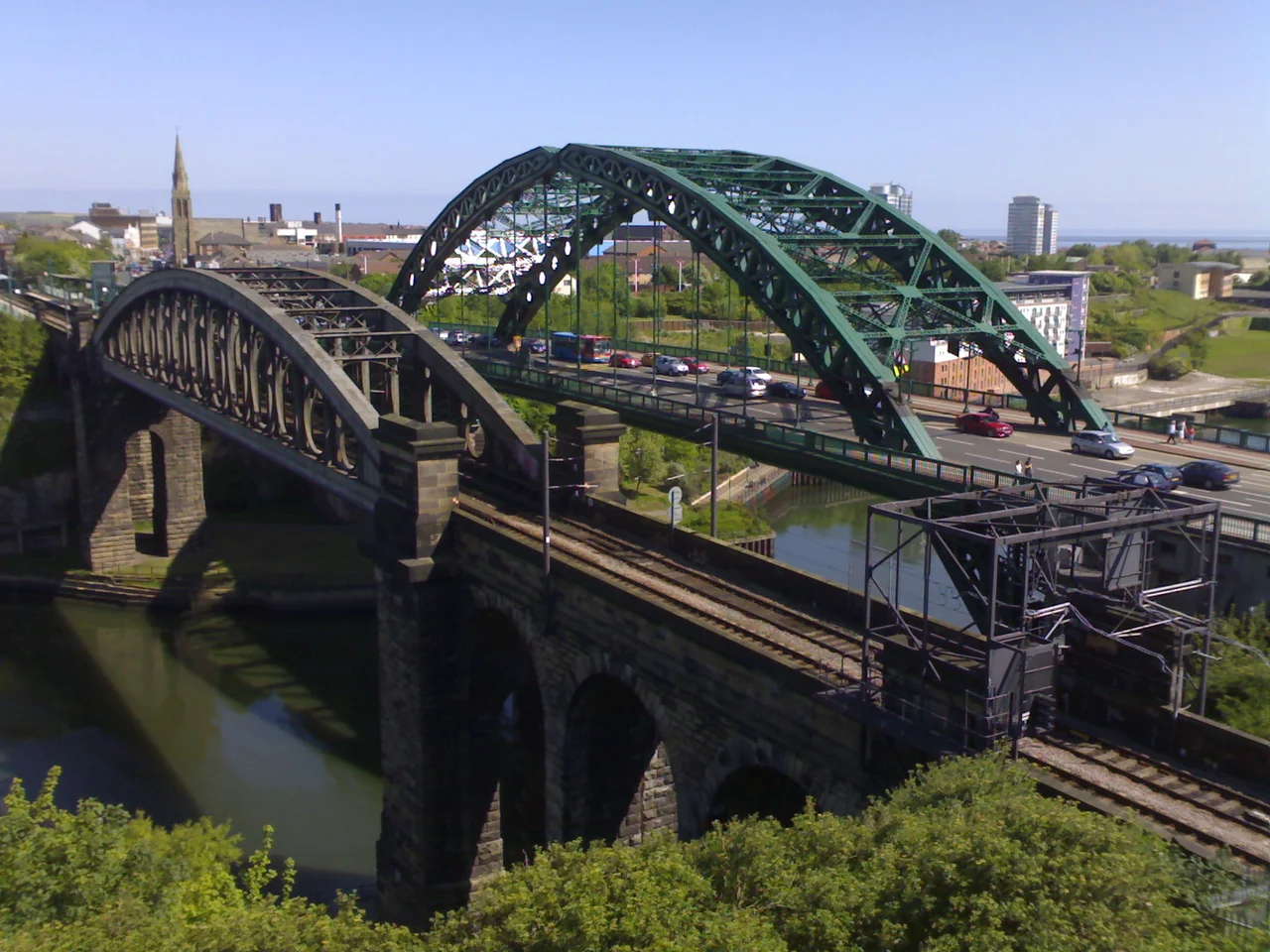

Monkwearmouth Railway Bridge
Thomas Elliot Harrison was solving a problem, not founding a school of engineering. He needed a 300-foot iron span to leap the River Wear and tie Newcastle to Sunderland by rail. So in 1879 he stitched box girders together with curved corner bracing, leaving elliptical voids in the lattice. The bridge worked. What Harrison did not know - what no one could have known - is that he had built the world a Vierendeel truss two decades before the Belgian engineer Arthur Vierendeel published the mathematics that would give the form its name.
Engineering Before the Theory
The Monkwearmouth Junction Line needed a river crossing tall enough that Wearside shipyards could keep launching beneath it. Harrison's solution rose 86 feet above high water and stretched 300 feet between piers - the kind of clear span that demanded a new way of carrying load. He chose an iron bowstring profile, then strengthened the corners of his bracing with curved fillets, producing those distinctive elliptical openings. Modern engineers recognize it instantly as a Vierendeel truss, the rigid-jointed frame whose ability to handle bending without diagonals revolutionized twentieth-century steel design. Harrison built one by feel in 1879. Hawks, Crawshay and Sons of Gateshead forged the ironwork. John Waddell laid the masonry approach arches - three 25-foot spans at each end, anchoring the iron leap to land.
The Line That Connected the Coast
Before this bridge, no direct railway crossed the Wear at Sunderland. Trains from Newcastle had to backtrack inland through Durham junctions to reach the south bank. Harrison's structure stitched together two formerly separate systems: the old Brandling Junction Railway on the north side and the Durham and Sunderland Railway on the south. Suddenly you could ride Newcastle to Hartlepool in something close to a straight line. Coal moved faster. Passengers stopped changing trains in cold waiting rooms. The Durham coast became a through route, and the shipyards beneath the bridge kept hammering steel hulls into existence while the steam locomotives crossed above them.
Second Life as a Metro
Grade II listing arrived in 1978, recognition that the bridge had been quietly carrying trains for a century while better-publicized Victorian spans collapsed or were replaced. When the Tyne and Wear Metro extended south to Sunderland in 2002, planners chose to put St Peter's station directly onto the northern approach viaduct rather than build something new. The old ironwork now hums with light rail traffic and the slower steel of the Durham Coast Line. In 2007 engineers installed 45 new transverse beams to strengthen the deck for the modern loadings. Harrison's accidental innovation was still doing its job, 128 years after the first train crossed.
Looking Down From the Bowstring
From a low pass above the river, the bridge reads as a flat steel ribbon set against the curved blue arch of its 1796 neighbor, the Wearmouth Road Bridge. Pleasure boats slip beneath both. Just upstream lies the Queen Alexandra Bridge - a third generation of Wear-crossing ambition. Together they tell the story of Sunderland in iron: a Georgian arch for road, a Victorian bowstring for rail, an Edwardian truss for coal. Three centuries of crossing the same hundred yards of water.
From the Air
Located at 54.9099 degrees north, 1.3835 degrees west, the railway bridge sits a few hundred feet upstream of the green-painted Wearmouth Road Bridge - the visual pair makes the spot unmistakable from 2,000 to 3,000 feet AGL. Nearest major airport is Newcastle International (EGNT), 12 nautical miles north-northwest. Durham Tees Valley (EGNV) sits 22 nautical miles south. Approach from the east following the Wear inland; the river runs almost due west into Sunderland city centre.
Nearby Stories
- Seaton Carew 2.7 km away
- HMS Unity (N66) 6 km away
- George Stephenson's Birthplace 6.1 km away
- Raby Castle 9 km away
- Cragside 15 km away
- Whitby Abbey 21 km away
- German submarine U-2367 46 km away
- Alexander L. Kielland (Platform) 277 km away