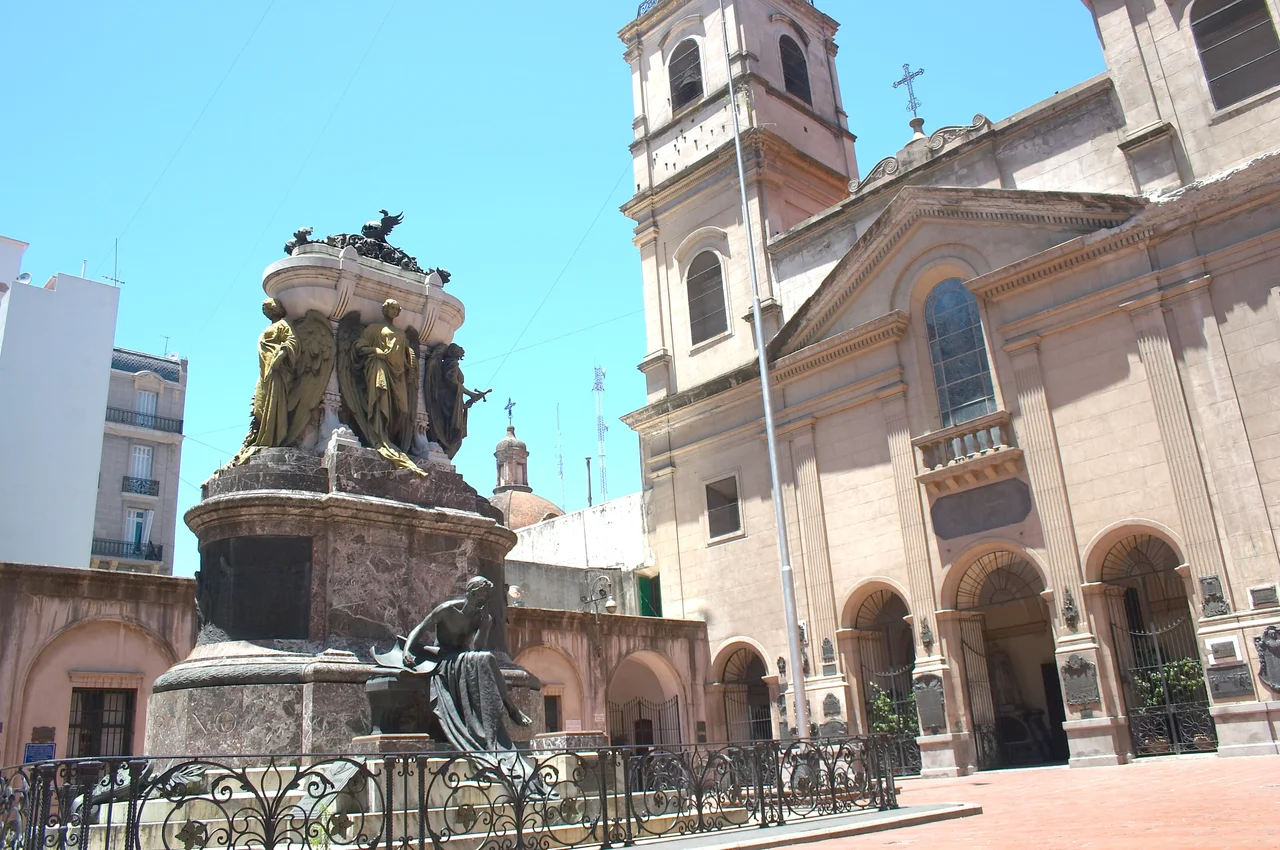

Monserrat, Buenos Aires
Step two blocks south of the Plaza de Mayo and the centuries fall away. Here, in the oldest corner of Buenos Aires, almost nothing you can see was built less than a hundred years ago. Cobblestones replace pavement. Narrow streets ignore the grid the modern city loves. Monserrat is where Argentina started, and it has never quite let go of the fact. The pink presidential palace, the old city hall, the national congress a mile west along a grand European avenue, all of them cluster in or around this single barrio, as if the country could not bear to govern itself anywhere else.
Where the City Was Born
In 1580, the Spanish adelantado Juan de Garay stepped ashore here and founded Buenos Aires for the second time, the first attempt having been starved and abandoned decades earlier. A rough fort, named for Juan Baltazar of Austria, went up in 1594. The shore was muddy, the settlement marginal, a far-flung outpost of an empire that barely noticed it. For nearly three hundred years, little changed. The colonial grid of low houses and cobblestone streets simply endured, accumulating churches and convents and the slow business of a port town that the Spanish crown had mostly forgotten. The barrio eventually took its name from a Catalan brotherhood devoted to the Virgin of Montserrat, whose chapel was raised here in 1769. When you walk Monserrat's surviving older blocks, you are walking the footprint of that patient, overlooked beginning, the seed from which one of the great cities of the Americas slowly grew.
The Illuminated Block
In 1608, newly arrived Jesuits received a two-hectare lot, and on it they raised something the young city had never had: real learning. They built the finest school and the finest library in town, offering colonial Buenos Aires its only truly classical education. People started calling the place the Manzana de las Luces, the Block of Enlightenment. At its heart rose the Church of San Ignacio, begun in 1686 and consecrated in 1734, the oldest church still standing in the city. Beneath it run colonial tunnels, dug for defense and, legend insists, for smuggling. Knowledge above ground, secrets below, all on one square block.
The Square Where a Nation Spoke
In May 1810, the colonial city hall, the Cabildo, became the stage for the pronouncements that set Argentina on the road to independence. To mark the moment, citizens raised the slender May Pyramid in 1811, in what would later become the Plaza de Mayo. Seventy quiet years followed, then a sudden rush. After 1875 the country boomed, the muddy shore was reclaimed, and new docks rose along the eastern edge, the thoroughfare of Paseo Colón running beside them. The two old squares were merged into the Plaza de Mayo in 1884, the year the pink presidential palace, the Casa Rosada, was completed at its head. Then, in the 1890s, wreckers tore down part of the Cabildo itself to drive the elegant Avenida de Mayo straight through the old town toward a new congress, which opened onto its own grand plaza in 1910. Progress arrived swinging a hammer, and Monserrat absorbed the blows, trading colonial fabric for the monumental face of a confident young republic.
Bohemia and Survival
Around 1950 the colossal Nueve de Julio Avenue, one of the widest streets on Earth, expanded southward and split the barrio in two. The office workers and the middle class drifted toward shinier high-rises to the north. What stayed behind was something better: a bohemian quarter of cheap rent, tango performers, artists, and the Spanish social clubs and restaurants that still anchor the neighborhood's old Catalan and Castilian soul. The barrio also kept its ghosts and its monuments, the house where Viceroy Santiago de Liniers once lived, the tomb of the patriot Manuel Belgrano at the Santo Domingo convent, the soaring Palacio Barolo nearby. Since the 1990s, marked by the opening of a high-rise hotel in 1993, visitors have rediscovered these quaint, narrow streets and their layered architecture. The story of Monserrat is the story of a place that kept losing its importance and, each time, found a new way to matter.
From the Air
Monserrat sits at the historic heart of Buenos Aires, at 34.61°S, 58.38°W, a few blocks inland from the Río de la Plata. From the air, look for the broad Avenida de Mayo running arrow-straight between the Plaza de Mayo and the domed Congress, with the immense Nueve de Julio Avenue and its obelisk slicing across nearby. Aeroparque Jorge Newbery (ICAO: SABE) lies barely 2 km northwest along the riverfront, making this barrio one of the first sights on approach; Ministro Pistarini / Ezeiza International (ICAO: SAEZ) is about 35 km southwest. Best viewing altitude is 1,500–3,000 ft on a clear day, when the contrast between the colonial grid and the grand 19th-century avenues is sharpest. The river haze can soften the cityscape on humid summer mornings.
Nearby Stories
- Ezeiza Massacre 1.9 km away
- Luján, Buenos Aires 5.1 km away
- Curutchet House 13 km away
- Colonia del Sacramento 17 km away
- Martín García Island 28 km away
- Atucha Nuclear Power Plant 37 km away
- Lobos 43 km away
- Cry of Asencio 87 km away