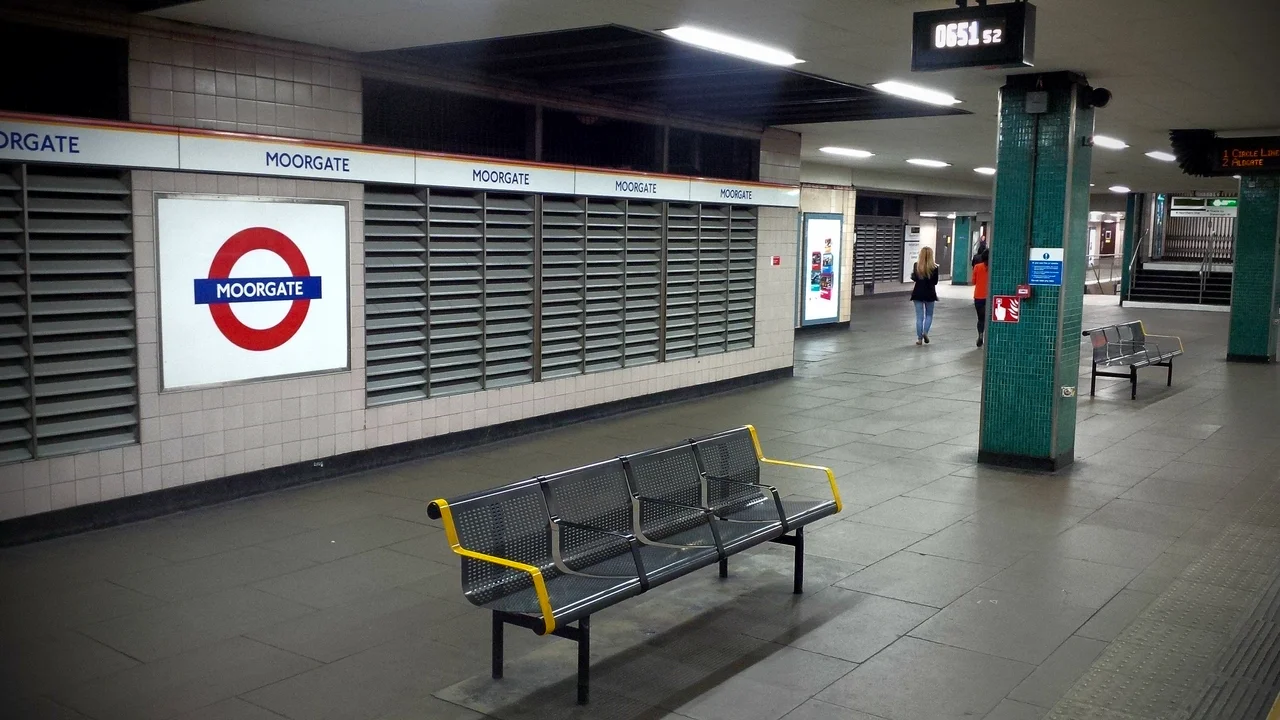

Moorgate Station
On 28 February 1975, at 8:46 in the morning, a southbound Northern City Line train entered Moorgate station and did not slow down. It passed through the platform at speed, crashed into the buffers at the end of the dead-end tunnel, and then drove into the wall beyond. Forty-three people were killed and seventy-four were seriously injured. The driver's failure to brake was never explained. No mechanical fault was found. He showed no sign of illness before the journey. The cause remains unknown, and the station's memorial to the dead stands in the passageway between platforms as a reminder of a morning that defies ordinary accounting.
A Station Built Before the City Changed
Moorgate station — originally named Moorgate Street — opened on 23 December 1865 as the first eastward extension of the Metropolitan Railway beyond its original terminus. Parliamentary authority had been obtained in 1861, two years before the Metropolitan Railway's own opening in January 1863. The station served the growing financial district of the City of London at a moment when the urban underground railway was a new and extraordinary thing. As traffic increased, the line was widened to four tracks between Farringdon and Moorgate, creating what became known as the City Widened Lines — a new tunnel at Clerkenwell, 16 feet lower than the original, opened in stages from 1866. The Metropolitan's director Edward Watkin, inspecting the station in 1874, described Moorgate Street as 'your great terminus' and recommended building a 100-bedroom hotel on top of it. The hotel was never built.
Layer Upon Layer
Moorgate accumulated underground lines across six decades, each addition adding new depth and complexity to the station. The City and South London Railway extended its network here in February 1900, providing the first deep-level tube platforms; the Northern line later inherited these. The Great Northern and City Railway began serving Moorgate in February 1904, using tunnels constructed at a larger diameter than most London tube tunnels — built, though never used, with the capacity to accommodate main-line trains. This line was the first in London to use automatic signalling throughout its length without any moving parts. By 1913 the Metropolitan Railway had purchased the route, but the planned through services to the Great Northern Railway's mainline were never implemented. By the mid-20th century, Moorgate had platforms on three distinct levels serving lines operated by multiple organizations. British Rail steam services ran into Moorgate until 1971, when a commemorative service ran to the depot at Neasden powered by a 0-6-0 tank locomotive.
The Crash of 1975
The Northern City Line platforms — platforms 9 and 10 — are terminal platforms. Trains arrive, discharge passengers, and then must reverse. There is no way through. On the morning of 28 February 1975, the driver of the 8:37 from Drayton Park was witnessed to be alert and normal at each station stop on the approach. There was no warning of what happened at Moorgate. The train entered the platform without slowing, struck the buffers, continued into the dead-end tunnel, and compacted the lead carriages against the tunnel wall. Emergency services worked for four days to clear the wreckage; the bodies of the last victims were not recovered until 6 March. The driver himself was among the dead. Seventy-four survivors suffered serious injuries. The station partially reopened on 1 March — from Drayton Park to Old Street only — and fully reopened on 10 March, eleven days after the crash. No satisfactory cause has ever been established.
Moorgate Today
Moorgate station now serves four London Underground lines — Circle, Hammersmith and City, Metropolitan, and Northern — with entrances on both Moorgate itself and Moorfields running parallel. National Rail services on the Northern City Line use the deep-level platforms as a terminal, connecting to Hertford North and destinations north via the East Coast Main Line. The station's connection to the Elizabeth line at the nearby Liverpool Street complex, which opened in 2021, added step-free access from Moorfields and a direct link eastward and westward across central London. The architecture is unremarkable by the standards of stations built for display; Moorgate was built for function, and its subsequent modifications have prioritized capacity over character. What distinguishes it is its history: one of the earliest stations on the world's first underground railway, carrying millions of passengers across 160 years, defined in the public memory by a single morning that no investigation has ever fully explained.
From the Air
Moorgate station is located at 51.5186°N, 0.0886°W in the City of London. From the air, the area is identifiable by the dense office blocks of the financial district surrounding it, with the Barbican complex visible to the north and the distinctive curve of the City Road to the west. The station has no visually distinctive surface feature but is situated at the junction of Moorgate and Moorfields streets. Nearest airport is London City (LCY), approximately 9km east. Recommended viewing altitude: 1,500–2,500 feet.
Nearby Stories
- Stevenage 5.7 km away
- Malling Abbey 5.7 km away
- 1952 Farnborough Airshow Crash 7.7 km away
- Ingatestone Hall 8.2 km away
- Hellfire Caves 9.1 km away
- The Carrington Event: The Solar Storm That Could Happen Again 9.8 km away
- Bletchley Park 16 km away
- Castle Hedingham 23 km away