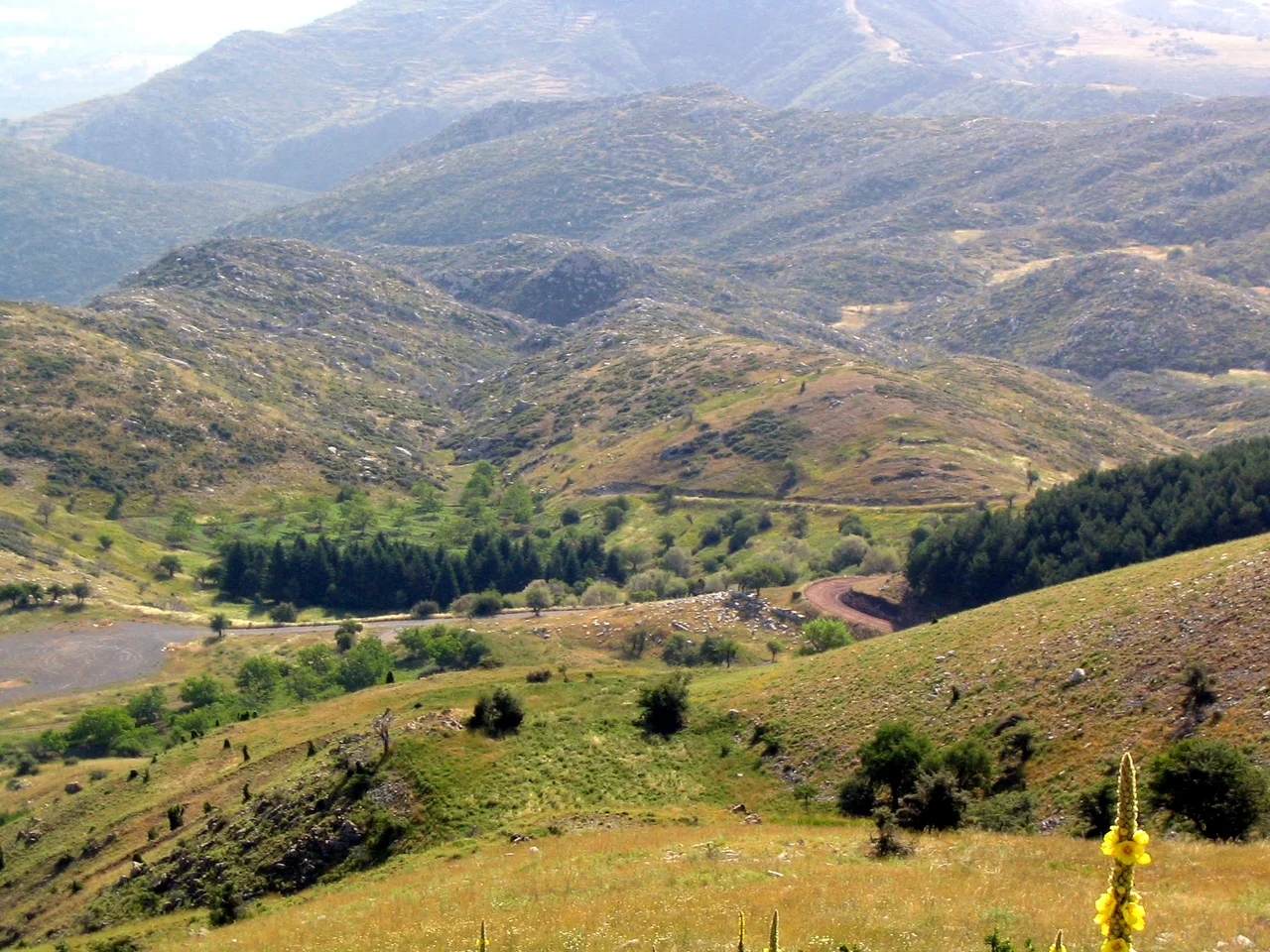

Mount Lykaion
The altar at the summit of Mount Lykaion is a circular mound of blackened earth, about 1.5 meters high and 30 meters across, built up over millennia from the ashes of sacrificed animals. When the Greek geographer Pausanias visited in the 2nd century CE, he could see it clearly — and then deliberately chose not to ask what had happened there. "The ritual," he wrote, was something he preferred to leave as it was from the beginning. That caution turned out to be well founded, at least archaeologically. Excavations begun in 2006 by a joint team from the University of Pennsylvania and the University of Arizona found cult activity at the altar dating to around 3000 BCE, at least a thousand years before Zeus was worshipped anywhere in Greece. The mountain had been sacred to someone, for something, long before its myths took their classical form.
The Mountain and Its Two Peaks
Mount Lykaion — Lýkaion Óros, "Wolf Mountain" — rises in the Arcadian highlands of the central Peloponnese with two summits. Stefani, the northern peak, reaches 1,421 meters; the southern peak, St. Ilias (Agios Ilias), stands at 1,382 meters and bears the ash altar of Zeus. Between and below the peaks lies a valley where the ancient stadium and hippodrome were built for the Lykaian Games held every four years. The hippodrome at Mount Lykaion is considered the only surviving hippodrome from Greek antiquity, constructed on a roughly north-south orientation with a retaining wall of about 140 meters along its eastern side. Archaeologists have mapped the full athletic complex: a bathhouse, a xenon (guest quarters), a stoa, rows of seats, fountains, and statue bases — a complete sanctuary infrastructure that served athletes and pilgrims for centuries.
Lycaon, Zeus, and the Mythological Weight
The mountain's mythology centers on Lycaon, son of Pelasgus, who is credited with instituting the worship of Zeus at the site and giving the god his local epithet, Lykaios. Ancient sources tell the story several ways. In one version, Lycaon invited Zeus to a banquet and served him flesh mixed with human remains, testing the god's omniscience; Zeus retaliated by killing Lycaon and his fifty sons. In another, from the Roman poet Ovid, Zeus transformed Lycaon into a wolf — one of the earliest documented accounts of lycanthropy in the Western tradition. The Arcadians also claimed that Lykaion was the birthplace of Zeus himself, and a cave on the mountain called the Kretaia was identified as the site where nymphs tended the newborn god. The precinct around the altar — the temenos — was said to be forbidden to all humans. Anyone who entered, according to tradition, would cast no shadow and would die within the year.
The Skeleton in the Ash
In 2016, excavators working in the ash mound at the summit made a discovery that reignited scholarly debate about the cult's most disturbing rumors. At the heart of the altar, within a narrow trench cut into the accumulated ash and burnt earth, they found a human skeleton. The bones were those of an adolescent, probably male, buried in a supine position and oriented east-west, with stone slabs covering the pelvis. The skull was absent. Ceramic evidence associated with the burial suggests it dates to around the 11th century BCE, during the transition from the Late Bronze Age to the Early Iron Age. Ancient sources — Plato among them — had claimed that the Lykaia ritual involved human sacrifice, but until this discovery, no physical evidence had ever been found. Scholars are careful to note what the evidence does and does not show: a human burial within a sacrificial altar is striking, but whether this individual was sacrificed, and under what circumstances, remains an open and actively debated question. What can be said is that the bones were there, at the center of the ash, in a place where ancient writers said they should not exist.
A Century of Excavation
The mountain has been studied formally since 1897, when archaeologist K. Kontopoulos dug trial trenches for the Greek Archaeological Service. K. Kourouniotes followed between 1902 and 1909, excavating the altar mound and learning that it was, as Pausanias described, a raised mound of blackened earth. His 1909 season uncovered the hippodrome, stadium, and bathhouse on the eastern slope below the summit. After nearly a century with little systematic work, Dr. David Gilman Romano of the University of Pennsylvania began a topographical survey in 1996. The full Mt. Lykaion Excavation and Survey Project launched in 2004, carrying out digital mapping, architectural analysis, and stratigraphic excavation across the entire sanctuary. Among the finds in the temenos were animal bones, miniature bronze tripods, knives, and terracotta statuettes of Zeus holding an eagle and a lightning bolt. A Late Minoan rock crystal seal bearing the image of a bull turned up among the earliest layers — a small object that had traveled a long way, suggesting connections to Crete even in the Bronze Age. Nearby Olympia, only 22 miles to the northwest along the same river corridor, has a similar ash altar. The question of which tradition is older, and whether one influenced the other, continues to occupy researchers.
From the Air
Mount Lykaion is located at 37.457°N, 21.975°E in the Arcadian highlands of the Peloponnese. The twin-peaked summit — Stefani at 1,421 m to the north and St. Ilias at 1,382 m to the south — is one of the most prominent terrain features visible from altitude in the central Peloponnese. The ash altar sits on the southern peak; the ancient athletic valley with hippodrome and stadium lies between the peaks. The nearest major airport is LGKL (Kalamata International), approximately 80 km to the south-southwest. Mountain weather on Lykaion can change rapidly; visibility from altitude is best in the morning before afternoon convection builds. The valley between the peaks, where the ancient games were held, is visible from the west and south in clear conditions.
Nearby Stories
- Battle of Meligalas 5 km away
- Battle of Picotin 13 km away
- Kastanitsa 13 km away
- Phlius 14 km away
- Cleitor 16 km away
- Pyramid of Hellinikon 16 km away
- Agios Andreas, Katakolo 19 km away
- Strofades 39 km away