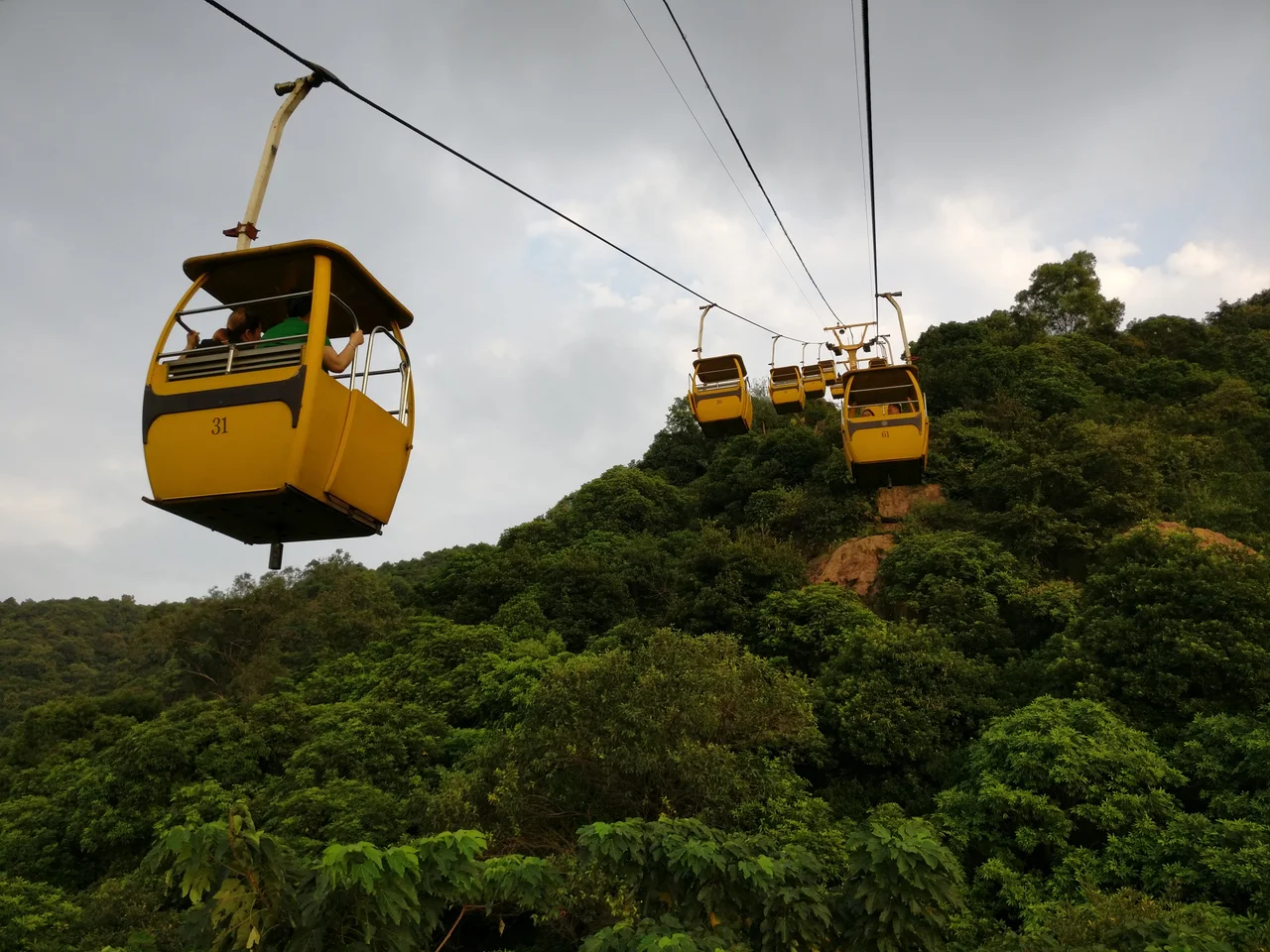

Mount Xiqiao
Forty to fifty million years ago, the Pearl River Delta was an open bay, and the seafloor shook. Volcanic eruptions hurled lava into the shallow water, cooling it into a conical mass that would eventually become the 72-peaked mountain the world now knows as Mount Xiqiao. The sea retreated. Vegetation crept in. And over millennia, humans arrived — first with stone tools shaped 6,000 to 8,000 years ago, then with ink brushes, revolutionary pamphlets, and, eventually, martial arts students. What makes this 14-square-kilometer national geological park remarkable isn't just its geological drama. It's the improbable density of history that the mountain's slopes quietly contain.
Fire Beneath the Delta
The story of Mount Xiqiao begins before the Pearl River existed. Between 40 and 50 million years ago, the region that would become one of China's most densely populated deltas was still an ancient bay. Repeated volcanic eruptions ejected lava into that bay, and as the molten rock cooled in seawater, it piled up into a volcanic cone. Eruption followed eruption, and the mountain grew, eventually forming 72 distinct peaks. The highest, Dacheng Peak, reaches 346 meters.
Then the sea slowly withdrew, and millions of years of erosion worked the hardened lava into the unusual rock formations that visitors encounter today. Water found its way through fractures in the volcanic rock, feeding 232 springs and cutting 28 waterfalls. The most celebrated of these, the Yunya Feipu, was considered one of the Eight Views of Guangzhou during the 18th-century Qianlong Era — remarkable recognition for a landmark 68 kilometers outside the city. Forty-two natural caves carve through the mountain's flanks, and the whole landscape carries a textured, layered quality that decades of geological upheaval and erosion produce and nothing else can replicate.
A Mountain That Grew Minds
Scholars have been drawn to Mount Xiqiao's seclusion for centuries. During the Ming and Qing Dynasties, learned men climbed these peaks not to conquer them but to think. The philosopher Zhan Ruoshui, a prominent Neo-Confucian thinker and student of the great Wang Yangming, lived on the mountain while developing his ideas. He Baiyun studied painting here. The mountain had a quality that concentrated thought — the springs, the cave quiet, the distance from court politics.
The most consequential tenant was Kang Youwei. In the late 19th century, this Cantonese intellectual began formulating what would become the Hundred Days' Reform of 1898 — an audacious attempt to modernize the Qing Dynasty's government in less than four months before the Empress Dowager Cixi crushed it. Kang Youwei planned that movement at Mount Xiqiao. The mountain didn't just shelter scholars; it incubated ideas that would shake the dynasty.
Where Southern Fist Was Born
One more name is attached to these slopes: Wong Fei-hung, known in Mandarin as Huang Feihong. The martial artist who would become perhaps the most filmed and celebrated folk hero in Chinese popular culture was born in the Mount Xiqiao area. It was here, in the foothills and villages of Nanhai District, that he trained in and refined Hung Ga — a southern Chinese style rooted in the Shaolin tradition, emphasizing powerful arm strikes, low stances, and a fighting discipline that would become synonymous with his name.
Wong Fei-hung went on to become a physician, a militia commander, and a cultural icon. Over 100 films have depicted his life. But before the legend, there was a young man training in the shadow of a volcanic mountain, working out the principles of a martial art that still carries the character of the landscape that shaped him.
Ten Scenic Areas, One Goddess
Today Mount Xiqiao is divided into ten major scenic zones, ranging from forested hiking trails to temple complexes. The Nanhai Guanyin Culture Park commands the most attention: it contains a 62-meter statue of the goddess Guanyin, a figure of compassion in Buddhist and folk traditions, her form rising above the treeline and visible for some distance around.
The Baiyun Caves wind through volcanic rock formations, and the Baofeng Temple offers a quieter counterpoint — a place where incense smoke rises among stone walls. The mountain also carries a designation as both a national forest park and a national geological park, a dual status that reflects its character: it is simultaneously a living ecosystem and a record of deep time, the kind of place where the age of the Earth is not a textbook abstraction but something you can press your hand against.
From the Air
Mount Xiqiao sits at approximately 22.927°N, 112.973°E in Nanhai District, Foshan, Guangdong. The mountain's highest peak, Dacheng Peak, reaches 346 meters (1,135 feet) above sea level — modest in height but distinctive in profile, with 72 visible peaks spread across 14 square kilometers. The nearest major airport is Guangzhou Baiyun International (ZGGG), approximately 68 kilometers to the northeast. Flying in from the east, the mountain appears as a green, multi-ridged formation rising from the Pearl River Delta plain. Approach altitudes of 2,000–3,000 feet MSL provide good visual contrast. The 62-meter Guanyin statue in the Nanhai Guanyin Culture Park is visible from altitude and serves as a useful waypoint landmark. Weather in the Pearl River Delta can be hazy, especially in summer and during the rainy season (May–September), so clearer visibility is best expected in autumn and winter months.
Nearby Stories
- Jiangmen 12 km away
- Pearl River 16 km away
- Opium War Museum 16 km away
- Pearl River Delta 24 km away
- Mount Luofu 47 km away
- Battle of Nanpeng Island 129 km away
- Temple of the Five Lords 394 km away
- Lugu Lake 1276 km away